History
Josh Jensen worked harvests at Domaine de la Romanee-Conti and Domaine Dujac, came home convinced that limestone explained Burgundy, and spent two years searching California for it before buying remote limestone slopes high in the Gabilan Range in 1974; Calera is Spanish for lime kiln. In 1975 he planted three vineyards and named them for the men behind the venture: Jensen for his father Stephen, Selleck for Dr. George Selleck, an early wine mentor, and Reed for William G. Reed Sr., an original partner and investor. The planting material came from Chalone, from old vines said to carry buds brought in from a top Burgundy vineyard, the origin of what is now called the Calera selection. The three parcels gave their first small crop in 1978, released as Calera's debut trio of vineyard-designate Pinot Noirs; the whole vintage was so small it went into half-bottles. Duckhorn bought Calera in August 2017, the sale covering the winery, tasting room and 85 acres of estate vineyards; Mike Waller, who joined as assistant winemaker in 2007 after an assistant post at Chalone and was named winemaker in 2009, stayed on, and Jensen joined the Duckhorn board and stayed involved at Calera after the sale; he died in June 2022 at 78.
The Site
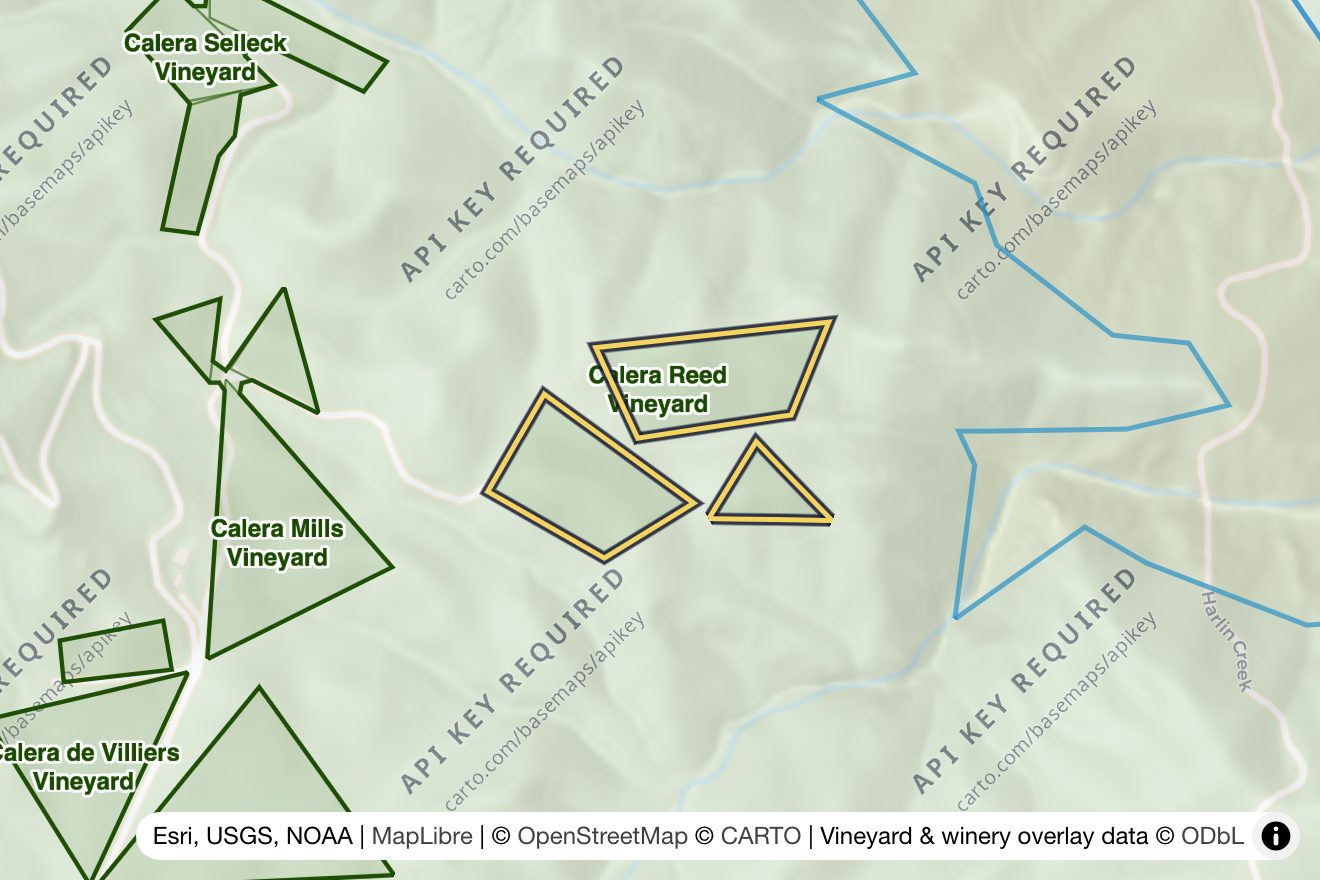
A shaded fold at about 2,200 feet on the San Benito County side of the Gabilans, roughly 25 miles east of Monterey Bay, whose cold marine air funnels through the bay's gap in the coastal hills. The soil is the limestone that brought Jensen to the mountain, carrying more loam and clay here than in the neighboring parcels, and the northern exposure keeps the fruit hanging after everything else is picked, occasionally into mid or late November. Published acreage disagrees: trade sources long listed 4.4 acres, Calera's founder biography gives 6.4, and the Prince of Pinot's profile records 4.4 acres of 1975 vines plus 1.54 acres added in 2012, a present footprint of about 5.94 acres. Mt. Harlan itself, approved in 1990 with a 1,800-foot floor, remains a single-producer AVA: the only vineyards in its 7,400 acres are Calera's.
Vines and Blocks
Pinot Noir only, in two ages: the original 1975 planting in the Calera selection, at 726 vines per acre, and the 1.54 acres added in 2012. The estate has been CCOF-certified organic since 2008, farmed with compost, cover crops, and beneficial insects in place of pesticides, and yields rarely exceed two tons per acre; Reed's ten-year average has run below one and a half.
The Wines
One bottling, the Mt. Harlan Pinot Noir Reed Vineyard, made to the house method: whole-cluster fermentation wherever the vintage allows, native yeasts, around 30 percent new French oak for 16 to 18 months, usually bottled unfiltered. Production runs in the hundreds of cases; 2010 yielded 398. The style is the estate's counterpoint: redder fruit and softer tannin than Jensen, less sheer power than its siblings but more perfume, with spice, black tea, and an acidity that has kept decades-old vintages fresh in retrospective tastings. That profile is the shaded northern aspect showing through.