History
Jensen worked the 1970 harvest at Domaine de la Romanee-Conti and spent time at Domaine Dujac and Chateau-Grillet, and came home holding the doctrine that limestone made great Burgundy. Two years of survey maps led him to Mount Harlan, a 3,278-foot peak in the Gabilan Range carrying one of California's larger deposits of pure limestone and an abandoned kiln that named the winery: calera is Spanish for lime kiln. He bought the land in early 1974 with backing from his father, from Dr. George Selleck, the family friend who had introduced him to wine, and from Bill Reed; the three parcels planted in 1975 carry their names, Jensen at fourteen acres, Selleck and Reed near five each. The first crop, in 1978, came to roughly 700 cases. In 1977 he added a 100-acre parcel down Cienega Road whose abandoned 1950s rock-crushing plant became a seven-level gravity-flow winery. Steve Doerner made the wines alongside him for fourteen vintages before leaving for Oregon's Cristom in 1992; Mike Waller arrived from Chalone in 2007 and runs the cellar today. Duckhorn bought the winery, tasting room and eighty-five acres of estate vineyard in August 2017, and Jensen agreed to consult for four years and joined Duckhorn's board; he died in 2022.
The Site
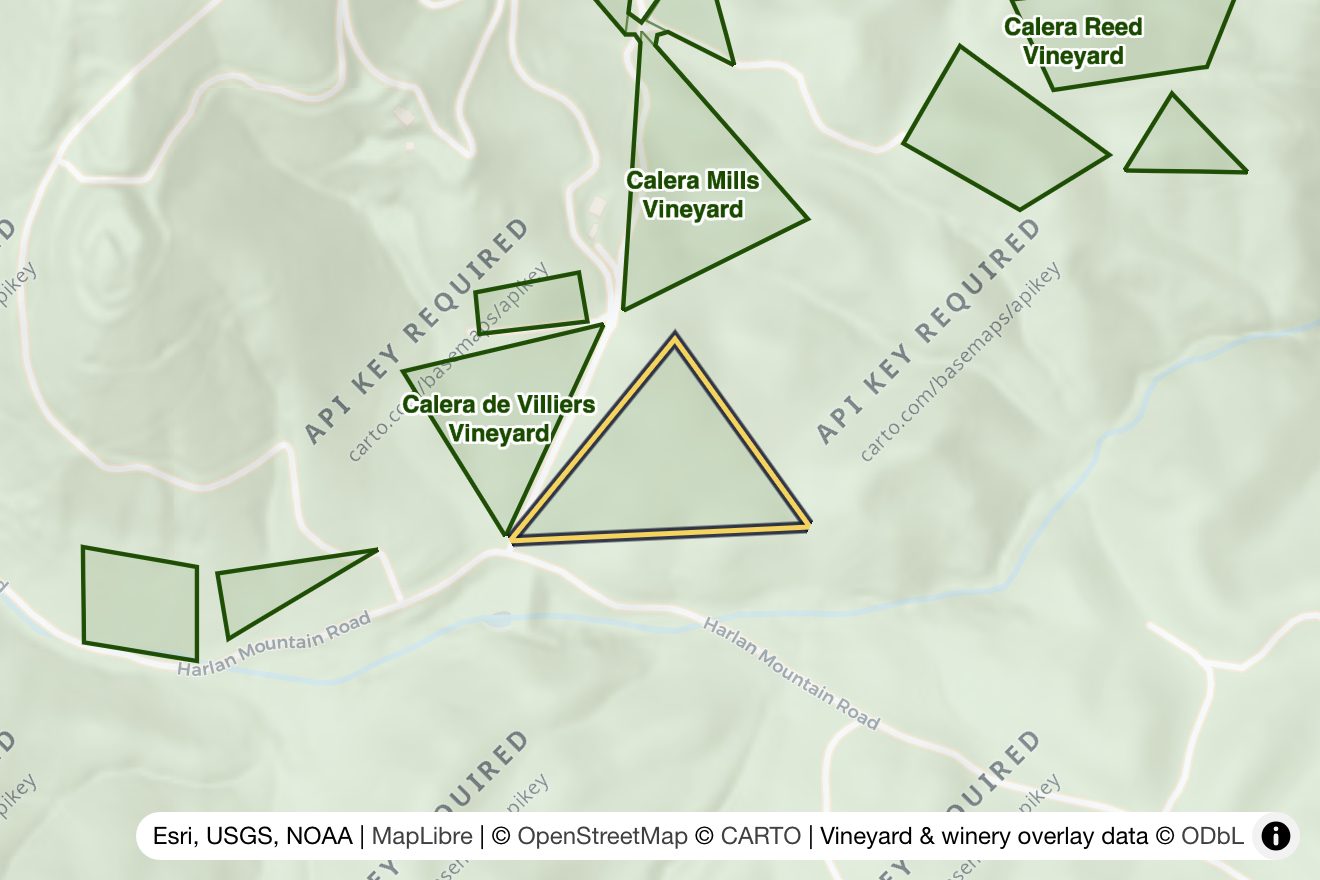
The vineyard occupies the east side of the Mt. Harlan estate at about 2,200 feet in San Benito County, 25 miles from Monterey Bay, among the highest and coolest vineyard land in California: cold marine air flows in off the Pacific, and elevation strips off roughly three degrees per thousand feet. Four hillside blocks with differing exposures sit around what Waller calls an amphitheater, with exposures far enough apart that four to six weeks can separate the first pick from the last. The soil is rocky and limestone-derived. The Mt. Harlan AVA, approved in 1990 largely on the strength of this estate, covers 7,400 acres and contains no vineyards but Calera's; farming has been CCOF-certified organic since 2008, formalizing roughly a decade of prior practice. Estate yields historically ran around a ton and a half per acre and now run closer to one, falling under half a ton in 2022; the one published Jensen figure is 1.22 tons per acre in 2010.
Vines and Blocks
Pinot Noir only, planted in 1975 on St. George rootstock; published acreage runs 13.5 to 14. Part of it carries the Calera selection, the heritage material whose Burgundian source Jensen never named: the cuttings reached him through Chalone, which held eighteen vines grown from Burgundian buds, and trade legend has always pointed at Romanee-Conti without confirmation. Each block is picked separately as its exposure ripens.
The Wines
Only Calera bottles it, as Mt. Harlan Pinot Noir Jensen Vineyard, typically in the low four figures of cases. Fermentation is whole-cluster on ambient yeasts; elevage runs 16 to 18 months in about thirty percent new French oak; the wine traditionally goes to bottle unfined and unfiltered, though recent vintages have seen light egg-white fining to settle the tannin. Jensen is consistently the most powerful and slowest to open of the six Pinot Noir crus: where Reed is floral and Selleck brooding, Jensen is the structural one, and its track record at twenty and thirty years is the point of the wine.