History
Jensen picked grapes at the Domaine de la Romanee-Conti in 1970, worked at Domaine Dujac, and came home persuaded that great Pinot Noir grew in limestone. Two years over state geological maps led him to Mount Harlan in 1974. Selleck, Reed and Jensen were planted in 1975, Mills in 1984, and the parcel that became de Villiers went in during 1997, twenty-two years after the founding blocks. Elsewhere the crus honor Jensen's father, his mentor George Selleck, his first business partner and, later, vineyard manager Jim Ryan; this one honors a writer. The Heartbreak Grape, published in 1993, chronicled Jensen's limestone project from the inside, and in 2007 the story got a vineyard of its own. Duckhorn has owned Calera since August 2017; Jensen died in 2022. Mike Waller, who joined in 2007, the same vintage that first carried the de Villiers name, and has been winemaker since 2009, still runs the cellar.
The Site
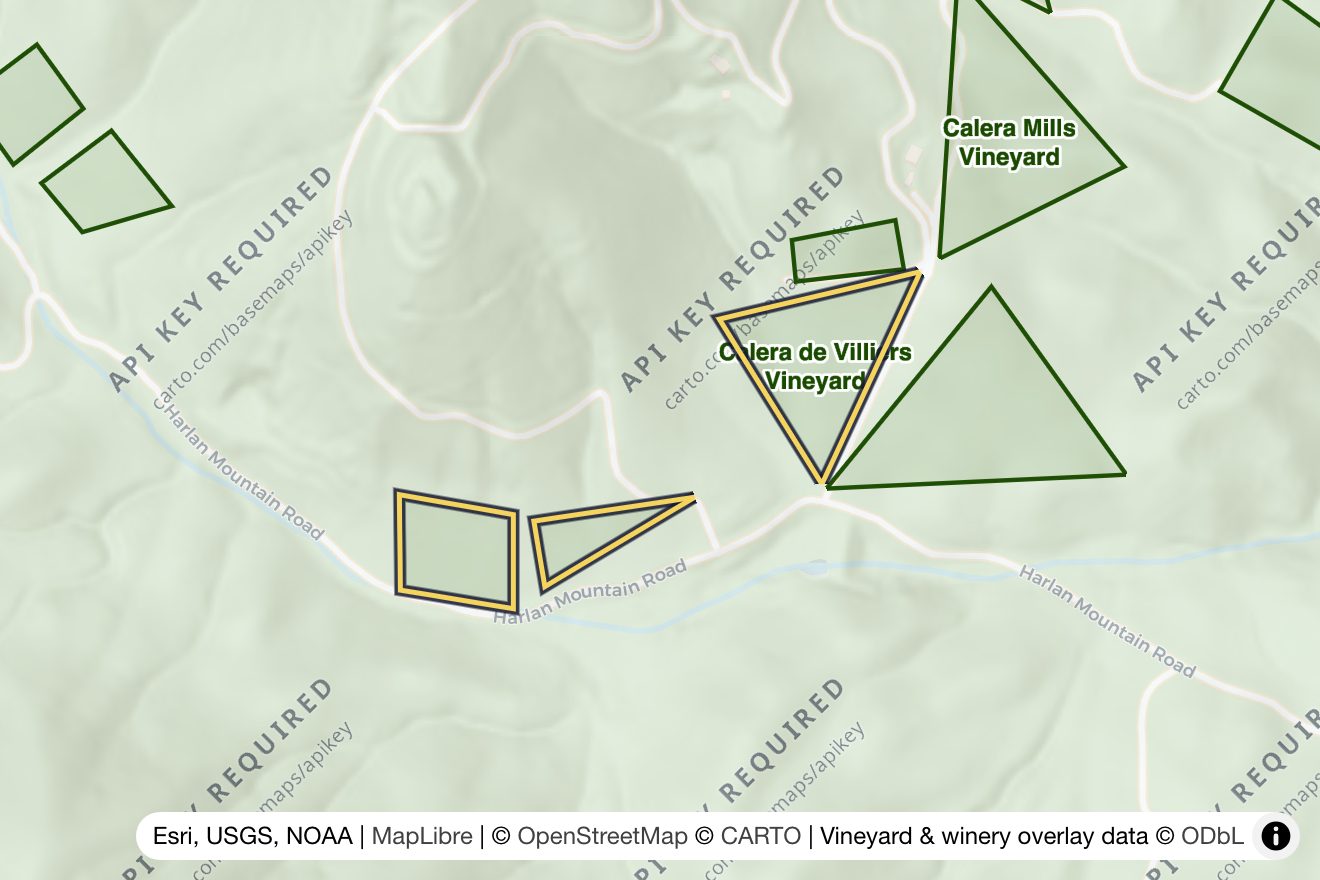
The Mount Harlan AVA, approved in 1990 with a floor of 1,800 feet, contains one winery and one grower: every vineyard in it is Calera's. The estate averages 2,200 feet in the Gavilan Range of San Benito County, roughly 25 miles from Monterey Bay, whose cold marine air keeps this among the highest and coolest Pinot Noir plantings in California. The limestone that drew Jensen was industry before it was terroir: the stone kiln where nineteenth century laborers baked lime still stands on the property and appears on the label, and calera is Spanish for lime kiln. De Villiers itself is east facing ground near the middle of the estate, between the Jensen and Mills vineyards.
Vines and Blocks
Pinot Noir across 15.6 acres, the largest of the six crus, ahead of Mills at 14.4 and Ryan at 13.1, and the second youngest; only Ryan, planted in 1998 and 2001, came later. The estate has been CCOF certified organic since 2008, and crops rarely pass two tons per acre. The block's defining habit is uneven ripening: harvest usually takes several passes, with timing that swings by weeks from year to year. The 2011 crop came off in October, late in a cool year; in 2023 harvest did not finish until late October. Repeated passes through one block are a real cost, the sort of detail that rarely reaches a back label.
The Wines
One grower, one bottling: Calera Mt. Harlan Pinot Noir de Villiers Vineyard. Waller ferments on native yeasts with whole clusters whenever possible, then ages the wine without racking in French oak, about 30 percent new, for 16 to 18 months. De Villiers sits at the voluptuous, dark fruited end of the Calera range in most vintages, lush texture over the mineral backbone limestone stamps on all six crus, and it ages easily a decade or more. Quantities stay small; the documented vintages have stayed under about 1,500 cases.