History
Cienega Valley is one of California's oldest wine districts: Théophile Vaché planted vines here in the early 1850s, and the AVA followed in 1982 on Almadén's petition. The oldest Wirz block is a field blend planted around 1902 to 1904, the "mixed blacks" in Pat Wirz's own phrase; Big Basin dates the Carignan to before 1927. Wirz's father added the white Riesling in 1964, roughly forty-five acres of it, and those vines now count among the oldest Riesling in the state. Pat Wirz has farmed the site for decades. The old reds nearly went at one point: Wirz considered pulling the Cabernet Pfeffer when he could not find buyers, before the variety's recent revival.
The Site
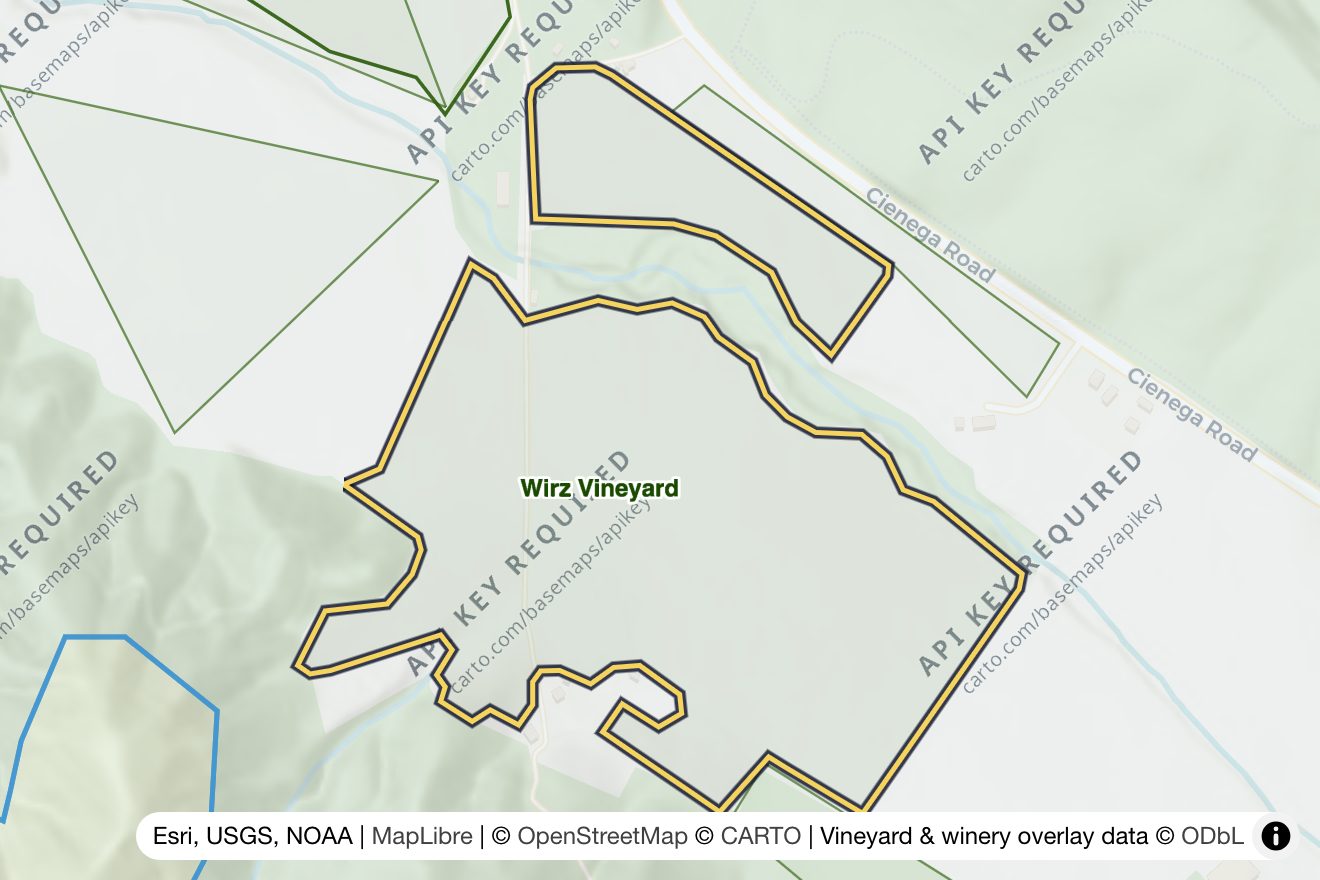
The ranch sits at roughly 920 to 1,094 feet on the northeastern flank of the Gabilans, in San Benito County's Cienega Valley AVA, twenty miles north of Pinnacles and twenty-five east of Monterey Bay, whose cooling the intervening ridges largely blunt. The San Andreas Fault runs straight through the property. The soils mix deep Salinian granite sand with darker clay loam weathered off limestone, cobbles of both rocks scattered through the rows; the Riesling stands mostly on the sand. Everything is dry-farmed and organically grown, yields run around a ton to the acre, and the fruit hangs late: Stirm picked its 2023 Riesling in passes across three weeks of October. Birichino credits a creek through the property with enough humidity to bring botrytis to late-hanging fruit in some years. Total size is reported inconsistently between fifty-two and sixty acres, of which the Riesling accounts for forty to forty-five.
Vines and Blocks
The field blend carries Zinfandel, Mataro, Carignan, Orange Muscat, Mission and Cabernet Pfeffer, own-rooted and head-trained. The Pfeffer is the rarity: named for William Pfeffer, the nineteenth-century nurseryman who propagated it after its original name was lost, it was identified through DNA work at UC Davis as Mourtaou, an old Bordeaux variety all but extinct in France, and fewer than twenty acres survive worldwide, nearly all of them in and around Cienega Valley. Stirm bottles the Mission under its old California name, Rosa del Perù. The Riesling block is the largest single planting on the ranch, trained to the same head-pruned form as the century-old reds.
The Wines
Bedrock, Stirm, Birichino, Big Basin and Maidenstoen all buy here; Ser makes a varietal Cabernet Pfeffer, and Thomas Fogarty has bottled the Riesling. Corison bottles the Riesling as Corazón, stainless-fermented, bone dry and modeled on German Trocken, an unexpected line on the CV of a St. Helena Cabernet house. Across producers the recent Rieslings come in dry, near thirteen percent alcohol and firmly acid-driven. Stirm works the deepest bench of the vineyard, bottling Riesling, Zinfandel, Cabernet Pfeffer and Rosa del Perù; its Zinfandel comes off the interplanted block and carried ten percent Riesling in 2023, a field blend in fact as well as in name.