History
Graff, who helped bring French oak and barrel fermentation to California, established the property while running Chalone; Seabold's account dates it to the 1970s, while the vine plantings are usually given as mid-1980s, 1985 on Birichino's and Jolie-Laide's sheets and 1986 on Samuel Louis Smith's, a spread no source reconciles. Graff died in January 1998 when the Cessna he was piloting crashed in Monterey County. Bob and Sue Antle owned and improved the property next, and it carried their name for years: Bill Brosseau farmed it as Antle Vineyard, and Enfield bottled a four-barrel Antle Pinot Noir as late as 2015. Kurt Gollnick, Scheid Vineyards' head of viticulture and chief operating officer until 2022, and Janet Rodgers bought it in the mid-2010s; Rodgers coined the Rodnick.farm name in 2016, Gollnick went full time on leaving Scheid, and CCOF certification in 2023 formalised decades of organic farming.
The Site
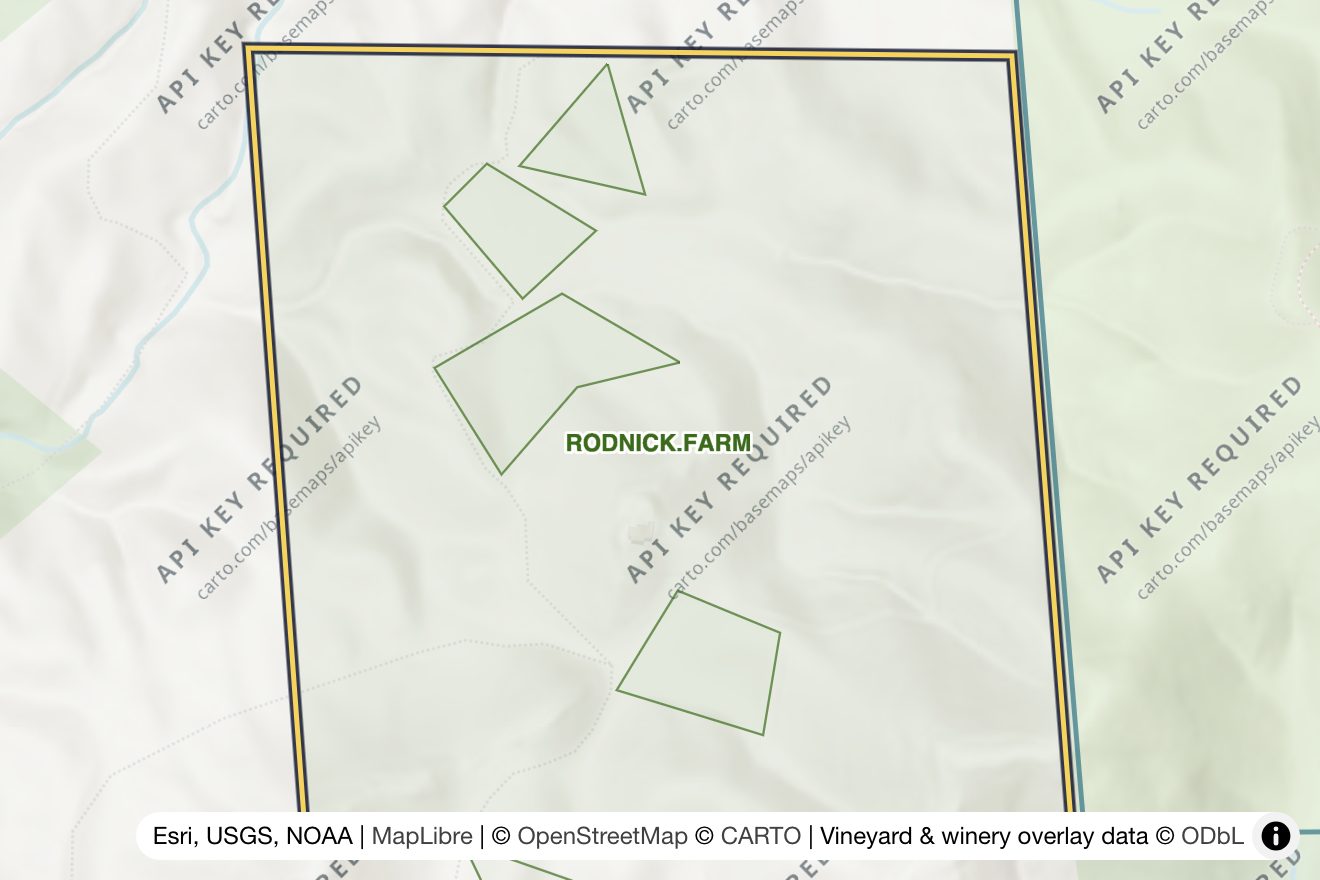
Roughly thirty planted acres slope west off the Gabilan Mountains near the east entrance to Pinnacles National Park, rolling between 1,600 and 1,900 feet across what the farm counts as six distinct microclimates. The climate is high desert moderated by Monterey Bay air, with an extreme day-to-night swing; the soils mix limestone and decomposed granite, which Big Basin logs as decomposed granite and calcareous shale over calcareous baserock. Water governs everything: irrigation arrives as a weekly ration from a community reservoir filled by wells in the Salinas Valley aquifer, and Gollnick runs a weather station and six soil-moisture sensor nodes to stretch the allocation. Two Agrothermal heat rigs run the rows as well; Gollnick credits the treatment with better fruit set in cool springs.
Vines and Blocks
Graff's survivors are gnarled, head-trained bush vines: Mourvèdre now past thirty-five years old, from what Jeb Dunnuck calls a "Samsonite" clone, and the contested white block. Birichino's account of that block is the clearest on record: Graff planted it in 1985 and called it Pinot Blanc because his Chalone predecessor William Silvear had used that name, and the fruit now sells as Melon de Bourgogne through Birichino and Jolie-Laide while Seabold bottles it as old-vines Pinot Blanc. Chenin Blanc on a Chalone selection went in around 2004, which places it after Graff's death. Pinot Noir grows on a northwest-facing slope at about 1,800 feet, and the farm lists Grenache, Albariño, Syrah and Viognier among its newer plantings.
The Wines
Birichino bottles Pinot Noir and a six-barrel Melon de Bourgogne, the 2023 raised eighteen months on its lees in stainless barrels and finished at 11.5 percent on an explicitly Muscadet model. Jolie-Laide has made the Melon across several vintages, Seabold's Old Vines Pinot Blanc ran sixty-four cases in 2021, and Big Basin takes three wines: Pinot Noir, a bone-dry Chenin Blanc raised partly in concrete egg, and the whole-cluster Old Vine Mourvèdre. Samuel Louis Smith also sources here, describing the ground as built for earthy, structure-driven wines. The through-line is the whites: saline, bright, and the reason a high-desert vineyard keeps appearing on Loire-minded labels.