The result? A region that quadrupled production between 2000 and 2019, introduced village-level classifications in 2019, and now exports its crisp, aromatic whites to more than 100 countries. But Rueda's success story obscures a more complex reality: this is a region still defining its identity, caught between volume-driven commercial wines and an emerging quality movement focused on old vines, terroir expression, and serious winemaking.
GEOLOGY
The Duero Basin Foundation
Rueda sits on the northern Meseta, the high plateau that dominates central Spain. The geological story begins in the Tertiary period (66–2.6 million years ago), when the collision of the African and Eurasian plates created the Alpine orogeny. This tectonic activity uplifted the Iberian Peninsula and formed sedimentary basins, including the Duero Basin where Rueda lies.
The bedrock consists primarily of sedimentary deposits from ancient river systems and alluvial fans that drained from the surrounding mountains. Unlike the limestone-dominated soils of neighboring regions, Rueda's geology is characterized by a complex mixture of materials deposited over millions of years of erosion and sedimentation.
Soil Composition: A Patchwork of Textures
The predominant soil types in Rueda are:
Sandy loams and gravels: These well-drained soils cover much of the region, particularly in lower-lying areas. The sand content can reach 60–70% in some sectors, providing excellent drainage, critical in a region where summer irrigation is often necessary. These lighter soils produce wines with aromatic intensity and freshness but less structural complexity.
Clay-limestone mixtures: Found on gentle slopes and higher elevations, these soils contain varying proportions of calcareous material mixed with clay. The limestone component rarely exceeds 30–40%, far less than in classic limestone regions like Chablis or the Côte d'Or. These soils retain more moisture and produce wines with greater texture and aging potential.
Alluvial deposits: River terraces near the Duero and its tributaries feature rounded stones (cantos rodados) mixed with sandy and silty sediments. These deposits can be several meters deep and provide natural drainage while the underlying clay retains some moisture.
Cascajo: This local term refers to soils with high concentrations of rounded pebbles and stones, similar to the galets of Châteauneuf-du-Pape but smaller in size. These stony soils absorb heat during the day and release it at night, contributing to ripening in what can be a challenging continental climate.
The Iron-Rich Red Soils
One distinctive feature of Rueda's geology is the presence of iron-rich red clay soils in certain sectors. These rust-colored soils, formed from the oxidation of iron minerals, appear in patches throughout the region and are particularly valued for Verdejo. The iron content contributes to the grape's characteristic phenolic structure and aging potential, though the mechanism remains debated among viticulturists.
Comparative Context: Not Quite Limestone Country
The soil composition of Rueda differs markedly from its red wine-producing neighbors. In Ribera del Duero, approximately 50 kilometers to the east, limestone content in the soils can reach 60–70%, contributing to the structure and longevity of Tempranillo. Toro, to the west, features more sandy soils with lower limestone content but higher clay percentages.
Rueda occupies a middle ground: enough calcareous material to provide mineral character and acidity retention, but not so much that it produces the austere, high-acid wines typical of pure limestone terroirs. The sandy component moderates the clay's water retention, preventing excessive vigor while maintaining aromatic intensity.
The relatively shallow topsoil (typically 30–60 centimeters deep) sits atop harder sedimentary layers or clay subsoils. This limits root penetration in some areas, though older vines can reach depths of 3–4 meters in more friable soils.
CLIMATE
Continental Extremes at Altitude
Rueda's climate is uncompromisingly continental. Vineyards sit at 700–800 meters elevation on the northern Meseta, exposed to temperature extremes that would challenge many wine regions. Summer daytime temperatures regularly exceed 35°C (95°F), while winter nights can drop below -10°C (14°F). This is not a subtle distinction.
The frost-free growing season typically spans 180–200 days, from mid-April to mid-October. But those dates are deceptive, spring frost remains a persistent threat, particularly in low-lying areas where cold air pools. The 2017 vintage saw devastating frost damage across central Spain, with some Rueda vineyards losing 50–70% of their potential crop.
The Rainfall Challenge
Annual precipitation averages 400–450 millimeters, concentrated in autumn and winter. Summer months can pass with zero measurable rainfall, 60 to 80 consecutive dry days are common during July and August. This creates a fundamental viticultural challenge: how to maintain vine health and achieve phenolic ripeness in extreme heat with minimal water.
The answer, for most producers, is irrigation. Unlike many European appellations that prohibit or severely restrict irrigation, Rueda allows it, and many vineyards employ some form of supplemental water. Drip irrigation is standard, with applications timed to prevent water stress during critical phenological stages, flowering, fruit set, and the final ripening period.
This reliance on irrigation has sparked debate within the region. Proponents argue it's essential for vine survival and quality in such an arid climate. Critics contend it encourages higher yields and dilutes terroir expression. The truth likely lies between these positions: judicious irrigation maintains vine balance, but excessive water applications compromise wine quality.
Diurnal Temperature Variation: The Quality Factor
Rueda's saving grace is its dramatic diurnal temperature shift. Summer nights cool rapidly, with temperatures dropping 20–25°C (36–45°F) between afternoon highs and pre-dawn lows. This diurnal variation preserves acidity in the grapes: the defining characteristic of quality Rueda wines.
The mechanism is straightforward: cool nights slow respiration in the vine, preventing malic acid from being metabolized. In regions with warm nights (many parts of Australia, California's Central Valley), malic acid levels plummet during ripening, producing flabby wines. Rueda's cool nights maintain acidity even as sugar accumulation continues, allowing producers to harvest at physiological ripeness without sacrificing freshness.
Wind and Sun: Double-Edged Swords
The Meseta is a windy plateau. Persistent winds during the growing season reduce disease pressure, powdery mildew and botrytis are rarely significant problems. But wind also increases evapotranspiration, exacerbating water stress and potentially damaging young shoots and flowers during critical periods.
Sunshine hours are abundant: 2,600–2,800 hours annually, comparable to southern France. This intense solar radiation drives photosynthesis and sugar accumulation but also increases the risk of sunburn on exposed berries. Canopy management becomes critical, producers must balance sun exposure for ripeness against protection from excessive radiation.
Climate Change: An Uncertain Future
Like most wine regions, Rueda faces climate uncertainty. Average temperatures have increased approximately 1.5°C since the 1980s, and harvest dates have advanced by 10–15 days. Paradoxically, spring frost events have become more frequent, earlier bud break due to warmer springs exposes vines to late frosts that previously occurred before vegetative growth began.
Extreme weather events (hail, severe storms, heat spikes above 40°C) occur with increasing regularity. The 2022 vintage was very hot and dry, with one of the earliest harvests in the DO's history, though the crop was large. Producers are responding with various adaptations: planting at higher elevations, adjusting canopy management, and experimenting with drought-tolerant rootstocks.
The long-term prognosis remains unclear. Rueda's high elevation provides some buffer against warming, but the region's aridity means it has less margin for error than more temperate climates. Water availability (both for irrigation and for human consumption) may become the limiting factor for further vineyard expansion.
GRAPES
Verdejo: The Indigenous Champion
Verdejo is Rueda's identity grape, and its story encapsulates the region's transformation. Tradition holds that Verdejo came from North Africa, but DNA analysis suggesting a Savagnin x Castellana Blanca cross points to a Spanish origin, probably Castilla y León. It found a home in Rueda's continental climate, where cool nights preserved its aromatic intensity while hot days ensured ripeness.
Viticultural Characteristics: Verdejo is moderately vigorous with medium-sized bunches of small, thick-skinned berries. The thick skins are crucial, they provide phenolic structure and protect against the intense solar radiation of the Meseta. Verdejo is generally described as early to mid budding and susceptible to spring frost, and ripens in mid-to-late September.
The variety is sensitive to water stress. In unirrigated vineyards on sandy soils, vines can shut down during peak summer heat, halting ripening and producing green, herbaceous wines. Conversely, excessive irrigation promotes vigor and dilutes flavor intensity. Finding the balance requires careful monitoring and experience with specific vineyard sites.
Soil Preferences: Verdejo performs best on clay-limestone soils with moderate water-holding capacity. The limestone component contributes to acidity retention and mineral character, while clay provides enough moisture to prevent excessive stress. Old-vine Verdejo on these soils produces the region's most complex wines, textured, age-worthy whites with phenolic grip and savory depth.
On purely sandy soils, Verdejo tends toward aromatic intensity and freshness but lacks mid-palate weight. These vineyards typically produce the region's entry-level wines: clean, fruity, and appealing but without the structure for extended aging.
Aromatic Profile: When handled protectively (cool fermentation, minimal oxygen exposure), Verdejo displays intense aromatics: fennel, fresh herbs, white flowers, citrus peel, and stone fruit. The aromatic intensity comes from specific thiols and terpenes that develop during ripening and are preserved through careful winemaking.
With skin contact or barrel fermentation, Verdejo reveals a different character: waxy texture, bitter almond, dried herbs, and a distinctive phenolic grip. This style has gained traction among quality-focused producers seeking to differentiate their wines from commercial bottlings.
Sauvignon Blanc: The Successful Import
Marqués de Riscal introduced Sauvignon Blanc to Rueda in 1974, betting that international varieties would help establish the region in export markets. They were right. By 2017, Sauvignon Blanc plantings exceeded those of Viura (Macabeo), making it the region's second most-planted variety.
Adaptation to Rueda: Sauvignon Blanc thrives in Rueda's continental climate. The cool nights preserve its characteristic thiols (3-mercaptohexanol, 3-mercaptohexyl acetate) that produce the variety's signature grapefruit, passion fruit, and boxwood aromas. Hot days ensure full ripeness, avoiding the green bell pepper character that plagues cool-climate Sauvignon Blanc in marginal vintages.
Rueda Sauvignon Blanc occupies a stylistic middle ground between Loire Valley minerality and New Zealand tropical fruit intensity. The wines display ripe citrus and stone fruit flavors with moderate acidity and alcohol levels typically between 12.5–13.5%. They lack the laser-like acidity of Sancerre but avoid the cloying ripeness of some New World examples.
Market Position: Sauvignon Blanc serves a specific commercial purpose in Rueda, it's a variety international consumers recognize and understand. For export markets unfamiliar with Verdejo, Sauvignon Blanc provides an entry point. Some producers blend the two varieties, though regulations require at least 85% of the named variety for varietal labeling.
Viura (Macabeo): The Fading Tradition
Viura was historically important in Rueda, particularly for the oxidative fortified wines that dominated production before the 1970s. Its neutral character and resistance to oxidation made it ideal for wines aged under flor or in barrel.
With the shift to fresh, fruity whites, Viura's role diminished. By 2020, it represented less than 10% of regional plantings. When used in modern Rueda, Viura typically blends with Verdejo (since 2024, DO Rueda whites need at least 75% main varieties: Verdejo, Sauvignon Blanc, Viura, Viognier and Chardonnay), contributing body and moderate acidity but little aromatic character.
A handful of producers continue making traditional oxidative wines from Viura, but these represent a tiny fraction of regional production. The style (nutty, aldehydic, with pronounced oxidative character) appeals to a niche audience but lacks commercial viability in contemporary markets.
Palomino Fino: The Historical Relic
Before Rueda's transformation, Palomino Fino dominated plantings, used for fortified wines similar to Sherry. The variety's low acidity and neutral character suited oxidative styles but proved disastrous for fresh, fruity whites.
The Consejo Regulador's successful campaign to replant Palomino with Verdejo represents one of the most dramatic varietal shifts in modern European viticulture. By the mid-2000s, Verdejo plantings tripled those of Palomino. Today, Palomino represents less than 5% of the region's vineyards, mostly in older sites awaiting replanting or maintained by a few producers making traditional fortified wines.
Tempranillo: The Red Wine Footnote
Red and rosé wines account for well under 1% of Rueda production: a footnote in a white wine region. Tempranillo is the primary red variety, but it faces fierce competition from nearby Ribera del Duero and Toro, both of which produce superior Tempranillo-based reds.
Rueda's continental climate can ripen Tempranillo, but the region's sandy soils and focus on white wine production mean red grapes receive less attention and investment. Most Rueda reds are light, early-drinking wines without the concentration or structure of their more famous neighbors.
WINES
The Modern Rueda Style: Fresh, Fruity, Early-Drinking
The archetypal modern Rueda is a stainless steel-fermented Verdejo or Sauvignon Blanc: aromatic, crisp, with moderate alcohol (12–13%), and designed for consumption within 18 months of vintage. This style emerged in the 1970s and remains the region's commercial backbone.
Winemaking Protocol: Grapes are typically machine-harvested at night or in early morning to preserve aromatics and prevent oxidation. Immediate pressing, cold settling, and fermentation at 14–16°C in stainless steel tanks preserves primary fruit character. Malolactic fermentation is blocked to maintain acidity. The wines are filtered, stabilized, and bottled within 3–6 months of harvest.
This approach produces clean, consistent wines with bright fruit flavors (citrus, stone fruit, tropical notes) and refreshing acidity. Quality ranges from industrial to good, depending on vineyard sourcing and winemaking precision. The best examples balance aromatic intensity with texture and length; lesser versions taste dilute and one-dimensional.
The Quality Movement: Texture, Complexity, Ageability
A growing cohort of producers is challenging the fresh-and-fruity paradigm, making Verdejo wines with texture, complexity, and aging potential. These wines employ techniques borrowed from Burgundy and other quality-focused white wine regions:
Barrel Fermentation and Aging: Fermenting in oak barrels (typically 500-liter puncheons or 228-liter barriques) adds texture through lees contact and gentle oxidation. The oak is usually neutral (3+ years old) to avoid overwhelming Verdejo's delicate aromatics. Aging on fine lees with regular bâtonnage builds mid-palate weight and creamy texture.
Skin Contact: Brief maceration (6–24 hours) before pressing extracts phenolic compounds from Verdejo's thick skins, contributing structure, bitterness, and aging potential. This technique produces wines with a distinctive waxy texture and savory character (fennel, dried herbs, bitter almond) that divides opinion. Advocates argue it reveals Verdejo's true character; critics find it heavy-handed.
Extended Aging: These wines spend 6–18 months in barrel and bottle before release, developing tertiary complexity while retaining freshness. The best examples age gracefully for 5–10 years, evolving from primary fruit toward honey, lanolin, and savory notes while maintaining the acidity that defines quality Rueda.
Gran Vino de Rueda: Introduced as a quality designation, this category requires grapes from vineyards over 30 years old with maximum yields of 6,500 kg/ha (approximately 42 hl/ha at the 65% transformation ratio). The wines must undergo extended aging and demonstrate concentration and complexity. While the category lacks the prestige of Grand Cru or Reserva classifications, it signals ambition and quality focus.
Traditional Styles: Rueda Dorado and Rueda Pálido
These oxidative fortified wines represent Rueda's historical identity but now account for less than 1% of production. Both styles use Palomino Fino or Verdejo, fortified to 15–17% alcohol.
Rueda Dorado: Aged oxidatively in barrel for a minimum of two years, developing nutty, caramelized flavors similar to Oloroso Sherry. The wines are amber to mahogany in color with pronounced aldehydic character.
Rueda Pálido: Aged under a layer of flor yeast, producing a wine similar to Fino or Manzanilla Sherry, pale, dry, with savory, yeasty character and sharp acidity.
A handful of producers maintain these traditions, but commercial demand is minimal. The styles require specific cellaring conditions and long aging periods that don't align with modern economic realities.
Sparkling Wines: A Minor Category
Some producers make traditional method sparkling wines from Verdejo, Viura, or Sauvignon Blanc. These wines must meet specific requirements for secondary fermentation and aging but represent a tiny fraction of regional production. Quality varies widely, and the category lacks clear identity or market positioning.
Labeling Hierarchy
DO Rueda: Since the 2019 vintage, the single category for still white wines; since 2024 it requires at least 75% main white varieties (Verdejo, Sauvignon Blanc, Viura, Viognier, Chardonnay).
DO Rueda Verdejo or DO Rueda Sauvignon Blanc: No longer separate categories: folded into the single Rueda category from the 2019 vintage. Most producers still use 100% of the stated variety.
DO Rueda Superior: A proposed tier that was not adopted; the old-vine premium category created instead is Gran Vino de Rueda.
Gran Vino de Rueda: Old vines (30+ years), restricted yields, extended aging. The quality tier for serious, age-worthy wines.
Village Classifications: Vino de Pueblo
In 2019, Rueda introduced village-level labeling (Vino de Pueblo, requiring at least 85% of the grapes from the named municipality), following similar initiatives in Priorat, Rioja, and Bierzo. The program allows wines to be labeled by village of origin, breaking with the tradition of regional blending.
The villages include La Seca, Serrada, Rueda (town), and others. Each supposedly expresses distinct terroir characteristics, though the classifications are too recent to have established clear identity. The initiative signals ambition (a move toward Burgundian specificity) but requires time to prove meaningful in the market.
APPELLATIONS AND GEOGRAPHY
The DO Rueda Boundaries
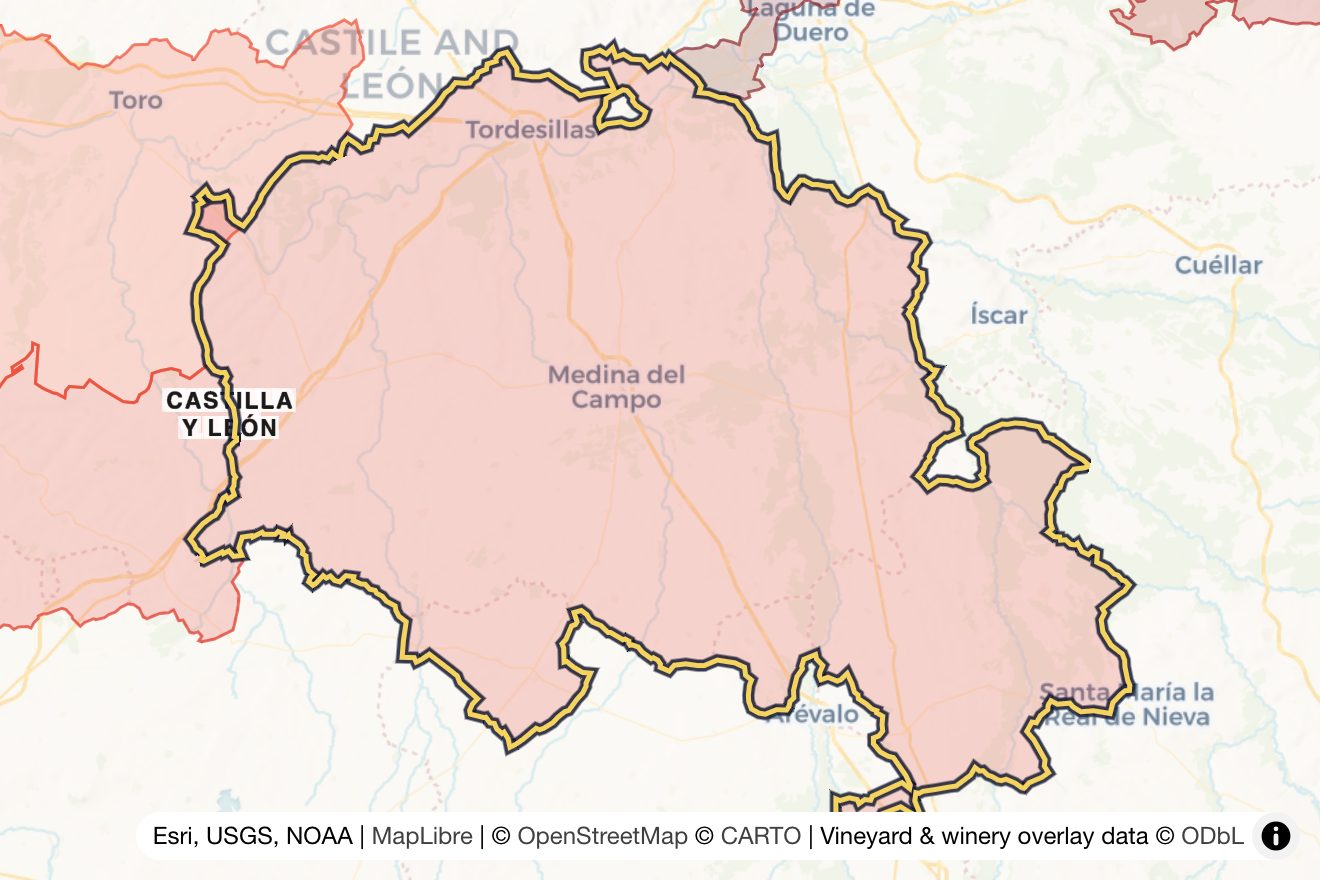
The Denominación de Origen Rueda covers approximately 20,000 hectares of vineyards across three provinces: Valladolid (by far the largest share of plantings), Segovia, and Ávila. The region extends roughly 80 kilometers east to west and 30 kilometers north to south, following the Duero River and its tributaries.
Key Villages and Subzones
La Seca: The largest wine-producing municipality, accounting for approximately 30% of regional production. Vineyards sit at 700–750 meters elevation on gentle slopes with mixed sandy-clay soils. La Seca produces archetypal Rueda: aromatic, fresh, with moderate structure.
Serrada: Higher elevation (750–800 meters) with cooler temperatures and slower ripening. Soils contain more clay and limestone than La Seca, producing wines with greater structure and aging potential. Several quality-focused producers source from Serrada vineyards.
Rueda (town): The region's namesake village, with diverse soil types ranging from sandy loams to clay-limestone mixtures. Historical center of the oxidative fortified wine tradition.
Medina del Campo: Central sector with warmer temperatures and sandier soils. Produces aromatic, early-drinking wines with less structure.
Nava del Rey: Southern area with red iron-rich clay soils. Some producers prize these sites for old-vine Verdejo with phenolic structure and aging potential.
The village classifications remain nascent, and clear stylistic differences have yet to crystallize in consumer perception. Most producers continue blending across villages, prioritizing consistency over site specificity.
VINTAGE VARIATION
Rueda's continental climate produces significant vintage variation, though the region's reliance on irrigation and protective winemaking moderates extremes.
Ideal Vintage Conditions
The best vintages balance sufficient winter rainfall (to replenish groundwater for irrigation), a frost-free spring, moderate summer temperatures (avoiding heat spikes above 40°C), and cool nights during ripening. September should be dry and sunny, allowing gradual maturation without disease pressure.
These conditions preserve acidity while achieving full phenolic ripeness: the key to quality in Rueda. Hot vintages with warm nights produce flabby wines lacking freshness. Cool, wet vintages risk under-ripeness and green, herbaceous character.
Recent Vintages
2022: Hot and dry, with one of the earliest harvest starts in the DO's history and a large crop of about 155 million kg. Wines show concentration but lower acidity than normal, drink early.
2021: A cold, wet season, one of the coldest and rainiest in recent years. Variable summer weather. Producers who managed yields carefully produced balanced wines with good acidity. Inconsistent quality across the region.
2020: Excellent vintage. Moderate temperatures, cool nights, and healthy fruit at harvest. Wines combine ripeness with freshness, ideal Rueda conditions. The best will age gracefully for 5–7 years.
2019: Very warm vintage with early harvest. Wines are ripe and generous but lack the tension of cooler years. Drink within 3–4 years.
2018: A historically large harvest, with fruit in excellent health thanks to a dry harvest season.
2017: Devastating spring frost caused widespread crop loss (50–70% in some vineyards). Production fell sharply, but the Consejo Regulador rated the vintage Excelente.
Aging Potential
Most Rueda wines are designed for early consumption, drink within 18–24 months of vintage. The fresh, fruity style fades quickly, and extended aging brings oxidation rather than complexity.
However, the quality tier (barrel-fermented Verdejo from old vines, particularly from clay-limestone soils) ages surprisingly well. These wines develop for 5–10 years, evolving from primary fruit toward honey, lanolin, beeswax, and savory notes while retaining the acidity that prevents flabbiness.
The key is phenolic ripeness and structural balance. Wines with adequate phenolics and acidity age gracefully; those lacking structure collapse into oxidation and fatigue.
KEY PRODUCERS
Marqués de Riscal
The catalyst for Rueda's modern transformation. In the early 1970s, this Rioja-based winery recognized Verdejo's potential and invested in temperature-controlled fermentation technology. Their pioneering work established the fresh, fruity style that defines contemporary Rueda.
Today, Marqués de Riscal produces both entry-level wines and more ambitious bottlings, including barrel-fermented Verdejo. Their commercial success validated the region and attracted subsequent investment.
Ossian
Founded by Ismael Gozalo and Javier Zaccagnini, Ossian focuses exclusively on pre-phylloxera Verdejo from ungrafted vines over 100 years old. The wines employ extended skin contact, barrel fermentation, and prolonged aging on lees, producing structured, age-worthy Verdejo that challenges regional stereotypes.
Ossian's approach is uncompromising: yields below 20 hl/ha, manual harvesting, native yeast fermentation, and minimal sulfur additions. The resulting wines are powerful, textured, and divisive, admirers praise their complexity and aging potential; critics find them heavy and over-extracted.
The estate's success has inspired other producers to seek out old-vine parcels and experiment with more ambitious winemaking.
Belondrade y Lurton
Didier Belondrade brought Burgundian techniques to Rueda in the 1990s, producing barrel-fermented Verdejo with texture, complexity, and aging potential. The wines undergo malolactic fermentation and extended lees aging, developing creamy texture and nutty complexity while retaining freshness.
Belondrade y Lurton demonstrated that Verdejo could produce serious, age-worthy wines comparable to quality white Burgundy, albeit with distinct regional character. The estate's wines age gracefully for 8–10 years, developing tertiary complexity while maintaining balance.
José Pariente
Founded in 1998 by Victoria Pariente and named for her father José, a grower who made Verdejo from his own vineyard in the 1960s. The family runs the estate, producing a range of Verdejo wines from stainless steel-fermented to barrel-aged.
The estate's focus on old vines (50+ years) and careful viticulture produces wines with concentration and structure. One of its top bottlings, the old-vine Verdejo Finca La Medina (formerly Cuvée Especial), is fermented in concrete eggs.
Naia
Part of the Bodegas Naia group, this producer focuses on terroir-driven Verdejo from specific vineyard sites. The wines balance freshness with texture, employing brief skin contact and partial barrel fermentation to add complexity without sacrificing Verdejo's aromatic character.
Naia's K-Naia is a fresh, lively blend of Verdejo and Sauvignon Blanc, while the flagship Naia and the top wine Náiades are the more ambitious bottlings.
Menade
A quality-focused estate practicing organic viticulture and minimal-intervention winemaking. Menade produces both conventional Verdejo and experimental wines with extended skin contact, amphora fermentation, and natural yeast.
The estate's "Sauvignon Blanc" demonstrates the variety's potential in Rueda, ripe citrus and stone fruit with moderate acidity and 13–14% alcohol. Their "Verdejo Fermentado en Barrica" employs barrel fermentation and lees aging, producing a textured, complex wine with aging potential.
Bodegas Mocén
A smaller producer focusing on old-vine Verdejo from specific parcels. The wines employ barrel fermentation and extended lees aging, producing structured, age-worthy Verdejo with phenolic grip and savory complexity.
Mocén's approach emphasizes site specificity and minimal intervention, native yeast fermentation, no fining or filtration, and minimal sulfur additions. The resulting wines are distinctive and terroir-driven, though production is limited.
WINE BUSINESS AND MARKET DYNAMICS
Explosive Growth
Rueda's expansion has been dramatic. From 2000 to 2019, production volumes quadrupled, reaching roughly 93 million bottles annually by 2019. Vineyard area increased from 6,500 hectares in 2000 to over 20,000 hectares by 2020.
This growth was driven by several factors:
- Consumer demand for fresh, aromatic white wines at accessible prices
- Export success, particularly in the Netherlands, Germany, and the USA
- Investment from established wine companies (Marqués de Riscal, González Byass, others) seeking to capitalize on Verdejo's commercial potential
- Irrigation availability, allowing viticulture in an otherwise marginal arid climate
Market Positioning
Rueda occupies a specific market niche: affordable, consistent white wines for everyday drinking. Most bottles retail for €5–12, competing with Pinot Grigio, Albariño, and entry-level Sauvignon Blanc.
The quality tier (barrel-fermented old-vine Verdejo) retails for €15–40, competing with white Burgundy, Pessac-Léognan, and premium New World Chardonnay. This segment remains small but growing, driven by producers seeking differentiation and higher margins.
Challenges and Criticisms
Homogeneity: Most Rueda tastes similar, clean, fruity, pleasant, but lacking distinctiveness. The emphasis on protective winemaking and commercial consistency produces wines that satisfy but rarely excite.
Irrigation dependency: The region's reliance on irrigation raises sustainability questions. As climate change increases water scarcity, Rueda's viability may be challenged.
Identity crisis: Is Rueda a terroir-driven quality region or a volume-oriented commercial zone? The village classification initiative suggests ambition toward the former, but the vast majority of production remains firmly in the latter category.
Competition: International Sauvignon Blanc from New Zealand, Chile, and South Africa offers similar styles at comparable prices. Verdejo's unfamiliarity in export markets requires consumer education: a challenging and expensive proposition.
Future Directions
The region faces a crossroads. Continued expansion risks oversupply and commodification. The quality movement (old vines, terroir focus, ambitious winemaking) offers differentiation but requires investment and time to establish market recognition.
The village classification system may provide a framework for quality stratification, but only if producers commit to site-specific viticulture and consumers perceive meaningful differences between villages.
Climate change looms as the long-term challenge. Rueda's aridity and irrigation dependency make it vulnerable to water scarcity. Adaptation strategies (drought-tolerant rootstocks, canopy management, higher elevation plantings) will be essential for long-term viability.