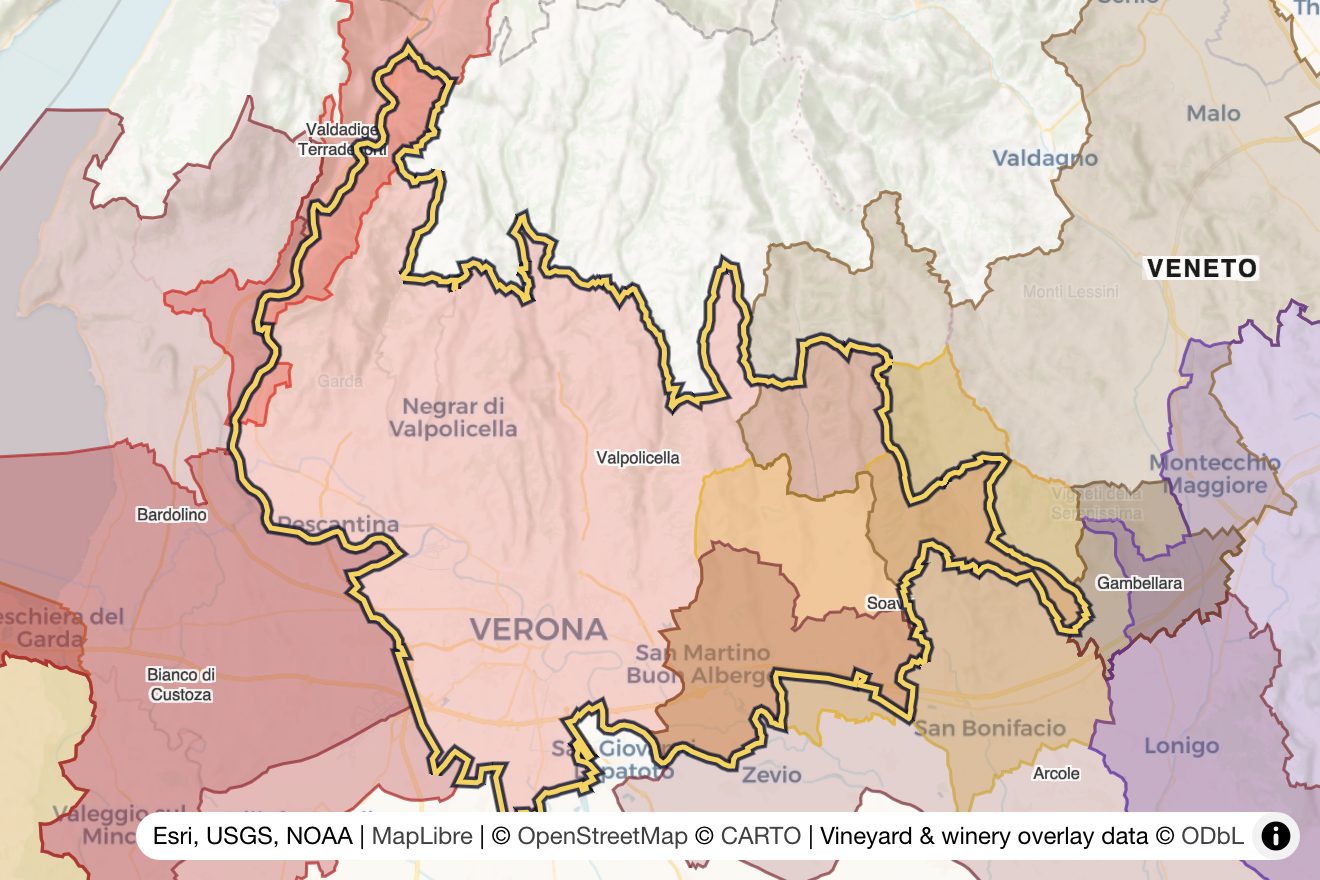
Overview
Annual production runs in the range of 15 million bottles, a volume that has grown severalfold since the 1990s as Amarone became the economic engine of the wider Valpolicella system.
History
Amarone descends from Recioto, the sweet dried-grape wine documented in the Veronese hills since antiquity. A Recioto fermented further than intended, consuming its sugar, produced a dry, bitter-edged wine; the name Amarone derives from amaro, bitter, distinguishing the dry result from the sweet original. Wines of this type were long an incidental product of Recioto cellars. Commercial bottlings labeled Amarone appeared in the 1950s, with Bertani among the first houses to market the style systematically.
Amarone was recognized within the DOC system in 1968 as a dry expression of Recioto della Valpolicella, and the style's international market grew strongly from the 1980s onward. In 2010 Amarone della Valpolicella was separated and elevated to its own DOCG, alongside a matching DOCG for Recioto.
Terroir & Climate
The production zone is that of Valpolicella: the foothill valleys between the Adige and the Lessini mountains, with the Classico communes in the west, the Valpantena subzone, and the eastern valleys of Mezzane, Illasi and Tramigna. Hillside fruit is favored for drying, since looser bunches and thicker skins from well-ventilated slopes withstand the long appassimento with less rot pressure. Soils range from limestone and moraine in the west to volcanic basalt in the east; both traditions supply respected Amarone.
Climate matters twice for this wine: once in the vineyard, where a moderated sub-continental climate ripens the Corvina family fully, and once in the drying lofts, where autumn and winter humidity must be managed over months of storage.
Grape Varieties & Wine Styles
The blend rules follow Valpolicella: Corvina Veronese 45 to 95 percent, with Corvinone permitted to replace up to half of the Corvina share, Rondinella 5 to 30 percent, and limited shares of other authorized local varieties such as Oseleta, Molinara and Croatina.
Production begins with selected, hand-harvested bunches set to dry in ventilated lofts, traditionally on bamboo racks or in shallow crates. Drying lasts roughly 100 to 120 days for most producers, into December or January, during which the grapes lose about a third of their weight. The concentrated must ferments slowly through winter to full or near-full dryness. Amarone must age a minimum of two years, counted from January 1 following the harvest, before release; Riserva requires four years. Producers divide between large Slavonian oak casks and smaller French barrels, and between long-drying traditionalists and shorter, cleaner modern appassimento regimes.
Amarone is full-bodied, high in alcohol and glycerol, with flavors of dried cherry, fig, dark chocolate, sweet spice and balsamic notes over substantial but ripe tannin. Despite its size the wine carries the acidity of its native varieties, and well-made examples age for two decades or more. The unpressed Amarone pomace is also the basis of Valpolicella Ripasso, which reuses it to enrich finished Valpolicella.
Notable Producers
Giuseppe Quintarelli and Romano Dal Forno set the modern benchmark for the category. Bertani's traditional bottlings document the style's history at commercial scale. Significant producers include Masi, Allegrini, Tedeschi, Speri, Brigaldara, Ca' La Bionda, Corte Sant'Alda, Roccolo Grassi, Zyme and Tommasi, together with the major cooperative and negociant houses that account for much of total volume.
What to Know
Amarone is a dry wine; sweetness on the palate comes from alcohol, glycerol and dried-fruit concentration rather than significant residual sugar, and the sweet counterpart from the same process is Recioto. Classico refers to the five historic western communes. The wine's scale suits it to braises, aged cheeses and deliberate drinking rather than everyday service, and its production volume, though much expanded, remains constrained by the share of the harvest sound enough to dry.