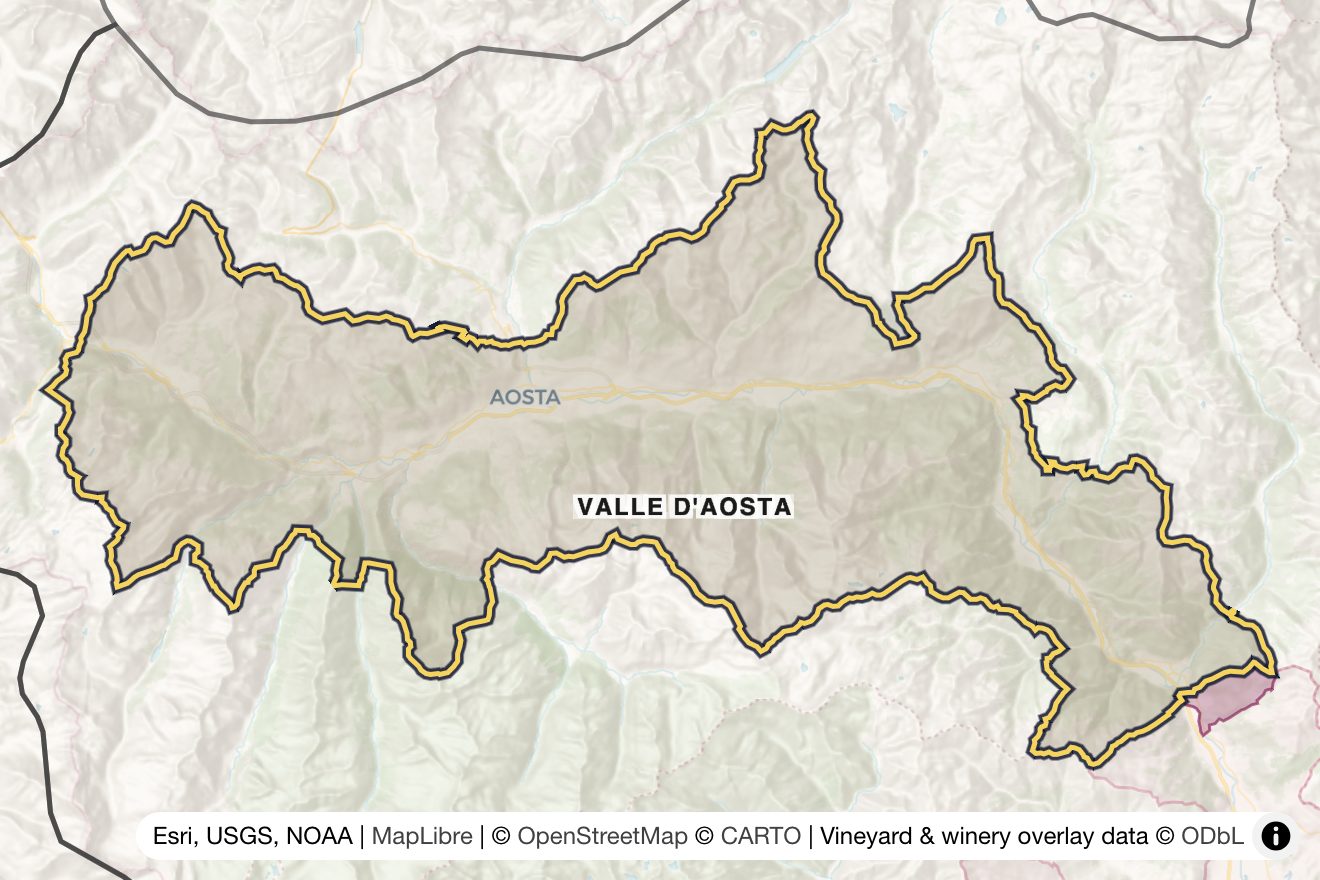
Overview
The Valle d'Aosta is Italy's smallest wine region: a single alpine valley along the Dora Baltea river between Piedmont and Mont Blanc, with well under 500 hectares of vineyard and one umbrella DOC, Valle d'Aosta, subdivided into named subzones from Donnas at the Piedmont border to Blanc de Morgex et de La Salle beneath Mont Blanc, where vines reach roughly 1,200 metres, among the highest in Europe. The region is bilingual, French and Italian, and its wines are correspondingly labeled.
History
Viticulture followed the Roman road over the Alpine passes, and the valley's terraces, like Valtellina's, were assembled over centuries to serve local and transalpine trade. Phylloxera never reached the highest plantings: the Prié Blanc of Morgex still grows ungrafted. The modern framework began with the Donnas DOC of 1971 and Enfer d'Arvier in 1972, and was consolidated into today's single regional DOC and subzone system in the mid-1980s, and small cooperative cellars, founded from the 1970s onward, remain the backbone of production alongside a growing tier of family estates.
Terroir & Climate
The valley is steep-sided glacial terrain: vineyards occupy terraces and moraine fans on the sunnier adret side, on sandy, stony, acid soils over granite and schist. The climate is dry for the Alps, rain-shadowed and föhn-ventilated, with intense light, cold nights and a short season that altitude stretches to the limit at Morgex. Sites range from the near-Mediterranean warmth of the central valley floor to true high-mountain viticulture within a few kilometres.
Grape Varieties & Wine Styles
The valley fields an unusual native roster: Prié Blanc for the alpine whites and sparkling of Morgex; Petit Rouge behind the reds of Torrette, Enfer d'Arvier and Chambave; Fumin, the structured, ageworthy dark grape; Cornalin and Mayolet; Petite Arvine shared with the Swiss Valais; and Nebbiolo, locally Picotendro, at Donnas, where it makes the valley's answer to Carema. Muscat at Chambave and passito traditions round out the range. Styles are alpine throughout: moderate alcohol, bright acidity, stony aromatics, with Fumin and Donnas the cellar-worthy reds.
Notable Producers
Grosjean and Les Crêtes are the region's most visible estates, the latter's Petite Arvine and oaked Chardonnay its best-known bottles. Cave Mont Blanc de Morgex et La Salle sustains the extreme-altitude whites and sparkling; Caves Cooperatives de Donnas and Cave des Onze Communes anchor their districts; and small growers, Ermes Pavese at Morgex, Château Feuillet, Lo Triolet for Pinot Gris, Didier Gerbelle, fill out an artisan roster.
What to Know
Production is tiny and largely consumed within the valley and its tourist economy, so the wines travel scarce. The subzone names are the map: Donnas for Nebbiolo, Torrette for Petit Rouge, Morgex for the high whites, Chambave for Muscat. Fumin is the collector's variety, and the ungrafted Prié Blanc vineyards are a piece of pre-phylloxera Europe still in production.