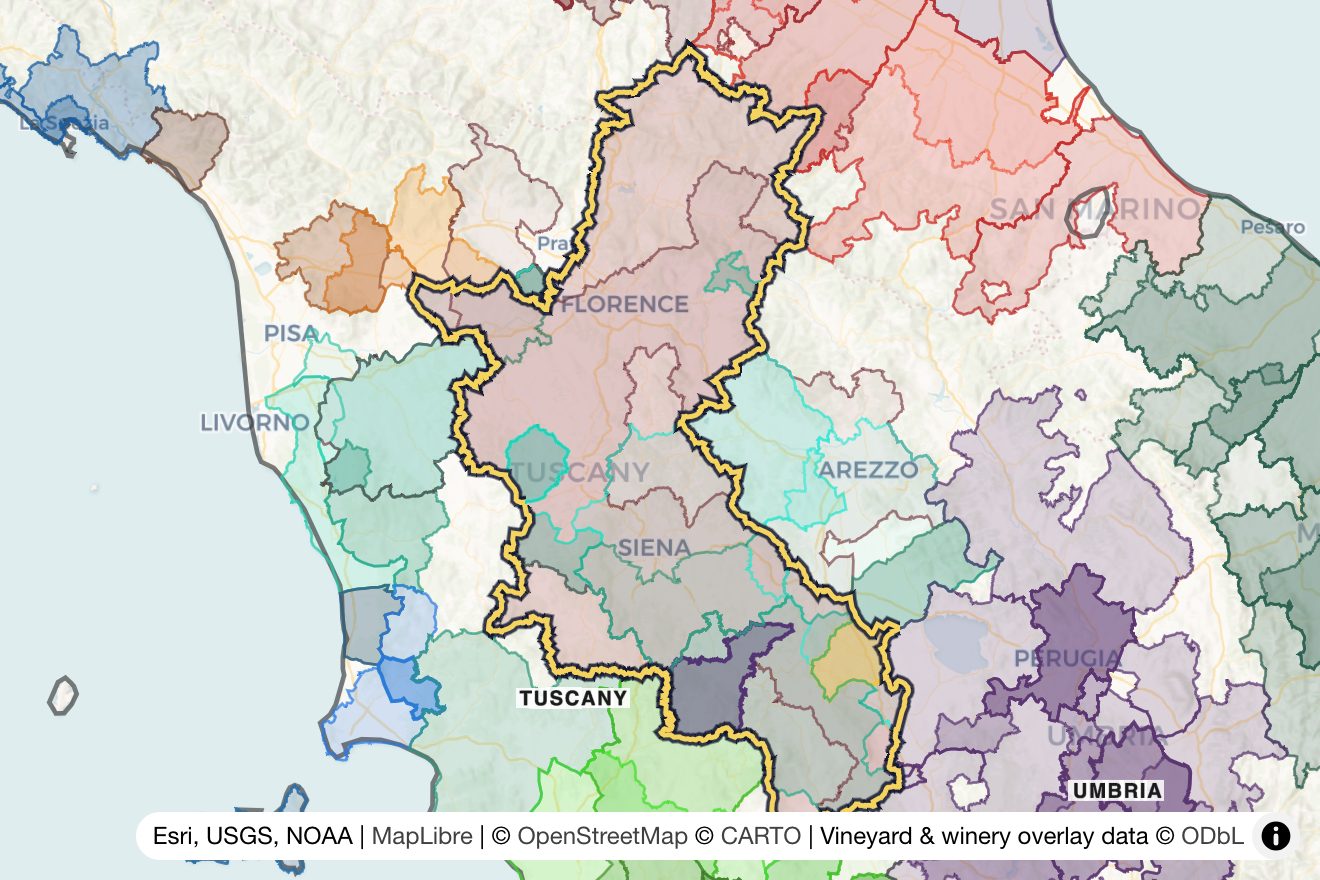
Overview
Chianti Classico is a separate denomination from Chianti DOCG, with its own production rules and its own consortium. The two zones do not overlap: wine grown inside the Classico boundary cannot be labeled Chianti, and vice versa. The denomination's identifying seal is the Gallo Nero, the black rooster, used by the consortium since 1924.
History
The boundary of the zone is among the oldest legal delimitations of a wine region. In 1716 Grand Duke Cosimo III de' Medici issued a decree defining the production area of Chianti, covering substantially the territory of today's Classico zone. In 1872 Baron Bettino Ricasoli of Castello di Brolio set out a formula for Chianti based principally on Sangiovese, a composition that shaped the wine's identity into the twentieth century.
The Consorzio per la difesa del vino Chianti was founded in 1924 by producers of the historic zone, adopting the black rooster as its mark. A 1932 ministerial decree distinguished the original territory as "Classico" within the by-then much larger Chianti production area. Chianti received DOC status in 1967 and DOCG status in 1984, with Classico as a subzone; Chianti Classico became an autonomous DOCG with its own disciplinare in 1996.
White grapes, once a mandated component of the blend, were progressively reduced and have been prohibited in Chianti Classico since 2006. In 2014 the consortium introduced Gran Selezione as a third quality tier above Riserva. In 2021 the zone was subdivided into eleven Unità Geografiche Aggiuntive (UGA), additional geographic units that may appear on Gran Selezione labels: Castellina, Castelnuovo Berardenga, Gaiole, Greve, Lamole, Montefioralle, Panzano, Radda, San Casciano, San Donato in Poggio and Vagliagli.
Terroir & Climate
The zone is hill country, with most vineyards planted between roughly 250 and 550 metres of elevation. Three soil types recur across the denomination. Galestro, a friable clay-marl schist, is widespread on higher slopes and is associated with aromatic, finely structured Sangiovese. Alberese, a compact limestone-rich soil, produces firmer, more muscular wines. Macigno sandstone dominates in a few sectors, notably around Lamole and parts of Greve, and tends to give lighter-colored, perfumed wines.
The climate is continental in character with Mediterranean influence: hot, dry summers, cold winters, and substantial diurnal temperature range at elevation. Rainfall concentrates in spring and autumn. Site altitude and exposure produce meaningful differences in ripening across the zone; the warmer, lower sectors of Castelnuovo Berardenga in the south and the high, cooler sites of Lamole and Radda frame the stylistic range.
Grape Varieties & Wine Styles
Chianti Classico must contain a minimum of 80 percent Sangiovese. The remaining share, up to 20 percent, may come from authorized red varieties, either native (principally Canaiolo Nero and Colorino) or international (principally Cabernet Sauvignon and Merlot). Many estates now bottle Chianti Classico from Sangiovese alone.
The denomination has three tiers. The base wine, commonly called Annata, requires a minimum of 12 months of aging. Riserva requires 24 months, including 3 months in bottle. Gran Selezione, introduced with the 2010 vintage and in force since 2014, requires 30 months including 3 in bottle and must be made exclusively from estate-grown fruit. Under amendments approved in 2021, Gran Selezione moves to a minimum of 90 percent Sangiovese with only native varieties permitted as the complement, applying from the 2027 vintage.
Stylistically, Chianti Classico is a medium- to full-bodied dry red marked by high acidity, firm tannin, and flavors in the red cherry, plum skin, dried herb and balsamic spectrum. It is a wine built for the table, and its structure supports aging: Riserva and Gran Selezione bottlings from strong vintages routinely develop over one to two decades.
The zone also played a central role in the Super Tuscan phenomenon: beginning in the 1970s several estates within the Classico boundary released Sangiovese- or Cabernet-based wines outside the DOC rules under what became the Toscana IGT designation, a practice that continues alongside the DOCG today.
Notable Producers
Producers of long standing include Barone Ricasoli at Castello di Brolio and Badia a Coltibuono in Gaiole, and Antinori, whose Chianti Classico holdings include Badia a Passignano. Estates closely identified with the modern reputation of the denomination include Fontodi in Panzano, Felsina in Castelnuovo Berardenga, Castello di Ama and San Giusto a Rentennano in Gaiole, Isole e Olena in Barberino, Castello di Volpaia and Monteraponi in Radda, Querciabella in Greve, and Castellare di Castellina and Riecine among many others. The consortium counts several hundred member estates, from multi-hundred-hectare houses to growers bottling from a few hectares.
What to Know
The Classico designation refers to the historic zone, not to an aging level; a Chianti Classico Annata and a Chianti DOCG from outside the zone are wines of different denominations, not different grades of the same wine. The black rooster seal on the neck or capsule identifies the consortium's wines. UGA village names currently appear only on Gran Selezione labels. Vintage variation is significant in the zone, and elevation is a useful guide to style: higher-altitude bottlings run brighter and more aromatic, lower and warmer sites fuller and darker.