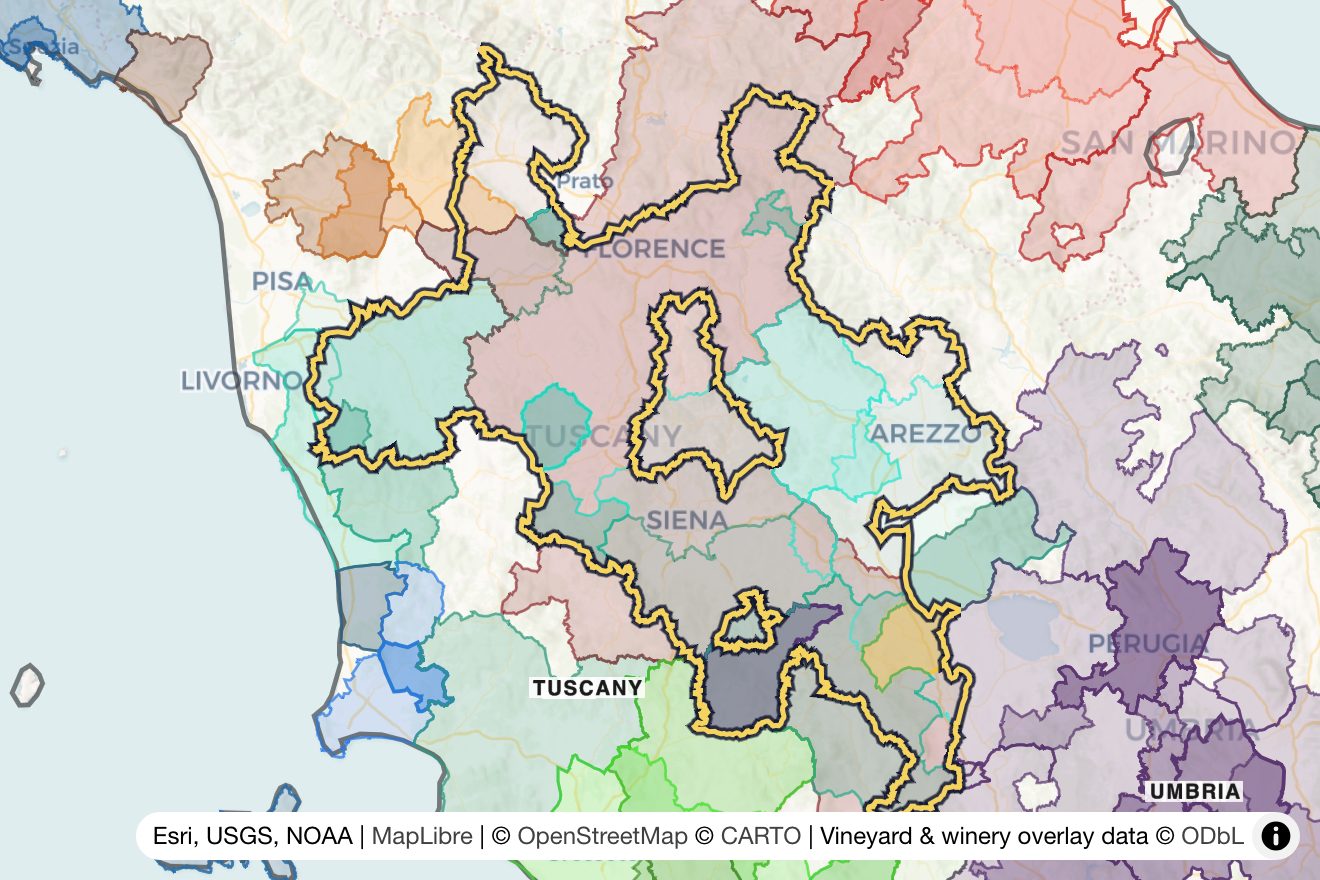
Overview
Chianti DOCG is the broad Sangiovese-based denomination of central Tuscany, covering a large territory across the provinces of Florence, Siena, Arezzo, Pisa, Pistoia and Prato. It is legally and geographically distinct from Chianti Classico DOCG, the historic zone between Florence and Siena, which has its own rules and consortium; the two do not overlap. Chianti's territory is organized into seven named subzones, of which Rufina, the smallest, holds the highest critical standing, alongside Colli Senesi, Colli Fiorentini, Colli Aretini, Colline Pisane, Montalbano and Montespertoli.
History
The name Chianti expanded outward from the historic hills over centuries of commercial success, until the 1932 ministerial decree fixed the enlarged map and reserved Classico for the original zone. Chianti became a DOC in 1967 and a DOCG in 1984. Its blend rules trace to Bettino Ricasoli's Sangiovese-based formula of 1872, which long included white grapes; the modern disciplinare has steadily reduced that inheritance. Chianti Classico's departure as a fully separate DOCG in 1996 completed the administrative divorce, leaving Chianti DOCG as the family's broad-church denomination, spanning everyday fiasco heritage and serious subzone estates.
Terroir & Climate
The territory spans most of upland central Tuscany: limestone, galestro and clay hills from the Apennine foothills of Rufina, the coolest and highest subzone, through the sandier hills toward Pisa and the warmer Sienese slopes. The climate is continental with Mediterranean moderation, and given the zone's breadth, subzone and site determine character more than the umbrella name; Rufina's altitude and cool nights, in particular, produce the structure and longevity that set it apart.
Grape Varieties & Wine Styles
Chianti requires a minimum of 70 percent Sangiovese, with subzones setting stricter shares, and permits supporting native varieties such as Canaiolo and Colorino, limited international varieties, and a small residual allowance of white grapes. Styles range from light, early-drinking reds with bright cherry fruit and brisk acidity to Riserva and subzone bottlings of genuine depth. Rufina Riserva is the category's summit, age-worthy on a Classico timescale; Colli Senesi provides the fullest everyday expressions. Superiore and Riserva designations impose higher ripeness and longer aging.
Notable Producers
Rufina's standard-bearers are Selvapiana and Frescobaldi's Nipozzano estate, with Colognole and Travignoli beside them. Across the other subzones, quality estates work alongside high-volume bottlers: the denomination supplies much of the Tuscan wine trade's base, and negociant and cooperative labels account for a large majority of its volume.
What to Know
Chianti and Chianti Classico are different appellations, not quality tiers of one wine; the Gallo Nero rooster belongs to Classico alone. Within Chianti DOCG, the subzone is the single most useful word on the label, and Rufina is the collector's corner. The denomination's price floor is low and its ceiling, in the right hands, surprisingly high, which makes producer knowledge worth more here than in most of Tuscany.