Overview
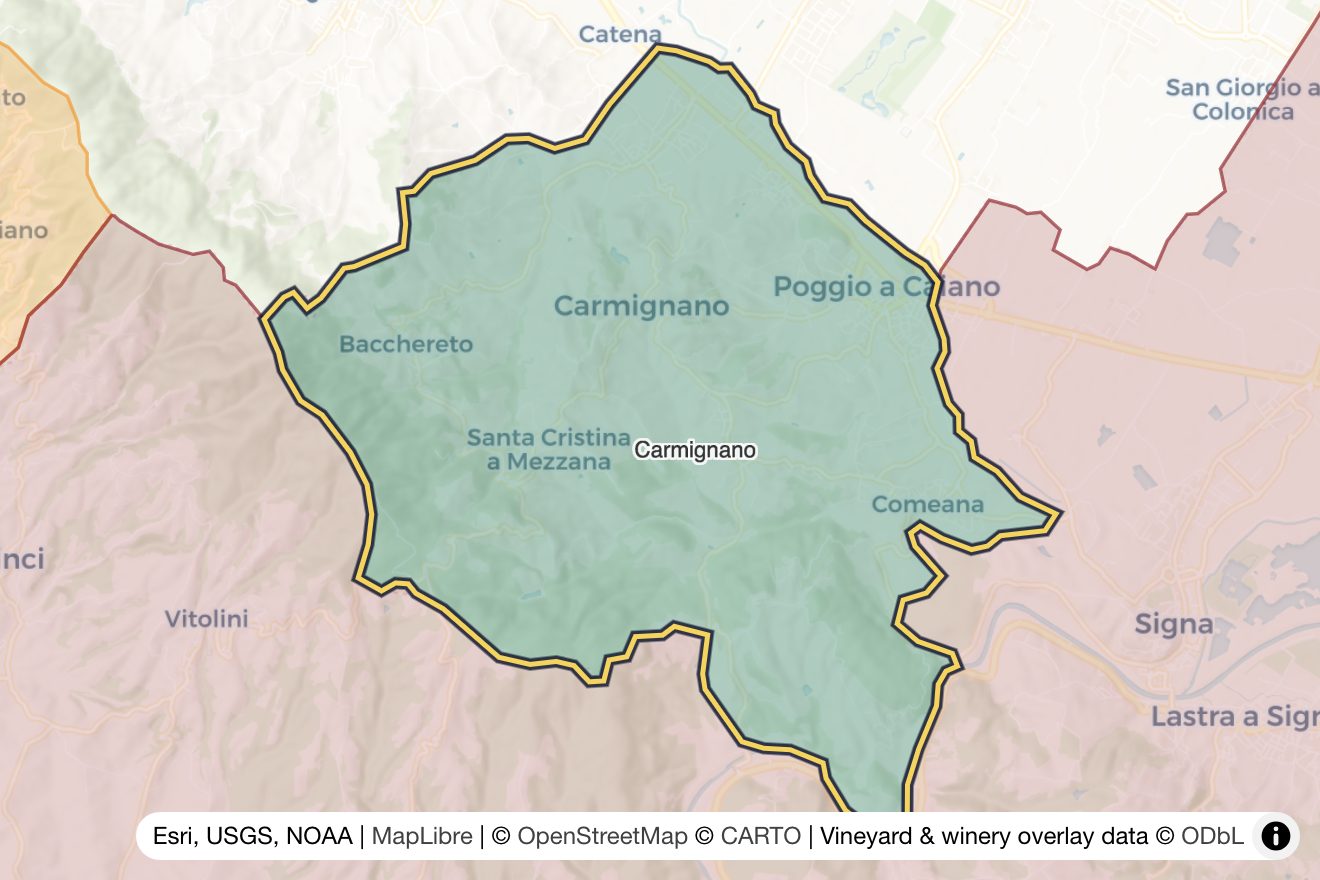
Carmignano is one of Tuscany's smallest and oldest fine wine denominations: a DOCG of scarcely more than a hundred hectares on the slopes of Montalbano west of Florence, near Prato. Its distinction is historical and ampelographic at once: Carmignano has blended Cabernet with Sangiovese since the Medici era, centuries before the Super Tuscans, and its disciplinare is the only one in Tuscany that requires the French varieties rather than merely permitting them.
History
Carmignano was among the four zones protected by Grand Duke Cosimo III de' Medici's 1716 decree, the founding act of Tuscan appellation law. The Medici had earlier introduced French vines to the area, the uve francesche maintained around their villas, and the local tradition of blending them into Sangiovese never lapsed. In the twentieth century the zone's wines were absorbed into Chianti Montalbano until producers, led by the Contini Bonacossi family of Tenuta di Capezzana, won a separate DOC in 1975 and DOCG status in 1990. The zone remains compact, farmed by a small circle of estates.
Terroir & Climate
The vineyards lie between roughly 50 and 400 metres on Montalbano's lower slopes, on schistous galestro, alberese limestone and clay. The climate is milder and somewhat warmer than the Chianti hills, moderated by the Arno basin's air and lower elevation, giving earlier ripening and rounder tannin than central Tuscany's norm; olive groves and woodland interleave the vineyard land in the old promiscuous pattern.
Grape Varieties & Wine Styles
The disciplinare requires a minimum of 50 percent Sangiovese and, uniquely, a mandatory 10 to 20 percent share of Cabernet Sauvignon or Cabernet Franc, with Canaiolo and other approved varieties completing the blend. Aging runs a minimum of two years, three for Riserva. Carmignano is a medium- to full-bodied red joining Sangiovese's cherry and acidity to Cabernet's cassis and structural fill, generally suppler than Chianti Classico of equivalent level and reliably age-worthy over one to two decades. The zone also maintains Barco Reale, its lighter DOC counterpart, alongside rosato and vin santo traditions of local repute.
Notable Producers
Tenuta di Capezzana is the denomination's historic and qualitative anchor. Piaggia has built the modern critical benchmark, with Fattoria Ambra, Le Farnete and a handful of small estates completing a producer roster that can be counted on two hands.
What to Know
Carmignano's Cabernet is heritage, not modernization: the zone documents French varieties in Tuscan blends three centuries before the term Super Tuscan existed. Production is small enough that availability, not comprehension, is the buyer's obstacle. Barco Reale offers the house style young and inexpensively; the DOCG and its Riservas repay cellaring.