Overview
Brunello is one of Italy's most regulated and longest-aged red wines. It was the first wine in Italy to be granted DOCG status, in 1980, and remains one of the country's benchmark expressions of Sangiovese, grown here in a warm, dry mesoclimate distinct from the rest of Tuscany.
History
The wine's origins are tied to a single estate. In the mid-nineteenth century Clemente Santi of the Il Greppo property began isolating and bottling Sangiovese on its own, and in 1865 a "vino rosso scelto (brunello)" from the estate received a medal at the agricultural fair of Montepulciano. His grandson Ferruccio Biondi-Santi is credited with codifying the style in the late nineteenth century: a wine from a single Sangiovese selection, given extended cask aging. The Biondi-Santi Riserva 1888 is conventionally cited as the first vintage labeled Brunello di Montalcino.
For the first half of the twentieth century production remained very small and largely confined to a handful of estates. The Consorzio del Vino Brunello di Montalcino was founded in 1967, following the wine's admission to the new DOC system in 1966. In July 1980 Brunello di Montalcino became the first Italian denomination elevated to DOCG. The zone expanded rapidly from the 1970s onward; Castello Banfi's establishment in the southern sector from 1978, backed by the American Mariani family, was instrumental in building the wine's international market, particularly in the United States.
The commune's other denominations frame Brunello's rules: Rosso di Montalcino DOC (1984) covers earlier-released pure Sangiovese from the same territory, Moscadello di Montalcino DOC (1984) covers the commune's historic sweet Moscato, and Sant'Antimo DOC (1996) covers other varieties grown in the zone.
Terroir & Climate
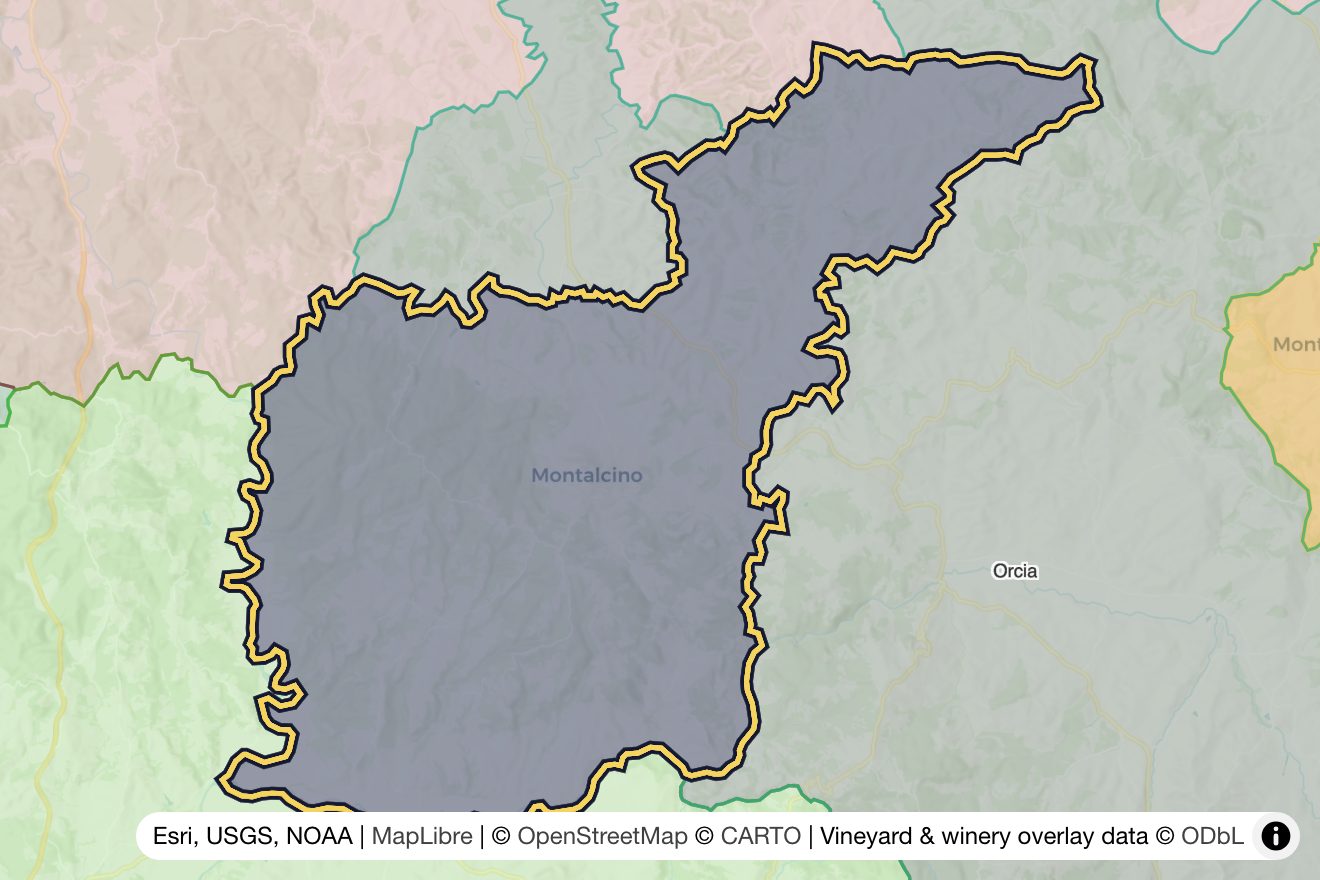
Montalcino is a freestanding hill massif between the valleys of the Ombrone, Asso and Orcia rivers, rising to 661 metres at the town itself. Vineyards are planted from roughly 120 metres up to a regulated maximum of 600 metres. The zone is among the warmest and driest in Tuscany, with annual rainfall near 700 millimetres; Monte Amiata, the 1,738-metre volcanic massif to the southeast, shields the territory from summer storms and hail.
Soils divide broadly by elevation and quadrant. Higher slopes carry galestro schist and marl, giving aromatic, structured wines; lower and southern sectors carry heavier clay and richer alluvial material, giving darker, fuller-bodied wines. The northern quadrant, cooler and later-ripening, and the warmer southern quadrant around Sant'Angelo produce recognizably different expressions of the same grape, and many estates blend across holdings in more than one sector.
Grape Varieties & Wine Styles
Brunello di Montalcino must be 100 percent Sangiovese; no other variety is permitted. The local name Brunello refers to the clonal population of Sangiovese Grosso historically selected in the commune.
The aging requirements are the longest of Italy's major red denominations. Brunello may not be released before January 1 of the fifth year after the harvest, with a minimum of two years in oak and four months in bottle. Riserva is released a year later, in the sixth year, with six months in bottle. Producers choose freely between large Slavonian casks, the traditional vessel, and smaller French barrels; élevage choice remains one of the clearest stylistic dividing lines in the zone.
Rosso di Montalcino, drawn from the same vineyards and often from younger vines or declassified lots, requires only one year of aging and serves as the denomination's earlier-drinking counterpart.
Brunello is a full-bodied dry red with high acidity and substantial tannin, characteristically showing red and black cherry, leather, dried herb, earth and balsamic notes, and taking on tobacco and dried-fruit complexity with age. Well-constituted vintages age for decades; the wine's traditional reputation was built on Riservas that remained sound after half a century.
Notable Producers
Biondi-Santi remains the denomination's reference estate. Producers with established reputations include Conti Costanti, Fuligni, Il Marroneto and Canalicchio di Sopra on the northern and eastern slopes; Salvioni's La Cerbaiola; Poggio di Sotto in the southeast toward Castelnuovo dell'Abate; Casanova di Neri and Valdicava; Lisini and Col d'Orcia in the south; Le Potazzine; Altesino and Caparzo in the north; and Argiano and Castello Banfi in the southwest. The zone runs from growers bottling a few thousand bottles to estates farming well over a hundred hectares.
What to Know
Brunello and Rosso di Montalcino come from the same commune and the same grape; the differences are aging requirements, selection, and release date. The DOCG guarantees minimum aging, not cask type or style, and producer choice on vessel size accounts for much of the stylistic spread. Release dates follow the vintage by more than four years: the current release in any given year is from the harvest five calendar years earlier for Brunello, six for Riserva. Elevation and quadrant within the commune are the most reliable guides to style, with northern and higher sites yielding the most perfumed wines and the southern sector the most powerful.