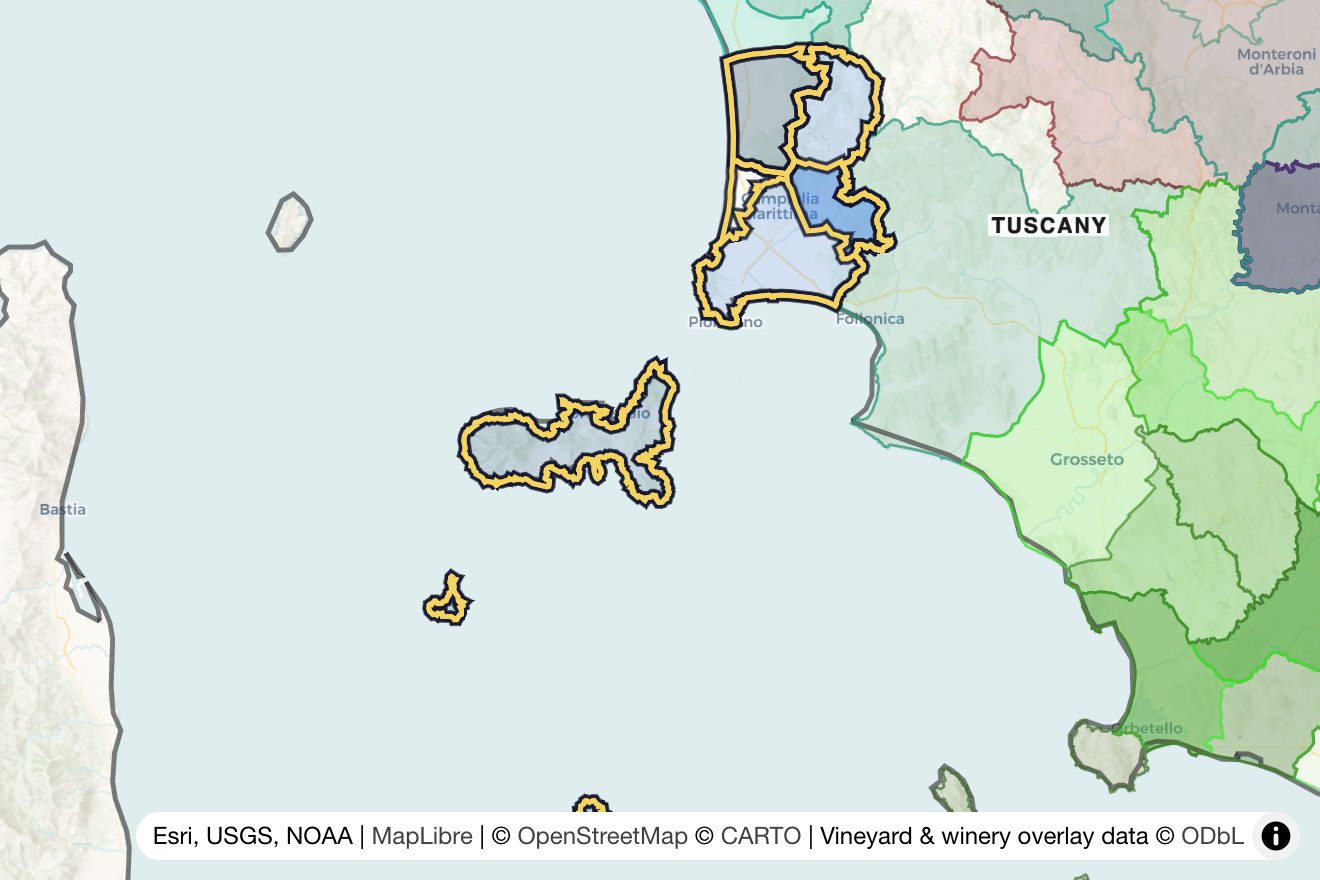
Overview
The zone is compact, an amphitheater of roughly 1,400 hectares between the Colline Metallifere foothills and the sea, and its rise from experimental obscurity to international benchmark occurred within a single lifetime.
History
Marchese Mario Incisa della Rocchetta planted Cabernet at the San Guido estate in the 1940s, seeking the character of the Bordeaux wines he admired; Sassicaia remained a private house wine until its first commercial vintage, 1968. Its critical success in the 1970s, alongside Antinori's neighboring ventures, exposed the absurdity of the wines' legal status as plain table wine. The Bolgheri DOC of 1983 covered only whites and rosato; reds entered with the revised DOC of 1994, which also created the Sassicaia subzone, elevated to a standalone DOC in 2013. Ornellaia, founded in the 1980s, its Merlot Masseto, and Le Macchiole's varietal bottlings completed the zone's modern canon, and investment from Tuscany's great houses followed.
Terroir & Climate
The zone slopes gently from wooded hills to the coastal plain, on a mosaic of alluvial fans, clays, gravels and pockets of limestone and marine sand. The climate is Mediterranean and maritime: sea breezes temper summer heat, luminosity is exceptional, and ripening runs earlier and more evenly than in inland Tuscany. The combination of drainage, warmth and ventilation suits the Bordeaux varieties precisely where Sangiovese, in most sites, gives coarser results.
Grape Varieties & Wine Styles
Bolgheri Rosso and Rosso Superiore are Bordeaux-modeled blends: Cabernet Sauvignon, Merlot and Cabernet Franc in any proportion up to 100 percent, with Syrah and Sangiovese in limited supporting roles. The wines are full-bodied and structured, marked by dark fruit, Mediterranean herb and fine-grained tannin, with the top Superiore bottlings aging on Bordeaux's clock. Cabernet Franc has become the zone's connoisseur strength. Whites, a small share, center on Vermentino. Bolgheri Sassicaia DOC requires a minimum of 80 percent Cabernet Sauvignon from the delimited San Guido subzone.
Notable Producers
Tenuta San Guido, Ornellaia and Masseto, Antinori's Guado al Tasso, Le Macchiole, Grattamacco, Ca' Marcanda of Angelo Gaja, Michele Satta and Poggio al Tesoro lead a denomination in which nearly every estate operates at ambitious level; the consorzio's membership has grown severalfold since the 1990s.
What to Know
Bolgheri's rules invert Tuscan convention: international varieties are the tradition here, and Sangiovese the outsider. Sassicaia is labeled under its own DOC, not Bolgheri Rosso, and the famous names that predate the red DOC, Ornellaia and Masseto among them, retain IGT Toscana labeling by choice for some bottlings. Pricing spans honest estate reds to trophy tiers; Rosso Superiore from the leading houses is the zone's classic expression.