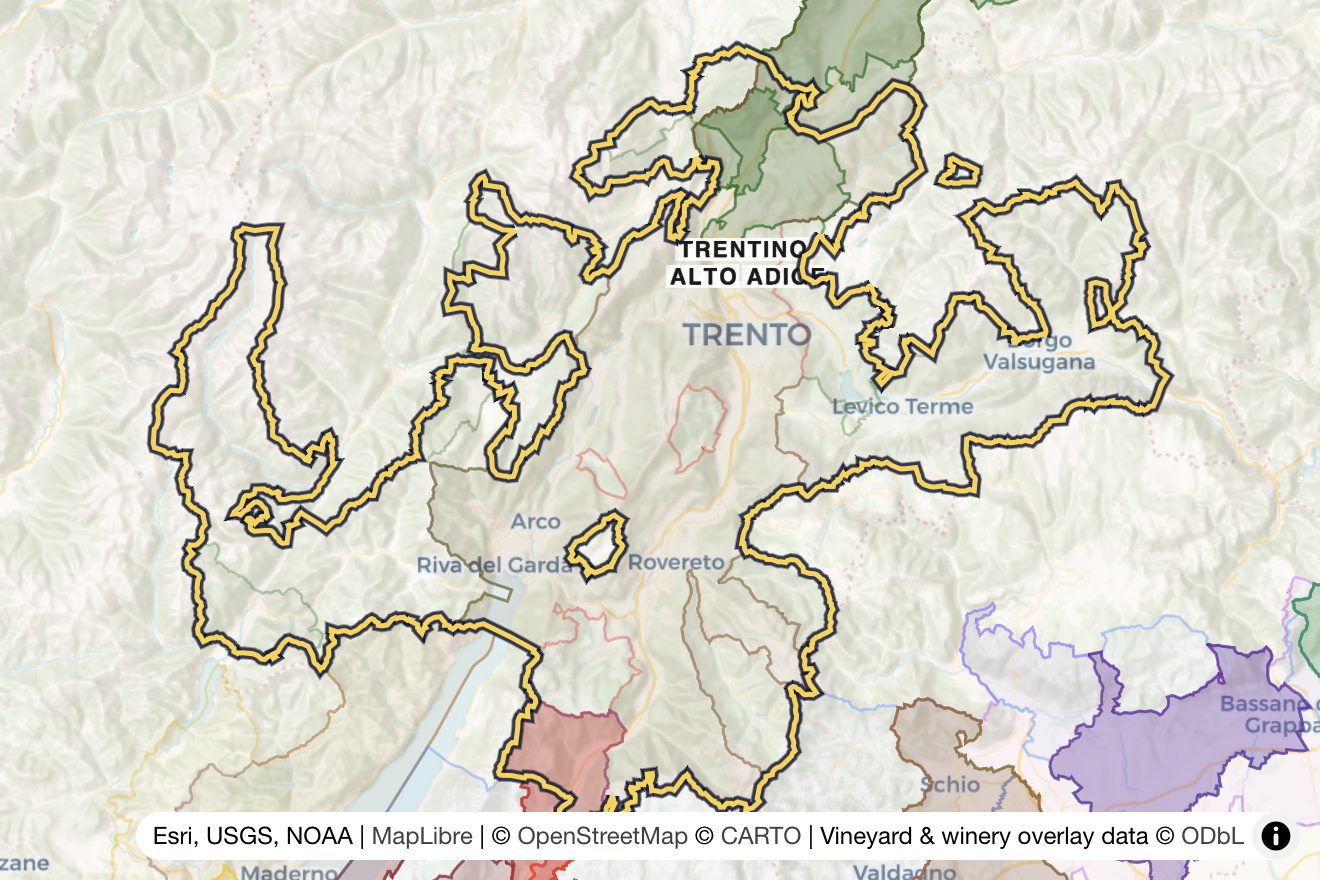
Overview
Cooperatives dominate the province's volume, handling the large majority of the harvest.
History
Viticulture in the Adige corridor predates Rome; Teroldego and Marzemino are documented in the valley from the Middle Ages, and Mozart's librettist placed Marzemino in Don Giovanni in 1787. The province's sparkling tradition began in 1902, when Giulio Ferrari, trained in Champagne, founded his eponymous house in Trento, convinced that the mountain valleys suited Chardonnay. Trentino DOC was established in 1971, and in 1993 the province's metodo classico production received its own denomination, Trento DOC, the first in Italy reserved for bottle-fermented sparkling wine; the collective brand Trentodoc was introduced in 2007.
Terroir & Climate
Vineyards follow the Adige and its side valleys, from the broad gravelly floor of the Campo Rotaliano in the north to the limestone slopes of the Vallagarina in the south and the glacial basins of the Valle dei Laghi toward Garda. Elevations run from about 200 metres on the valley floor to above 800 metres on sites destined for sparkling base wine. The climate is alpine-continental moderated by the Ora del Garda, the afternoon lake wind that funnels up the valley, drying canopies and widening the diurnal range. Soils span alluvial gravels, limestone scree and porphyry.
Grape Varieties & Wine Styles
Chardonnay and Pinot Grigio lead plantings. Chardonnay's most consequential role is as the backbone of Trentodoc, grown at elevation for acidity and yielding sparkling wines of alpine tension aged on lees from 15 months for non-vintage to 36 or more for riserva. Pinot Nero contributes to the sparkling blends and appears as a still varietal.
The native reds are district wines. Teroldego, confined by tradition to the Campo Rotaliano gravel plain under the Teroldego Rotaliano DOC, gives deeply colored, violet-scented reds of dark fruit and bitter cherry. Marzemino, centered on Isera and Ziresi in the Vallagarina, is a lighter, floral red. Nosiola, the province's native white, grows in the Valle dei Laghi and Pressano hills, dry versions saline and slender, and provides the base for Trentino Vino Santo, a rare passito pressed from raisined grapes in Holy Week. International reds, Merlot and the Cabernets, are long established, with San Leonardo's Vallagarina Bordeaux blend the reference.
Notable Producers
Ferrari remains the flagship of Trentodoc, alongside Rotari, Cesarini Sforza, Letrari, Abate Nero and the high-elevation grower houses. Foradori at Mezzolombardo redefined Teroldego from the 1980s and remains its reference estate. San Leonardo leads the Vallagarina, Pojer e Sandri and Cavit's and Mezzacorona's better selections carry the cooperative sector, and Pravis and Giovanni Poli work the Valle dei Laghi and its Vino Santo tradition.
What to Know
Trentino and Alto Adige are distinct halves of one administrative region, with separate denominations and traditions; this entry concerns the southern, Trentino side. Trentodoc is a sparkling-only denomination and the province's clearest claim to distinction, while the native varieties are geographically specific: Teroldego to the Rotaliano plain, Marzemino to the southern Vallagarina, Nosiola and Vino Santo to the Valle dei Laghi. Valley-floor varietal wine, much of it Pinot Grigio, accounts for most volume and travels under provincial or regional designations.