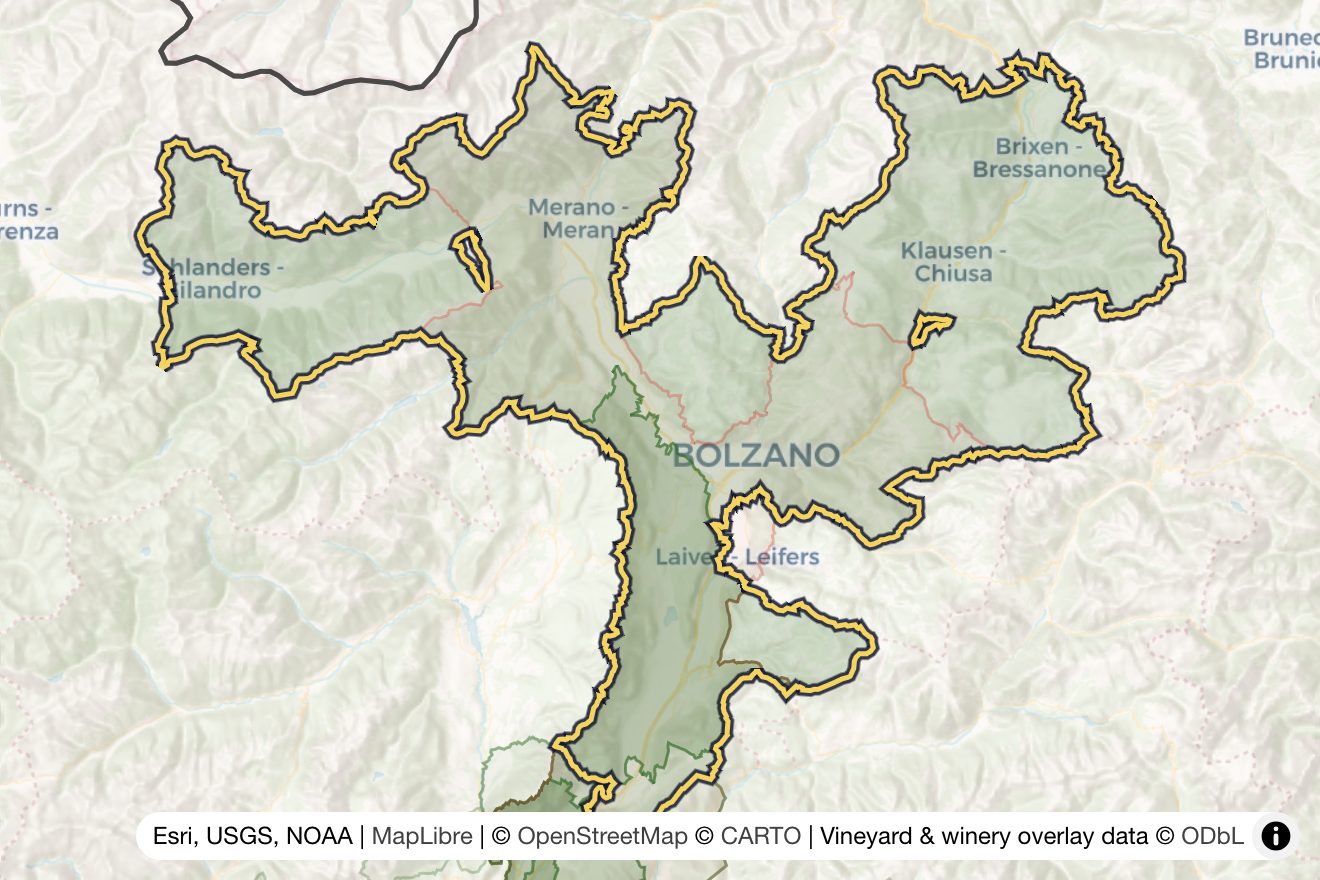
Overview
Alto Adige, Südtirol in its German-speaking majority's tongue, is Italy's northernmost wine province, the upper half of the Trentino-Alto Adige region along the Adige and Isarco valleys below the Alpine crest. With roughly 5,600 hectares it is small, but its quality concentration is unmatched in Italy: nearly the entire harvest is bottled under DOC, the highest share of any Italian region, and its cooperative system is widely considered Europe's finest. Whites lead a portfolio of remarkable range for the size, with the native reds Schiava and Lagrein alongside.
History
The valley has carried wine over the Alps since the Iron Age Rhaetians; centuries under Habsburg Austria oriented its trade north and left the bilingual culture its labels still reflect, the province joining Italy in 1919. Overcropped Schiava dominated the mid-twentieth century until a quality conversion, led from the 1980s by the cooperatives and winemakers such as Terlano's and San Michele Appiano's cellarmasters together with estates like Alois Lageder and Hofstätter, rebuilt the province around site-matched varieties at controlled yields. The Alto Adige DOC, established in 1975, now spans the province with a set of named subzones.
Terroir & Climate
Viticulture climbs from about 200 metres on the valley floor to above 1,000 on the steepest terraces, across porphyry around Bolzano, limestone and dolomite on the eastern walls, quartz and mica schists in the Isarco valley and glacial moraine elsewhere. The climate pairs Alpine nights with strikingly warm, sunny days, over 300 days of sun in the Bolzano basin, among Italy's hottest summer cities, while side valleys and altitude supply every gradation of cool. Subzones mark the classic sites: Terlano's porphyry for whites, Lake Caldaro and Santa Maddalena for Schiava, Gries for Lagrein, the Isarco and Venosta valleys for razor-edged aromatics.
Grape Varieties & Wine Styles
Whites are the calling card: Pinot Grigio and Pinot Bianco of uncommon seriousness, structured Chardonnay and Sauvignon, Gewürztraminer at its ancestral village of Tramin, and Kerner, Sylvaner, Riesling and Grüner Veltliner in the Isarco valley. Terlano's blends and single vineyards have demonstrated multi-decade aging. Among reds, Schiava gives the pale, easy classic of the region's taverns; Lagrein, dark and muscular, is Bolzano's own; and Pinot Nero from Mazon and neighboring slopes is Italy's most convincing. The style register across all of it is precise, aromatic and mountain-fresh.
Notable Producers
The great cooperatives, Cantina Terlano, San Michele Appiano, Tramin, Colterenzio, Girlan and Nals Margreid, stand at quality levels few private estates match. Alois Lageder, Hofstätter with its Barthenau Pinot Nero, Elena Walch, Tiefenbrunner, Kuenhof and Falkenstein in the side valleys, and Abbazia di Novacella, among the world's oldest working wineries, lead the estate tier.
What to Know
Labels are bilingual, Alto Adige and Südtirol interchangeably, with German site and variety names common. The cooperative mark here signals excellence, not volume compromise, an inversion of the usual Italian expectation. Subzone and site names carry the fine detail, and the province's whites, drunk young by habit, reward patience far beyond it.