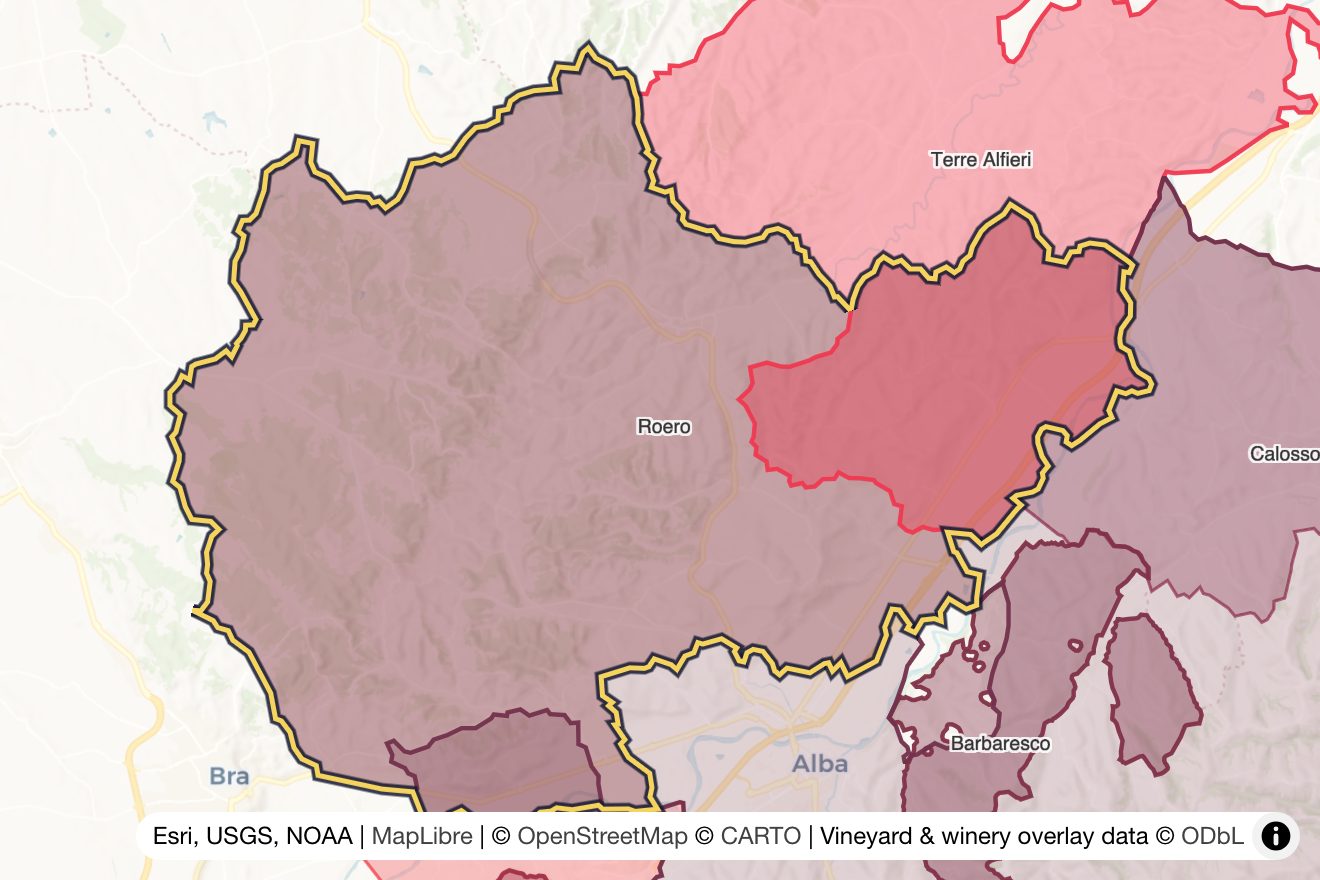
Overview
Roero is a DOCG on the left bank of the Tanaro river in the province of Cuneo, Piedmont, facing the Langhe across the water from the towns of Canale, Vezza d'Alba and Monteu Roero. The denomination covers two wines: Roero, a Nebbiolo-based red, and Roero Arneis, the white that revived the zone's fortunes and now leads its production. Elevated to DOCG in 2004, the zone stands as Piedmont's third Nebbiolo denomination of consequence after Barolo and Barbaresco, distinguished from both by its soils.
History
The Roero's castles and vineyard records document medieval viticulture, and its Nebbiolo entered Alba's markets alongside Langhe wine for centuries without a name of its own. Arneis, the local white, had declined nearly to extinction by the 1960s, kept alive by a few growers including Vietti and Bruno Giacosa, whose varietal bottlings in the 1970s began its recovery. The Roero DOC was created in 1985 and the DOCG followed in 2004, covering red and white together. The modern era's defining figure was Matteo Correggia of Canale, whose single-vineyard Nebbiolos in the 1990s demonstrated that the sands could produce reds of the first rank; the estate continues under his family.
Terroir & Climate
The Roero's soils are the young marine sands of the Pliocene, lighter and faster-draining than the compact marls of the Langhe opposite, interspersed with clay and limestone bands and cut by the Rocche, a dramatic eroded escarpment running through the zone. Vineyards lie between roughly 200 and 400 metres on steep, wooded hill country. The climate matches the Langhe's continental pattern, but the sands warm quickly and drain fast: Nebbiolo ripens earlier here, and drought stress in hot years is the greater risk.
Grape Varieties & Wine Styles
Roero rosso requires at least 95 percent Nebbiolo and a minimum of 20 months of aging, six in wood, with Riserva at 32 months. The sand-grown Nebbiolo is aromatic and earlier-opening than Langhe counterparts: rose, red cherry and spice over fine tannin, most examples at their best within a decade, the top crus longer. Roero Arneis, minimum 95 percent Arneis, is a dry white of pear, white flowers, almond and chamomile with moderate acidity, mostly for early drinking; a Spumante version exists and old-vine bottlings show the variety can carry age.
Notable Producers
Matteo Correggia remains the reference estate for red Roero, joined by Malvirà, Angelo Negro, Cascina Val del Prete, Monchiero Carbone and Cascina Chicco. Arneis standard-bearers include Vietti and Bruno Giacosa, whose bottlings sustained the grape, alongside the Roero estates themselves, and Ceretto's Blangé is the variety's largest international label.
What to Know
The Roero and the Langhe share a river, a market town and a grape, but not soils: sand against marl is the essential contrast, and it shows in the wines' earlier charm. Arneis accounts for most Roero volume, red Roero for most of its critical attention. Prices remain well below Barolo and Barbaresco, which has made the zone a conventional answer to the question of value in Piedmont Nebbiolo.