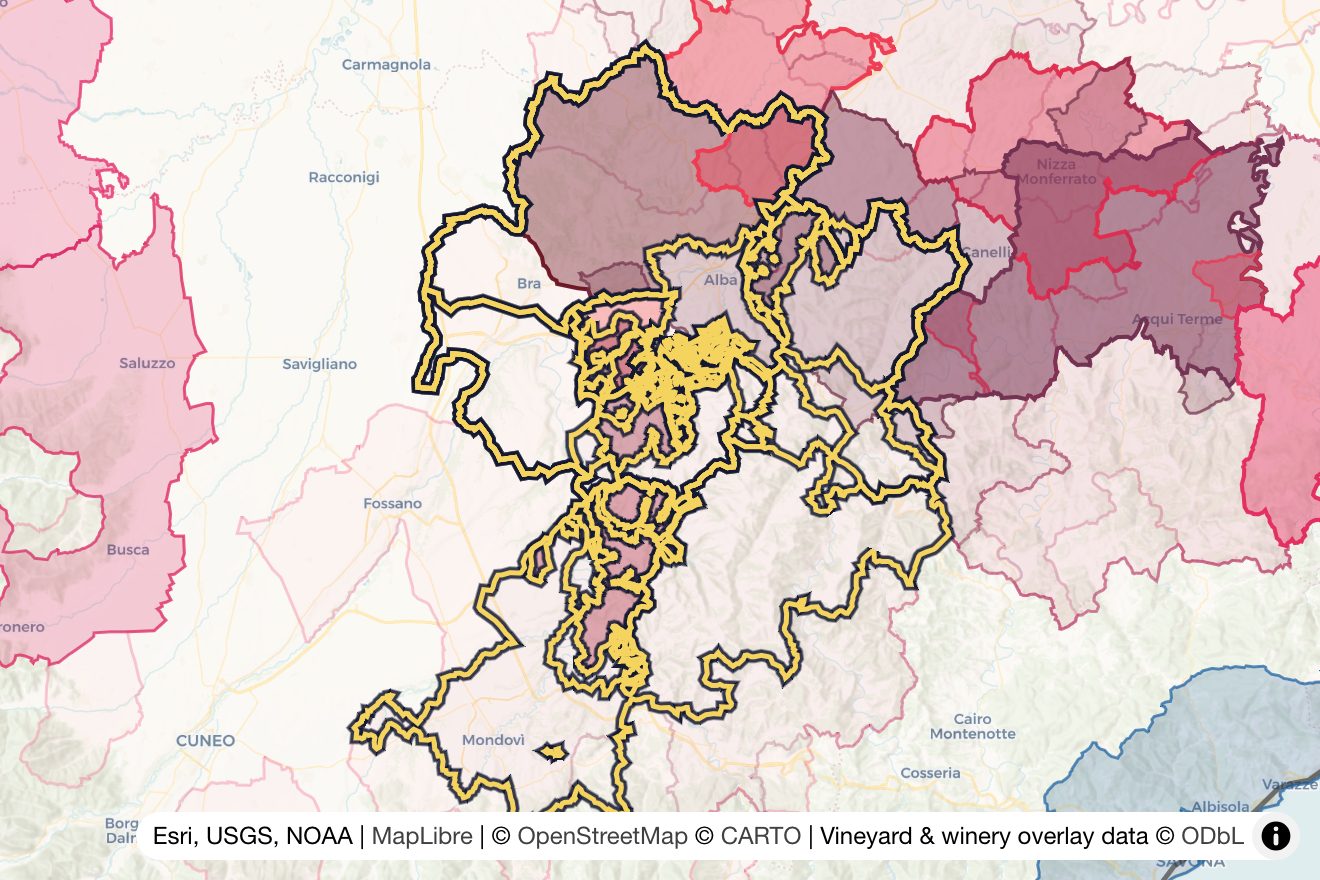
Overview
Because of this design, the Langhe DOC spans a wider stylistic and price range than any other name in the zone, from simple declassified lots to some of the area's most expensive bottles.
History
The name Langhe is ancient, describing the ridged hill country between the Tanaro and the Apennine watershed, but the DOC is recent. Its creation in 1994, together with the parallel Piemonte DOC, was a deliberate act of appellation architecture: it gave the Alba zone a flexible regional tier so that experimentation and declassification could occur inside the DOC system rather than under generic table wine labels. The category legitimized wines that already existed, most famously the Chardonnays and Nebbiolo-based blends that leading estates had introduced in the 1970s and 1980s, and gave rise to Langhe Nebbiolo as the zone's standard introductory red.
Terroir & Climate
The DOC covers the Langhe hills on the right bank of the Tanaro and adjacent territory, including the Barolo and Barbaresco zones, the Dolcetto country toward Dogliani, and the higher Alta Langa ridges. Soils are the zone's calcareous marls, clays and sandstones; elevations run from the river terraces to above 600 metres. The climate is continental with long autumns and marked vintage variation. Since the wine may be sourced anywhere in this territory, terroir expression in a Langhe-labeled wine depends entirely on the producer's sourcing.
Grape Varieties & Wine Styles
Varietal Langhe wines require at least 85 percent of the named grape. Langhe Nebbiolo is the most consequential category: sourced from young vines, lesser exposures or declassified parcels of the great crus, it presents Nebbiolo's rose, tar and red fruit in a lighter, earlier-drinking frame, and its quality tracks its source. Langhe Chardonnay carries the zone's international whites, Gaja's Gaia & Rey and Rossj-Bass among the founding examples. Langhe Bianco and Rosso accommodate blends and varieties outside the traditional roster, including Riesling, Sauvignon and Barbera-Nebbiolo assemblages; several estates use Langhe Rosso or Langhe Nebbiolo for wines deliberately made outside Barolo and Barbaresco rules.
Freisa, Favorita and Arneis also appear under the Langhe name, and Nascetta, the zone's native white, has its own mention centered on Novello.
Notable Producers
Virtually every estate of the Barolo and Barbaresco zones bottles under the Langhe DOC. Reference Langhe Nebbiolo comes from producers such as G.D. Vajra, Vietti, Produttori del Barbaresco (as Nebbiolo Langhe), Giuseppe Mascarello and Roagna; Gaja's Langhe bottlings include both its Chardonnays and, for a period, its former Barbaresco crus; G.B. Burlotto, Cavallotto and many others use the category for younger-vine Nebbiolo.
What to Know
Langhe on a label states territory, not quality: the same name covers an entry-level Nebbiolo and a collector Chardonnay. Langhe Nebbiolo is the customary first step into the zone's reds and is frequently declassified from vineyards of standing, making it one of Piedmont's better values. The producer and, where stated, the sourcing carry the information the appellation name deliberately leaves open.