Position
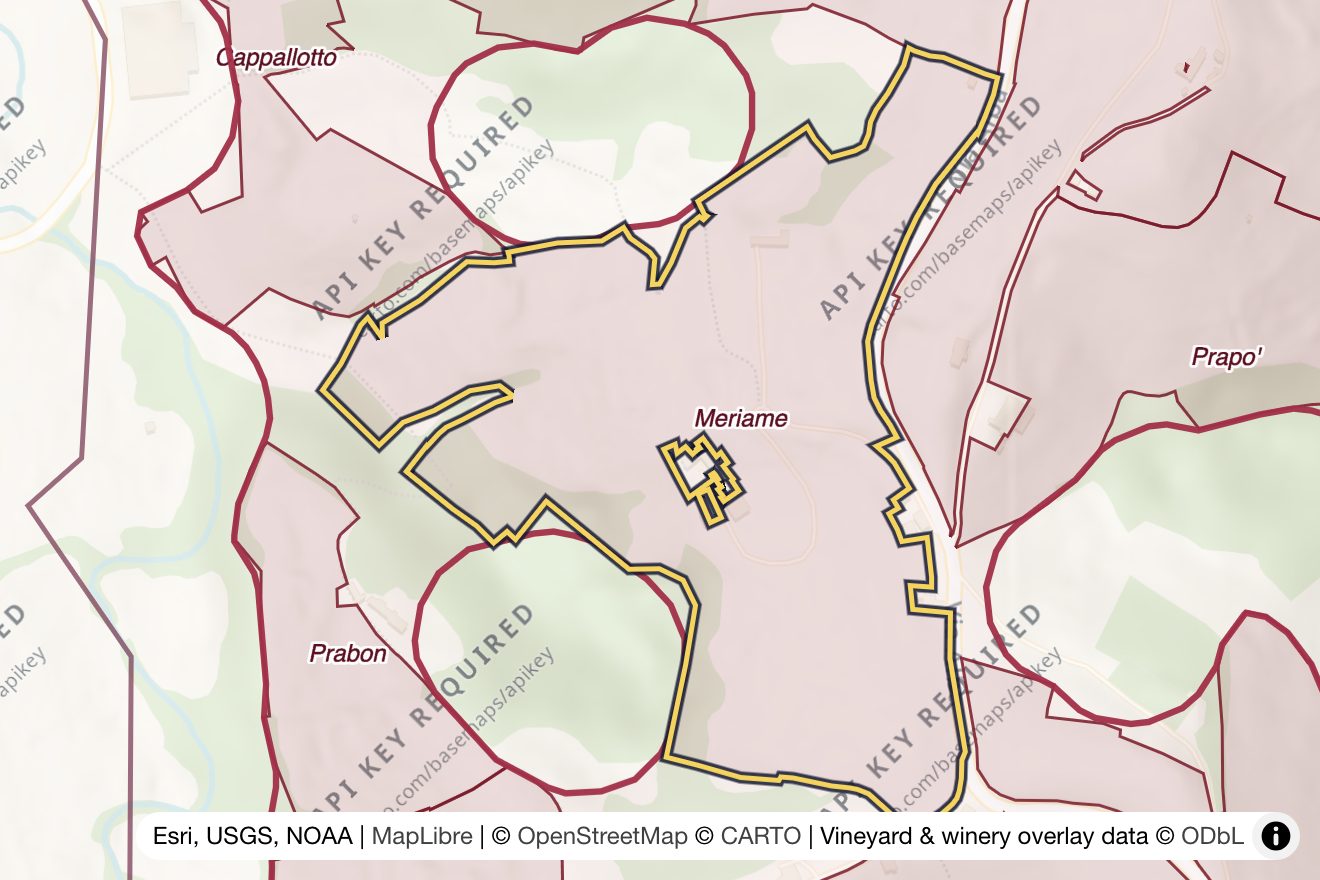
The delimited elevation runs from roughly 230 metres at the lower edge to 370 metres at the top. The bowl form is what growers and reference entries both reach for, and it explains why the aspect is not fixed across so small a site. Enrico Serafino gives its parcel as west-facing. Luigi Vico's Meriame fruit likewise comes from a west-facing site. Paolo Manzone describes the amphitheatre as facing south and south-west, which is also how the mention is summarised as a whole. The spread runs roughly from due west to south-southwest, wider than a single hillside face would give.
The orientation matters more than the numbers. Meriame looks west, across the Talloria valley toward Castiglione Falletto, rather than holding the full-day southern exposure of Serralunga's marquee parcels further south. It faces Castiglione Falletto; it does not border it.
One caution on figures. The Sukula estate's holding is reported at around 400 metres, above the top of the delimited range. Where a producer's self-reported altitude sits outside the mention's published band, the delimitation is the better guide.
Geology
Serralunga's substrate is the Formazione di Lequio, Serravallian material of roughly 13 million years, built from alternating bands of clay-rich marl and compacted sand with a high limestone fraction. Soil accounts published for Meriame cover a narrow band of much the same material: clays with a heavy carbonate load, limestone, and marls running from clay-rich to sandy. Sukula reports sandstone with clay; Enrico Serafino says simply clay.
Northern Serralunga is also where that Serravallian material meets the younger Sant'Agata Fossili marls. Baudana, the hamlet on Meriame's northern side, is routinely described as carrying both formations rather than Lequio alone, and reference descriptions of Meriame's own soils name Sant'Agata material as well as Lequio. The site sits on that transitional ground.
The Wines
Enrico Serafino frames its Meriame around perfume and cut rather than weight. The estate's own note swings between floral and red-berry aromatics on one side and liquorice, spice and tobacco on the other, the whole of it set on a firm, energetic tannin frame that carries well past the swallow. Paolo Manzone's is the bottling most closely identified with the site, and reviewers reach consistently for its concentration: dark peppery spice over ripe fruit, a mid-palate with real breadth to it, and length on the close. Brandini takes a different route in the cellar, fermenting with the stems left on for nine bunches in ten and holding the wine two years in large wood; production stops at a thousand bottles.
Producers and History
Meriame takes its name from a farmstead, and the estate that carries the reputation carries the name too. Paolo Manzone founded Cascina Meriame in 1999 with Luisella, whose family had held the house and the vineyards for generations, and he put the cru name on the label from the start, a decade before the 2010 delimitation made it official. The estate farms around 14 hectares in total, across Dolcetto, Barbera, Nebbiolo and Barolo, so the holding is not confined to the mention. The Riserva comes from the oldest plantings, past 65 years of age, and is raised for three years in large casks followed by two years in amphorae; it is roughly 80 percent Meriame fruit, the remainder from elsewhere in Serralunga.
Other holders are small. Luigi Vico's family has held its parcel since 1920, when the plot was still worked for fruit rather than wine; trees survive at the row ends, kept for biodiversity and as a marker of what the ground used to be. The family's Barolo del Comune di Serralunga d'Alba comes entirely from Meriame, a single-vineyard wine in all but name, though the holdings also take in Prapò and Prato Done. Sukula arrived in 2006, when a Finnish couple bought a small vineyard here; the property still runs to a shade under two hectares, half a hectare of it Barbera and the balance Nebbiolo, farmed organically. Enrico Serafino's parcel is 0.24 hectares, planted in 1980. Villadoria and Boasso Franco both label the mention as a named cru, as do Casa E. di Mirafiore and, from a base in La Morra rather than Serralunga, Agricola Brandini.