Position
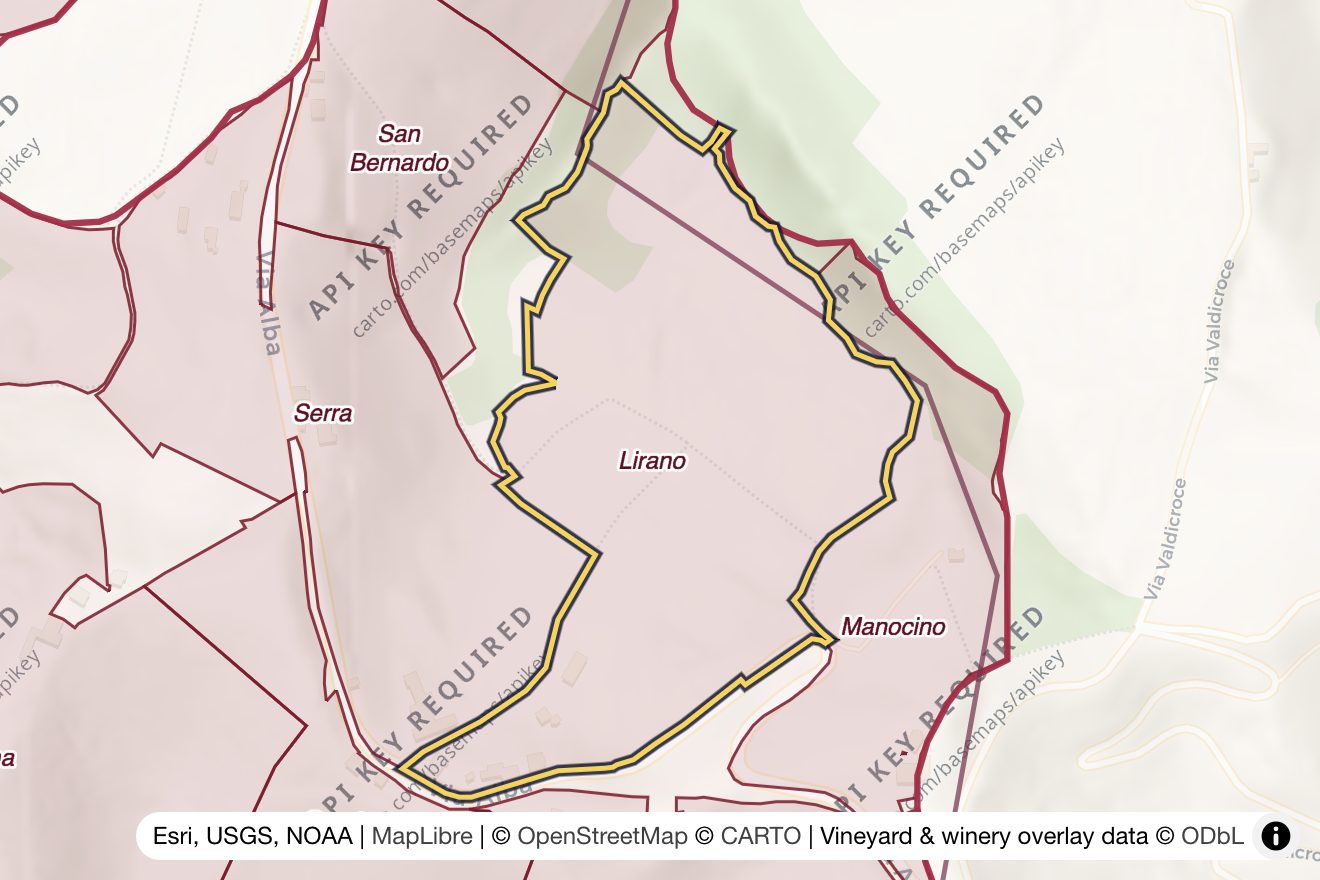
The hill called Lirano is larger than the MGA called Lirano, and the two sit on opposite sides of a commune line. Rivetto, whose estate stands on that hill, draws the distinction directly: on paper the place answers to Sinio, while everything about its landform ties it to the Serralunga range. Sinio lies outside the Barolo DOCG, so the delimitation stops where the Serralunga side stops. The name is the same on both sides of the boundary; the appellation is not.
Published cartography does not assign Lirano a sector within Serralunga, and it does not list the MGA's borders. The one adjacency stated in print comes from Mauro Veglio, who farms a parcel that, in the estate's own words, extends between the Manocino and Lirano MGAs; merchant descriptions of that wine place Lirano immediately north of Manocino. Manocino is therefore the only neighbour that can be sourced, and the direction is north, not south-east. Nothing in the published record supports placing Lirano against Falletto, Ornato, Serra, San Bernardo or Colombaro, and no reliable elevation range, gradient or aspect for the delimitation has been published.
Altitudes reported by the growers cluster between roughly 300 and 400 metres. Rivetto places its Lirano fruit at 350 to 400 metres and reads the local climate as a hybrid of Alta and Bassa Langa: temperatures on the mild side, air that keeps moving, and light in quantity. The last of those matters, because it cuts against any reading of Lirano as a shaded or north-turned site.
Soils
Both estates that describe the ground describe the same thing. Rivetto names the Formazione di Lequio, grey marl and yellow sand stacked in alternating bands; what weathers out of it is mostly silt, though enough sand and clay remains to hold rainwater down at depth. Mauro Veglio's account of its Manocino-Lirano parcel puts limestone and grey marl in the majority, broken up by sandier bands running through them. The Lequio formation underlies much of Serralunga and is the usual explanation for the commune's structure and longevity; what the two accounts add for Lirano specifically is the weight of the sandy fraction.
What Lirano Gives
The clearest statement of the site's character comes from how it is used rather than from how it is described. Ferdinando Principiano builds a Barolo del Comune di Serralunga d'Alba from roughly 80 percent Boscareto and 20 percent Lirano, and the estate's own account of the blend divides the roles between them: the limestone under Boscareto is what accounts for depth and mineral cast, while the sandier Lirano fruit lightens the wine and refines it. That is a producer defining a site by its function within a blend, and it is consistent with the sandy Lequio profile the growers report.
The market position follows. Lirano reaches the bottle chiefly inside commune-level Barolo rather than under its own name, which for a site of this size and profile is an ordinary use rather than a judgement against it.
Who Works It
Rivetto is the estate most identified with the hill, a family wine business since 1902, farming there from the Sinio side, working biodynamically, and bottling a Vigna Lirano from vines at 350 to 400 metres, fermented and aged in terracotta amphorae. The wine is labelled Nebbiolo d'Alba DOC, not Barolo and not Langhe Nebbiolo, which places that fruit outside the Barolo delimitation even though the toponym is shared.
Mauro Veglio, a La Morra house, farms a parcel planted in the early 1970s extending between Manocino and Lirano and bottles it as Barolo del Comune di Serralunga d'Alba. Giovanni Rosso lists Lirano among its Serralunga holdings alongside Vignarionda, Cerretta, Serra, Meriame, Costabella, Sorano and Damiano. Ferdinando Principiano draws on it for the Serralunga commune blend.