Introduction
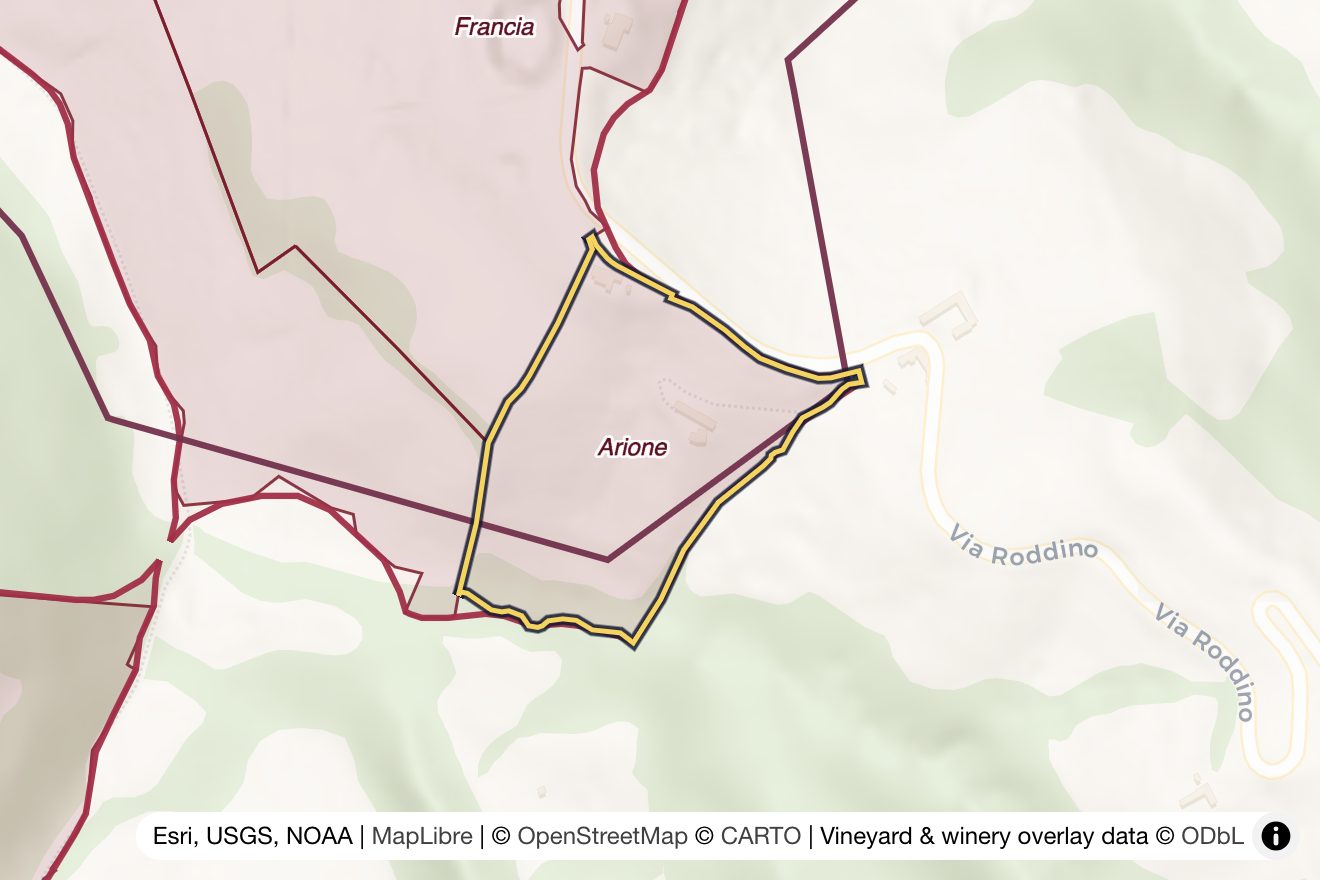
The recognition of Arione among the elite crus of Serralunga d'Alba places it in distinguished company. Expert consensus, while never absolute in matters of Barolo's hierarchy, groups Arione with Francia, Lazzarito, Ceretta, and Vignarionda as the commune's most celebrated sites. This recognition spans both the written tradition of Barolo scholarship (from 19th-century agronomist Lorenzo Fantini through modern cartographers like Alessandro Masnaghetti) and the oral tradition of the zone itself, historically reflected in the premium prices négociants paid for fruit from privileged positions.
Serralunga d'Alba: Context and Character
To understand Arione is to understand Serralunga d'Alba, for this commune produces wines of such distinctive character that they have long been recognized as occupying one pole of Barolo's stylistic spectrum. Serralunga sits on the eastern side of the Barolo production zone, its vineyards benefiting from excellent sun exposure and a terroir foundation that shapes wines of formidable structure and longevity.
The geological substrate of Serralunga d'Alba differs from the Tortonian formations that dominate La Morra and much of Barolo proper. Here, Helvetian (Serravallian) soils (older, more compact, with higher proportions of sandstone relative to calcareous marl) create wines of prodigious tannic strength and mineral tension. These are not the perfumed, immediately seductive Barolos of Brunate or Cerequio, but rather wines built for the long term, requiring years (sometimes decades) to fully reveal their complexity.
The topography of Serralunga features some of the highest elevations in the Barolo zone, with vineyards extending well above 400 meters. The amphitheater of hills surrounding the medieval tower that dominates the commune's skyline creates a complex patchwork of exposures and mesoclimates, allowing for subtle but significant variation between sites. The diurnal temperature variation in these elevated sites contributes to the development of intense aromatics while preserving the natural acidity essential to age-worthy Nebbiolo.
The MGA System and Arione's Official Recognition
The introduction of the Menzione Geografica Aggiuntiva system represented a significant evolution in Barolo's regulatory framework. For decades, the proliferation of single-vineyard bottlings in the absence of official classification had the paradoxical effect of reinforcing attention on individual producers rather than on the vineyard sites themselves. The MGA list formally identifies and delimits single vineyards throughout the Barolo zone, conferring official "cru" status without imposing a hierarchical classification.
Arione's inclusion in this official register confirms what experienced Barolo producers and collectors have long understood: this is a site capable of yielding distinctive wines of serious quality. The MGA designation requires that wines carrying the vineyard name be produced entirely from grapes grown within the delimited boundaries of that specific site, bringing transparency and geographical precision to Barolo labeling. This system, while stopping short of the formal classification that some have advocated, provides consumers with reliable information about vineyard origin and begins to build a framework for understanding Barolo's complex mosaic of terroirs.
Wine Character and Style
Wines from Arione express the fundamental character of Serralunga d'Alba while presumably offering their own site-specific inflections. Serralunga Barolos are traditionally characterized by their imposing tannic architecture, a structural intensity that can seem almost austere in youth but which provides the foundation for extraordinary aging potential. The sandstone-rich soils contribute to wines of notable grip and mineral drive, while the elevation and exposure support the development of complex aromatic profiles.
In the glass, one expects from Serralunga sites like Arione a color of considerable depth and opacity, particularly in the wine's youth. The aromatic profile typically emphasizes darker fruits (black cherry, blackberry, plum) rather than the red fruit spectrum more common in La Morra. Floral notes of rose and violet interweave with tar, licorice, tobacco, and underbrush, the classic "tar and roses" combination for which Nebbiolo is celebrated, expressed here with particular intensity and complexity.
On the palate, structure defines the experience. The tannins in young Barolo from Serralunga can be formidable, requiring either extended cellaring or pairing with substantial cuisine to integrate fully. Yet this is not harshness but rather nobility: the tannic framework that will carry these wines through decades of evolution. Acidity remains vibrant, the mineral tension cutting through the wine's considerable depth and contributing to a finish that can seem to extend indefinitely.
The aging trajectory of wines from sites like Arione differs markedly from their counterparts on the western side of the zone. Where wines from Tortonian soils in La Morra might begin to drink beautifully at seven to ten years of age, Serralunga Barolos often demand at least a decade before beginning to reveal their full complexity, and the finest examples can continue to evolve for thirty years or more. This is Barolo in its most architectural form, wine as monument rather than immediate pleasure.
Arione in the Hierarchy of Barolo
The consistent recognition of Arione among Serralunga's premier sites speaks to a quality threshold that has been maintained over time. In a zone where reputations are built slowly and jealously guarded, inclusion in the informal hierarchy of "finest crus" represents the accumulated judgment of generations of producers, négociants, and observers who have tracked the performance of individual sites across countless vintages.
It is worth noting that Barolo's traditional five-commune core (La Morra, Barolo, Castiglione Falletto, Serralunga d'Alba, and Monforte d'Alba) each contributes distinctive styles to the denomination's overall identity. Within Serralunga, the recognition of multiple elite sites including Arione reflects both the commune's overall quality and the meaningful variation that exists even within a single village's boundaries. The interplay of elevation, exposure, soil composition, and human intervention creates distinct personalities among vineyards that may be separated by mere hundreds of meters.
The absence of a formal classification system in Barolo (unlike the structured hierarchies of Burgundy or Bordeaux) means that reputation rests primarily on demonstrated quality over time and on the consensus of those who know the region most intimately. Arione's standing derives not from official decree but from its consistent ability to produce Nebbiolo of distinction, a reputation built bottle by bottle, vintage by vintage.
Conclusion
Arione represents Serralunga d'Alba's capacity to produce Barolo of power, structure, and profound aging potential. While it may not carry the international cachet of a Cannubi or Brunate, its recognition among the commune's finest sites reflects a quality threshold that serious students of Barolo understand and respect. In an era when the MGA system is beginning to bring greater precision and transparency to Barolo's complex vineyard landscape, Arione stands as an officially recognized cru worthy of attention from collectors and enthusiasts seeking wines that exemplify Nebbiolo's most architectural expression. These are wines that reward patience, built not for immediate gratification but for the long contemplation of terroir translated into liquid form.