Introduction
While the research data on the finest Barolo crus focuses primarily on Bussia and Ginestra as Monforte's flagship sites, Ravera di Monforte has emerged over the past three decades as a cru of comparable stature, particularly among producers and critics who value elegance and aromatic complexity over sheer power. The introduction of the MGA system has provided official recognition to sites like Ravera, helping to clarify boundaries and establish these vineyards as identified 'crus' within the Barolo zone, even if they remain unclassified in any formal hierarchy.
Terroir
The terroir of Ravera di Monforte reflects the geological character typical of the eastern Barolo communes. As documented in the research data, Monforte d'Alba sits on soils from the Helvetian epoch, characterized by a higher proportion of compressed sandstone compared to the Tortonian calcareous marls that dominate La Morra and Barolo to the west. These Helvetian soils are less fertile and promote moderate vine vigor, encouraging the development of concentrated, structured wines with pronounced tannic backbone.
More specifically, Ravera's soils show a complex stratification of Sant'Agata Fossil Marl with layers of blue-gray calcareous clay and thin veins of sandstone. This particular composition differs from the heavier sandstone concentrations found in Serralunga d'Alba's sites like Francia or Lazzarito, positioning Ravera somewhere between the elegance of La Morra's sites and the power of Serralunga. The calcareous component in Ravera's soils contributes to the wines' aromatic lift and fine-grained tannins, while the clay provides structure and the capacity for long aging.
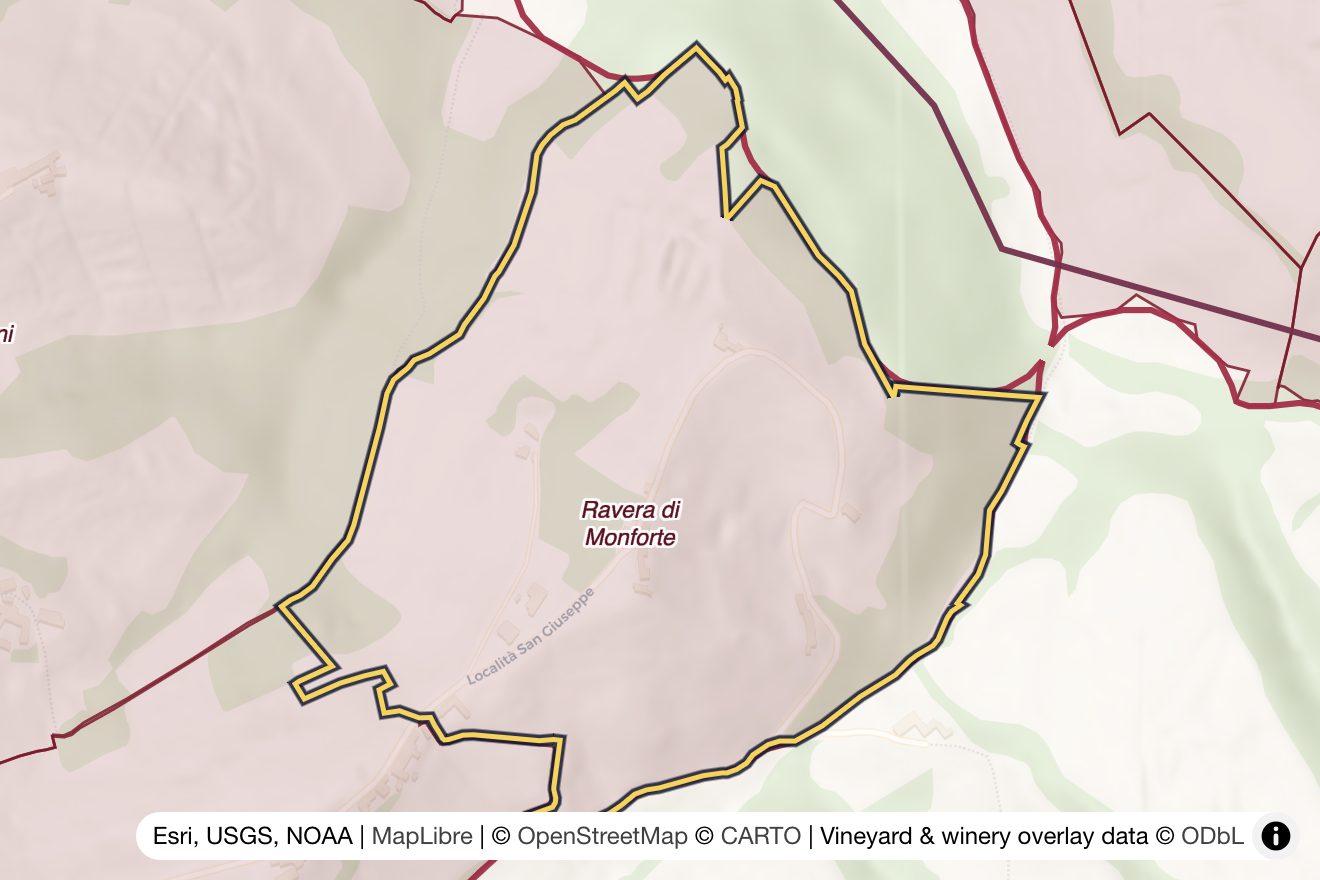
The aspect of Ravera di Monforte is predominantly southwest-facing, providing excellent sun exposure throughout the growing season. This orientation proves crucial in cooler vintages, as the hillside captures afternoon warmth that facilitates complete phenolic ripening of Nebbiolo, a variety that demands a long growing season and substantial heat accumulation. The elevation range creates notable mesoclimates within the MGA itself: the higher sections experience greater diurnal temperature variation, preserving acidity and aromatic freshness, while the mid-slope sections represent the sweet spot where ripeness and elegance achieve optimal balance.
The physical characteristics of Ravera's soils align with the findings of researchers like Professor Gérard Seguin, whose work demonstrated that moderate fertility and well-regulated water supply (rather than specific chemical composition) are the key soil attributes influencing wine quality. Ravera's compact soils drain efficiently, subjecting vines to controlled water stress during the growing season. This stress, particularly during véraison and ripening, encourages the vine to concentrate its resources into the fruit, developing the phenolic complexity and structural intensity that defines serious Barolo.
Wine Characteristics
Wines from Ravera di Monforte occupy a distinctive position in the spectrum of Barolo expressions, offering a synthesis of power and refinement that distinguishes them from other Monforte sites. While Bussia is often characterized by robust structure and Ginestra by muscular intensity, Ravera produces wines that emphasize aromatic complexity, textural elegance, and what might be described as "vertical" rather than "horizontal" architecture (meaning the tannins and acidity create lift and tension rather than broad amplitude on the palate.
The aromatic profile of Ravera typically centers on red fruits) specifically cherry, raspberry, and red currant (rather than the darker fruit spectrum associated with sites like Bussia or Serralunga's Francia. These red fruit notes are complemented by pronounced floral characteristics: rose petal, violet, and dried flowers are hallmarks of well-made Ravera. With bottle age, the wines develop tertiary complexity including tar, tobacco leaf, leather, white truffle, and dried herbs) particularly sage and mint (along with subtle spice notes of cinnamon, anise, and white pepper.
On the palate, Ravera demonstrates the tension between elegance and structure that defines Barolo's finest expressions. The tannins are typically fine-grained and tightly woven rather than broad or rustic, creating a textural impression of silk stretched taut rather than velvet draped loosely. This tannic profile reflects both the calcareous component in the soils and, crucially, the site's capacity to achieve complete phenolic ripeness, allowing producers to extract refined tannins without extracting harsh or green phenolics.
Acidity in Ravera wines tends toward the bright rather than aggressive, providing freshness and ensuring remarkable aging potential. The wines typically show medium to full body rather than the formidable weight of sites like Monprivato in Castiglione Falletto or the aforementioned Francia. This relative restraint) restraint being a relative term in Barolo (contributes to Ravera's accessibility in youth compared to the most austere sites, though the wines still demand patience.
In terms of aging potential, well-made examples from strong vintages can evolve gracefully for 20 to 30 years or more. The combination of structural elements) tannin, acidity, concentration (ensures longevity, while the aromatic complexity and textural refinement reward extended cellaring. Ravera tends to enter an approachable phase slightly earlier than the most structured sites, typically showing well after 8 to 12 years, though this varies significantly by vintage and producer philosophy.
Compared to other Monforte MGAs, Ravera offers greater aromatic expression than Bussia, which tends toward austerity in youth, and more immediate appeal than Ginestra, which can require decades to integrate its formidable tannins. The site shares certain characteristics with Perno) another Monforte cru (particularly the balance between fruit purity and structural elements, though Perno's recent controversial enlargement makes generalizations increasingly difficult.
Producers & Wines
Several distinguished producers farm parcels in Ravera di Monforte, each bringing their interpretive vision to the site while remaining faithful to its fundamental character. The quality benchmarks for the MGA have been established by producers who combine traditional Barolo values) extended maceration, aging in large Slavonian oak botti (with contemporary precision in viticulture and cellar hygiene.
Ferdinando Principiano produces a Barolo Ravera di Monforte.
Other notable producers working in Ravera include Rocca Giovanni, which bottles a Barolo Ravera di Monforte, and E. Pira (Chiara Boschis), which uses its Ravera di Monforte fruit in the Barolo Via Nuova. Each producer's bottling offers a slightly different perspective on the MGA, reflecting differences in parcel location, vine age, and winemaking philosophy, yet all share the fundamental Ravera characteristics of aromatic complexity, refined tannins, and vertical structure.
The quality benchmarks for Ravera di Monforte include complete phenolic ripeness without over-ripeness, aromatics that emphasize red fruits and flowers rather than darker or cooked fruit notes, tannins that provide structure without astringency, and length of finish that extends for 30 seconds or more. The best examples show transparency to vintage character while maintaining site identity, developing gracefully in bottle over decades while remaining recognizable as Ravera.
Historical Context & Recognition
The historical trajectory of Ravera di Monforte reflects the broader evolution of Barolo from a relatively undifferentiated wine to a appellation defined by distinct crus and producer identities. While sites like Cannubi in Barolo and Rocche di Castiglione have longer documented histories, Ravera's reputation has been built primarily in the modern era, particularly following the quality revolution of the 1980s and 1990s.
The multiplication of single-vineyard bottlings from the 1980s onward, as noted in the research data, had "the paradoxical result of focusing attention on and reinforcing confidence in single producers" rather than established vineyard hierarchies. Ravera benefited from this trend, as quality-focused producers began bottling the site separately and demonstrating its distinctive character across multiple vintages. This producer-driven recognition preceded) and ultimately contributed to (the site's official recognition within the MGA system.
The introduction of the MGA system provided formal acknowledgment of Ravera's status as an identified cru, even if the sites remain unclassified in any official quality hierarchy. This official recognition has helped clarify boundaries and reduce confusion in the marketplace, though the existence of Ravera di Novello as a separate MGA continues to require careful attention from consumers and critics. The two Raveras produce distinctly different wines, with Ravera di Novello generally showing softer tannins and earlier approachability, while Ravera di Monforte offers greater structure and aging potential.
Critical recognition for Ravera di Monforte has grown steadily over the past two decades, with the site increasingly appearing on shortlists of Barolo's finest crus alongside the historically dominant sites. While it may not yet command the prices or universal acclaim of Cannubi or Brunate, informed critics and collectors recognize Ravera as a site capable of producing profound, age-worthy wines that express both site character and vintage variation with clarity and distinction.
The evolution of Ravera also reflects broader changes in Barolo production philosophy. The site has benefited from improved viticulture) including better clonal selection, reduced yields, and more precise harvest timing, as well as cleaner winemaking that allows terroir expression to emerge with greater transparency. Producers working in Ravera have generally avoided the extremes of either ultra-traditional or modernist winemaking, instead pursuing a middle path that respects Barolo's aging requirements (38 months total, with at least 18 months in oak, as mandated by the DOCG regulations) while embracing contemporary understanding of extraction, élevage, and hygiene.
Conclusion
Ravera di Monforte stands as one of Monforte d'Alba's most distinguished MGAs, producing wines that synthesize power and elegance in a manner that distinguishes them from both the softer, earlier-maturing wines of western Barolo and the more austere, structured expressions of sites like Francia in Serralunga. The site's complex soils (Sant'Agata Fossil Marl with calcareous clay and sandstone) combined with its southwest aspect and elevation range create conditions that allow Nebbiolo to achieve complete ripeness while maintaining the acidity and tannic refinement essential to profound Barolo.
The wines of Ravera emphasize aromatic complexity, particularly red fruits and flowers, with fine-grained tannins that provide structure without weight. While demanding patience, they tend toward accessibility slightly earlier than the most powerful sites, entering a rewarding phase after 8 to 12 years while possessing the structural elements to evolve gracefully for decades. The site's character places it among Barolo's elite crus, recognized increasingly by critics, collectors, and, most importantly, by the producers who farm its slopes with dedication and skill.
For those seeking to understand Barolo's diversity and the ways in which terroir shapes Nebbiolo's expression, Ravera di Monforte offers an essential reference point: a site where Monforte's characteristic structure meets unexpected elegance, where power serves refinement rather than overwhelming it, and where patience is rewarded with wines of profound complexity and enduring appeal.