Introduction
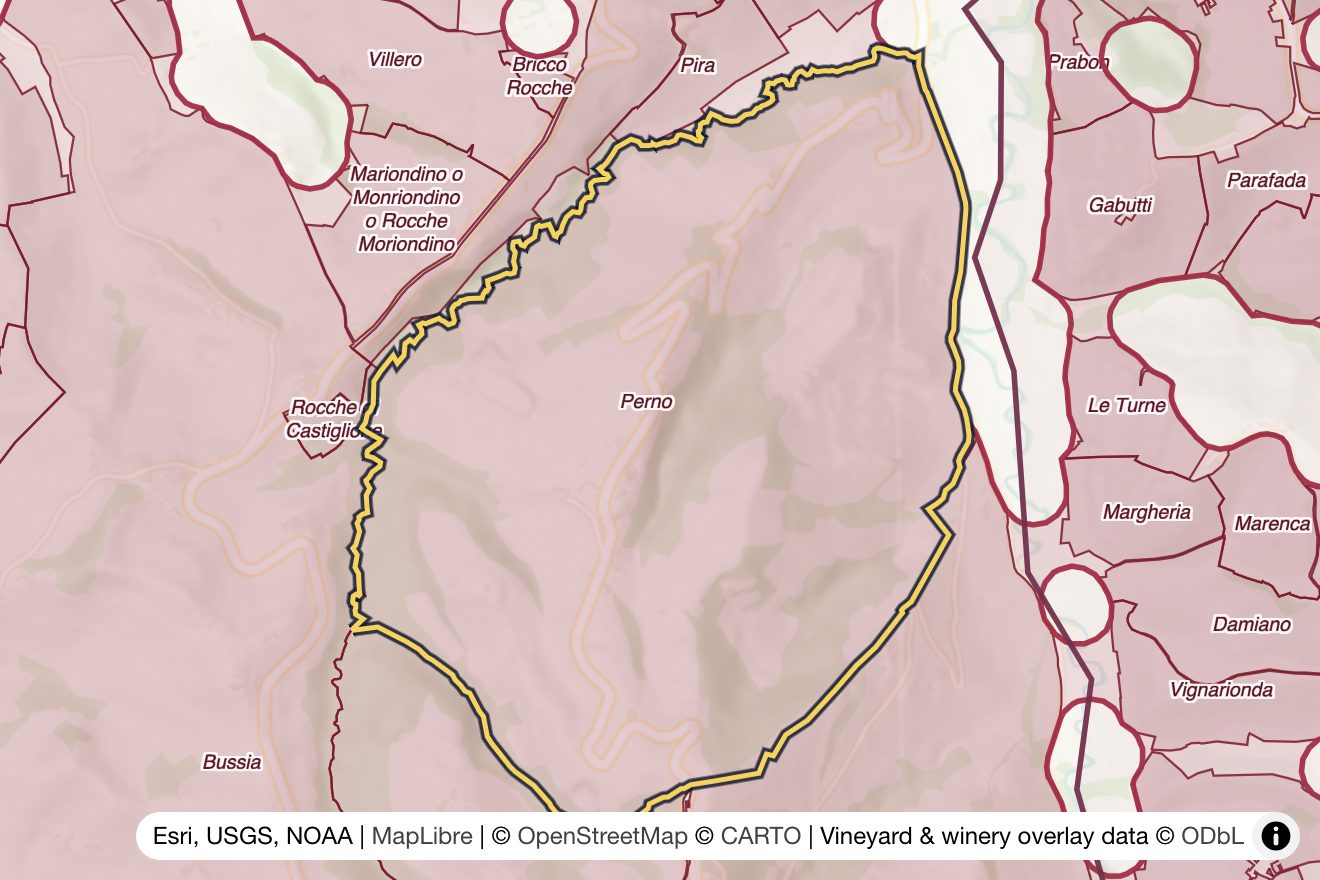
The Perno MGA represents one of the more controversial outcomes of Barolo's official Menzione Geografica Aggiuntiva (MGA) designation system. Located in the commune of Monforte d'Alba, in the southeastern quadrant of the Barolo production zone, Perno has become a lightning rod for debates about the proper delineation of Barolo's historic vineyard sites. The source of this controversy is straightforward: the official Perno MGA boundaries have been, in the assessment of serious observers, drawn very large, covering the whole Perno frazione (it is the third largest MGA in Barolo) and including the Santo Stefano di Perno sub-zone (a vineyard that long enjoyed independent recognition among the finest crus of Monforte d'Alba.
This enlargement matters because Santo Stefano di Perno historically stood alongside Bussia and Ginestra on most shortlists of Monforte's elite sites. By folding this distinguished vineyard into a larger Perno designation, the MGA system has arguably obscured rather than clarified the hierarchy of quality that generations of growers, négociants, and consumers had come to understand through both oral tradition and the written record. For anyone seeking to understand wines labeled as Perno today, this historical context is essential.
Geographic Context and Terroir
Monforte d'Alba occupies a privileged position within the Barolo landscape, situated on the eastern side of the Alba-Barolo road that runs through the valley floor and serves as a rough dividing line between the denomination's two primary soil types. This geographic distinction has profound implications for wine style and character.
The vineyards of Monforte, including those within the Perno MGA, are characterized by soils of the Helvetian epoch, distinguished by a higher proportion of compressed sandstone (known locally as arenarie) compared to the Tortonian calcareous marls that dominate La Morra and Barolo to the west. These Helvetian soils tend to be less fertile and yield wines of notable structure, power, and longevity. The sandstone content contributes to excellent drainage while the soils' lower fertility naturally limits vine vigor, concentrating the plant's energy into smaller crops of more intensely flavored fruit.
The elevation and aspect within the Perno zone vary considerably, which is partly why the enlarged MGA designation proves problematic) it encompasses diverse mesoclimates and exposures that don't necessarily share the same quality potential or stylistic signature. The historic Santo Stefano di Perno occupied a more precisely defined area with particularly favorable conditions, which helps explain its elevation to elite status in pre-MGA discourse.
Monforte's continental climate, moderated somewhat by altitude and the distant influence of the Mediterranean, provides the long, often luminous autumns that Nebbiolo requires to achieve full phenolic ripeness. The combination of these climatic conditions with the structural soils of the Helvetian formation creates an environment that consistently produces Barolos of notable power and aging potential.
Wine Characteristics
Barolos from Monforte d'Alba, including those designated as Perno, typically express the structural signatures associated with the commune's Helvetian soils. These are wines built for the long term, with pronounced tannic frameworks, notable extract, and the muscularity that distinguishes eastern Barolo from the generally softer, more immediately approachable wines of La Morra.
The sandstone influence in Monforte soils tends to produce wines with particular aromatic intensity (often showing dark fruit characteristics (black cherry, plum), tar, tobacco, leather, and the complex spectrum of tertiary aromas that emerge with extended aging. The tannins in Monforte Barolos are typically firm and fine-grained rather than rustic, providing structure without harshness when the wines are properly made and given adequate time to evolve.
What distinguishes the historic Santo Stefano di Perno specifically) now subsumed within the larger Perno designation (was its reputation for combining Monforte's characteristic power with particular elegance and aromatic complexity. This nuance is worth noting because bottles labeled "Perno" today may come from the historic Santo Stefano parcels or from other sections of the enlarged MGA that lack the same pedigree.
The aging potential of Monforte Barolos is considerable, often requiring a decade or more to begin showing their full complexity and another decade to reach their peak. The combination of natural acidity, tannic structure, and concentrated fruit allows these wines to develop the haunting complexity) dried flowers, truffle, forest floor, aged tobacco (that defines great Nebbiolo at maturity.
The MGA System and Its Discontents
Understanding the Perno MGA requires grappling with the broader context of Barolo's attempt to formalize its vineyard hierarchy. The introduction of the MGA system was meant to address the paradoxical situation that had developed since the 1980s, when the proliferation of single-vineyard bottlings, in the absence of official classification, had focused attention on individual producers rather than specific sites. The MGAs were intended to identify official crus throughout the Barolo zone, though notably they remain unclassified) merely identified rather than ranked.
The enlargement of Perno to incorporate Santo Stefano represents precisely the kind of political compromise that undermines the utility of such a system. For generations, Santo Stefano di Perno commanded recognition and premium prices as a distinct site.
This dynamic is not unique to Perno (similar controversies have emerged around other MGAs where boundaries have been drawn more generously than historical usage and quality considerations would suggest. The result is that consumers and professionals must look beyond the MGA designation itself, focusing on specific producers, specific parcels within the larger MGA, and the historical reputation of sites that may now be absorbed into broader designations.
Navigating Perno Today
For those seeking to understand and evaluate Barolos labeled as Perno, several strategies prove useful. First, investigate whether the producer's holdings fall within what was historically recognized as Santo Stefano di Perno or in other sections of the enlarged MGA. Many serious producers will specify this distinction in their communications even if not on the label itself.
Second, recognize that the producer's identity and approach matter at least as much as the site designation. The MGA system, for all its intentions, has not replaced the importance of individual producer reputation in Barolo. A skilled, quality-focused grower can produce compelling wine even from less distinguished parcels within an MGA, while indifferent viticulture and winemaking can squander the potential of even the finest sites.
Third, consider the wine's price positioning and critical reception as signals about its likely provenance within the MGA. Wines from the historic Santo Stefano parcels typically command higher prices and receive greater critical attention than those from peripheral sections of the expanded Perno designation.
Conclusion
The Perno MGA embodies both the promise and the problems of Barolo's attempt to formalize its vineyard geography. The incorporation of the historically distinguished Santo Stefano di Perno into a larger, more diffuse designation serves as a cautionary tale about the political pressures that can compromise the integrity of appellations systems. For consumers and professionals, this means that the MGA designation, while useful, cannot be taken as definitive without understanding the historical context and internal variations that labels may obscure.
What remains constant is that the finest parcels within what is now called Perno) particularly those of the historic Santo Stefano (continue to produce Barolos of genuine distinction, expressing Monforte's characteristic power and structure with particular refinement. These are wines that reward patience, revealing their complexity only after years in the bottle, and offering compelling evidence of Nebbiolo's capacity for greatness when planted in propitious sites and handled with skill.
The story of Perno ultimately reinforces a fundamental truth about Barolo: official designations matter, but they matter less than the combination of site, grower, and vintage that determines what ends up in the bottle. In a region where terroir differences are real and significant, but where human choices) from vineyard management through vinification and aging, profoundly shape the final wine, the label is a starting point for investigation, not a conclusion.