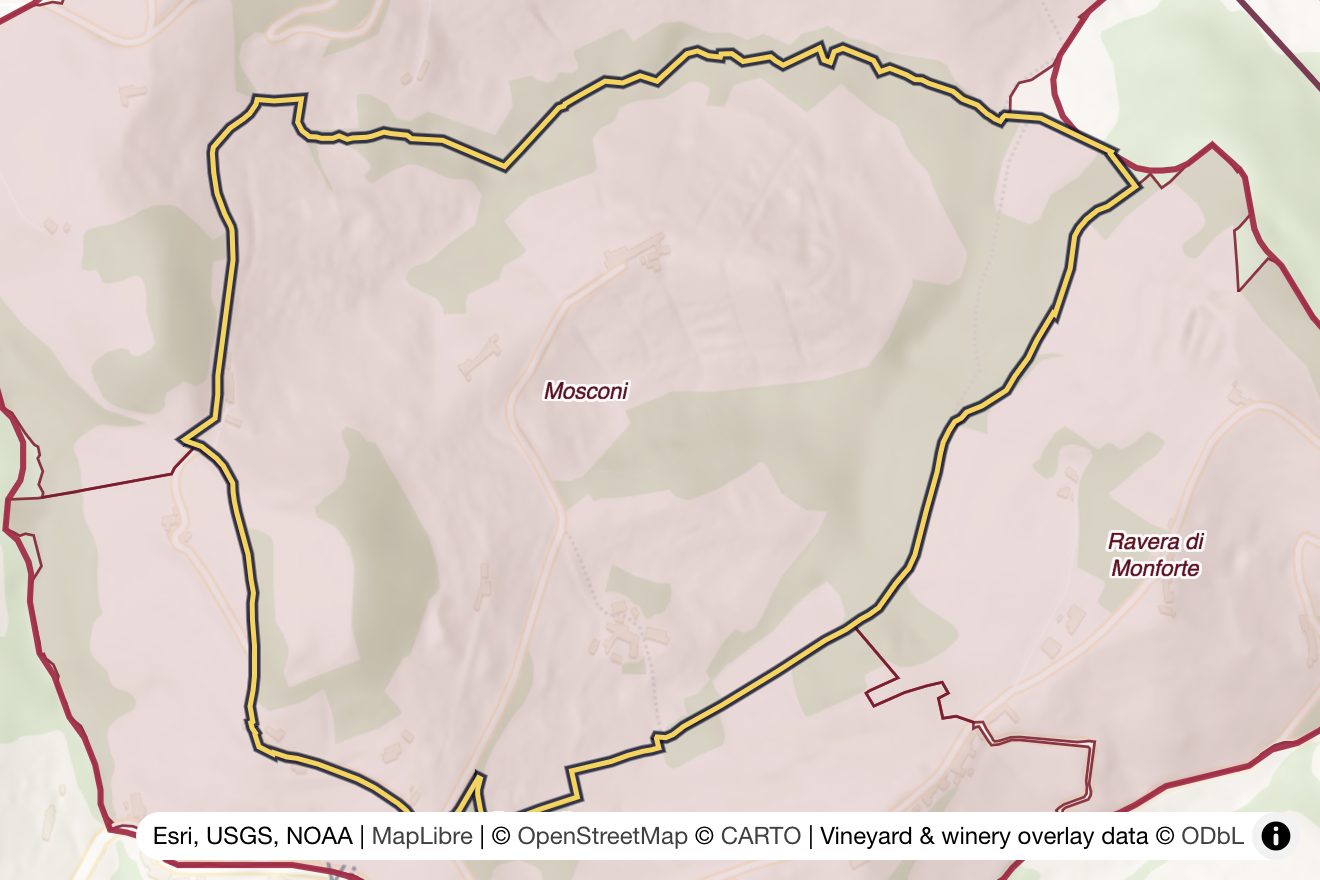
Introduction
The MGA system, introduced to bring order to the proliferation of single-vineyard bottlings that emerged from the 1980s onward, does not classify sites hierarchically but rather officially recognizes them as distinct geographical entities. Mosconi, like all registered MGAs, must adhere to Barolo's stringent production regulations: maximum yields of 56 hl/ha and a minimum aging requirement of 38 months, with at least 18 months in wood. Within the constellation of Monforte's vineyards, Mosconi occupies a position outside the shortlist of "finest crus" that typically includes Bussia and Ginestra, yet it shares the fundamental geological and climatic characteristics that define this important township.
Terroir
Monforte d'Alba sits in the eastern portion of the Barolo zone, on the right bank of the valley floor marked by the Alba-Barolo road) a geographical division that proves critical to understanding the wines produced here. The eastern townships of Monforte d'Alba, Serralunga d'Alba, and parts of Castiglione Falletto are distinguished by their Helvetian epoch soils, which contrast markedly with the Tortonian marls that dominate La Morra and Barolo to the west.
The Helvetian soils characteristic of Monforte d'Alba contain a higher proportion of compressed sandstone compared to the calcareous marls found in the western communes. These soils are less compact and notably less fertile, creating a more challenging environment for the vine. This relative infertility proves advantageous for quality wine production, as it naturally limits vigor and concentrates the vine's energy into fewer, more intense grape clusters. The sandstone component also contributes to the particular structure and mineral backbone that defines wines from this sector of the Barolo zone.
The physical characteristics of soil (its drainage capacity, water retention, depth, and the layering of strata) prove more influential on wine quality than chemical composition, as research by Professor Gérard Seguin and subsequent scholars has demonstrated. In Monforte's case, the compressed sandstone creates soils with well-regulated water supply: sufficiently draining to avoid waterlogging, yet capable of maintaining moderate moisture during the growing season. This balanced hydric regime encourages the vine to develop deep root systems that explore the various soil horizons, accessing both water and mineral nutrients throughout the season.
The topography of Monforte d'Alba is characterized by steep, amphitheater-like hillsides with varying exposures and elevations. Mosconi is generally described as lying on largely south-facing slopes, and shares the general climatic conditions of the commune: a continental climate moderated by the Tanaro River valley, with significant diurnal temperature variation during the growing season that preserves acidity while allowing phenolic ripening in Nebbiolo.
Wine Characteristics
Wines from Monforte d'Alba, and by extension from Mosconi, express the influence of the township's Helvetian soils and continental mesoclimate in a distinctive aromatic and structural profile. The compressed sandstone soils yield more intense, structured wines that mature more slowly compared to the softer, more immediately approachable expressions typical of La Morra's Tortonian marls.
The color of Barolo from Monforte sites follows Nebbiolo's characteristic evolution: never deeply opaque (as the variety produces lighter-pigmented wines similar to Pinot Noir), ruby in youth, tending relatively quickly toward garnet and eventually brick-red hues with age. The aromatics display the complex interplay of fruit, floral, and earthy elements that define fine Barolo: fresh cherries and plums in youth, evolving with time toward dried cherries, rose petals, tar, liquorice, and other tertiary complexities.
What distinguishes Monforte expressions is their structural intensity and aging trajectory. The tannins tend to be more pronounced and robust compared to wines from the western communes, with a mineral backbone that provides both grip and longevity. These wines often require extended cellaring to integrate their components fully (the compressed sandstone soils produce grapes with greater phenolic concentration and firmer acid structures that demand patience from the collector.
The mouthfeel of Monforte Barolos typically exhibits a more austere, architectural quality compared to the floral elegance of La Morra or the balanced harmony of Castiglione Falletto. These are wines built for the long term, often showing their best after a decade or more of bottle age, when the initially formidable tannins have softened and integrated, and the complex tertiary aromatics have fully emerged.
Mosconi, while not occupying the same exalted status as Bussia or Ginestra in the historical and commercial hierarchy, would be expected to share these fundamental Monforte characteristics: intensity over immediate charm, structure over softness, and the potential for extended aging that rewards patience.
Producers and Context
The landscape of Barolo production has evolved considerably since the 1980s, when the proliferation of single-vineyard bottlings fundamentally changed how the zone was understood and marketed. Prior to this period, négociant houses dominated production, blending wines from different sites to create harmonious house Barolos that expressed general regional characteristics. While this approach could) and still does when executed skillfully (produce balanced and representative wines, it obscured the distinctive character of individual sites.
The modern era's focus on single-vineyard bottlings has had the paradoxical effect of reinforcing confidence in individual producers rather than creating a universally agreed-upon hierarchy of sites. Without an official classification system (the MGA registry identifies but does not rank sites), the reputation of a vineyard like Mosconi depends significantly on the quality and renown of the producers who work it.
The historical written tradition of Barolo, from Lorenzo Fantini in the late 19th century through Luigi Veronelli, Renato Ratti, and more recently Alessandro Masnaghetti, has consistently recognized certain privileged positions) reflected both in critical opinion and in the higher prices paid by négociants for grapes from these sites. That Mosconi does not appear in the shortlist of most celebrated crus alongside Bussia or Ginestra suggests it has had less historical renown than Monforte's best-known crus, though this should not be mistaken for a lack of quality or legitimacy.
Place in the Barolo Landscape
Understanding Mosconi requires situating it within the broader context of Monforte d'Alba and the Barolo zone's stylistic geography. Castiglione Falletto, positioned on a spur dividing the western and eastern valleys, produces wines that bridge the elegance of Barolo and La Morra with the structure of Serralunga and Monforte. Monforte itself, along with Serralunga, anchors the eastern, Helvetian soil side of this equation (wines of power, structure, and longevity.
Within Monforte, the hierarchy of recognition places Bussia and Ginestra at the apex, sites with long-established reputations and premium pricing. Santo Stefano di Perno once occupied similar status before its controversial inclusion in an unreasonably enlarged Perno MGA. Mosconi exists as part of the broader tapestry of Monforte sites that, while perhaps lacking the historical prestige or critical consensus of the most celebrated crus, nonetheless produce legitimate Barolo that expresses the township's fundamental character.
For collectors and enthusiasts, Mosconi represents an opportunity to explore Monforte's distinctive style without the premium attached to its most famous neighbors. The site's wines would be expected to reward cellaring, displaying the intensity and structure characteristic of the commune while potentially offering more accessible pricing than bottles from Bussia or Ginestra.
The MGA system's establishment has formalized what the oral tradition of the zone long recognized: that specific parcels produce distinctive wines shaped by their particular terroir. Mosconi's inclusion in this official registry confirms its status as a recognized lieu-dit within one of Barolo's most important communes, even if it has not achieved the mythical status of Monforte's) or Barolo's, most celebrated sites.