Introduction
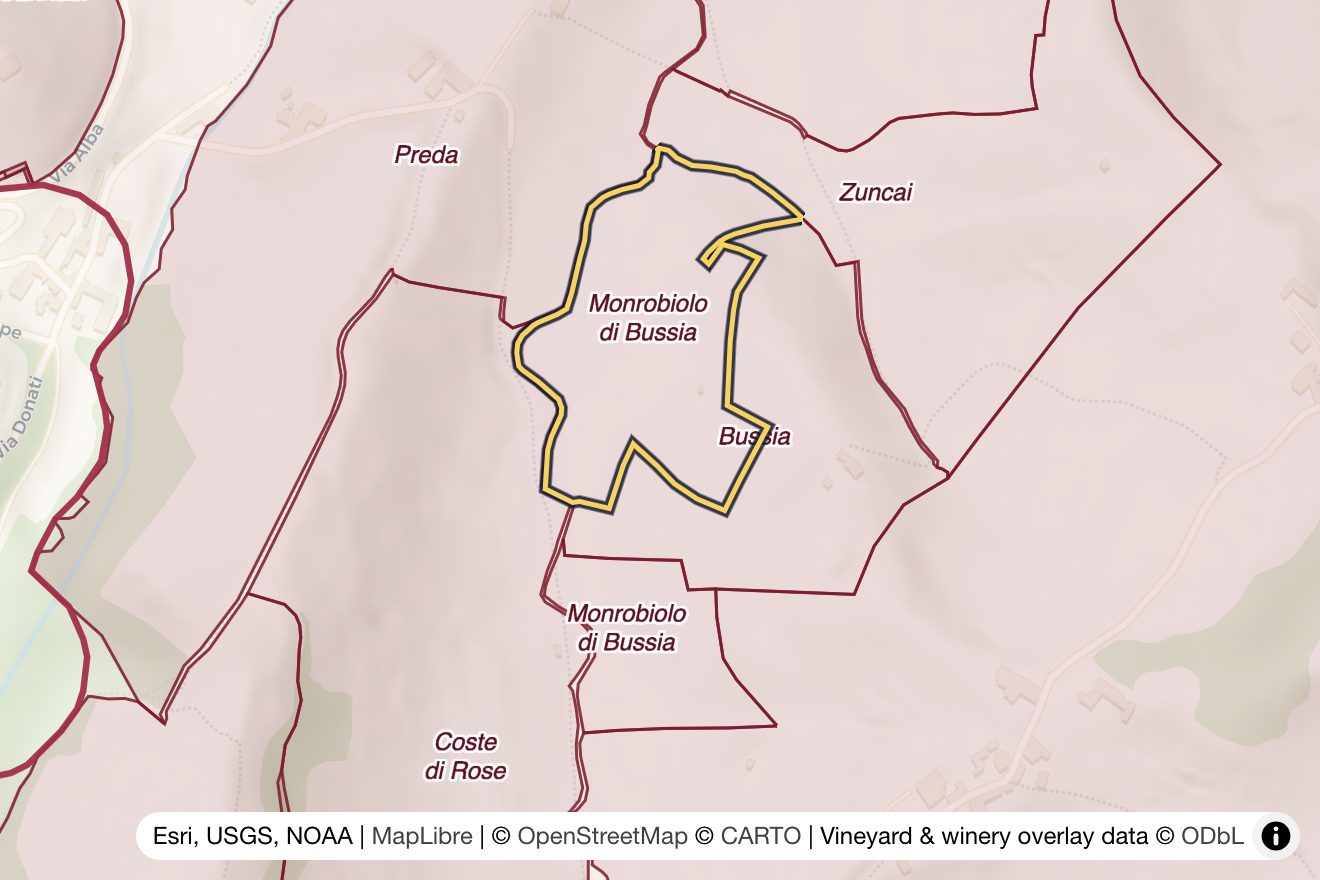
The introduction of the official MGA system in 2010 formalized what generations of growers and producers had long understood: that Bussia produces Barolo of exceptional quality and distinctive character. Monrobiolo di Bussia is an MGA of its own and appears under its own name on labels, for example Barale Fratelli's Barolo Monrobiolo di Bussia.
Geographic and Viticultural Context
Monforte d'Alba occupies a pivotal position in the Barolo landscape, both geographically and qualitatively. The commune's vineyards are characterized by complex topography, with numerous exposures and elevation gradients that create significant mesoclimatic variation within relatively compact areas. This complexity is fundamental to understanding sites like Monrobiolo and the neighbouring Bussia amphitheater.
The Bussia vineyard complex itself covers substantial terrain on the hillsides surrounding Monforte d'Alba, with various parcels offering different exposures, elevations, and subtle variations in soil composition. This internal diversity within a single MGA is precisely what has driven producers to maintain distinctions between specific parcels, even within the official designation system. The manner in which vines navigate the complex layering of soil strata in sites like these dictates the amount of water and nutrients plants can access throughout the growing season, fundamentally shaping vine behavior and grape development.
Terroir Characteristics
The terroir of Bussia reflects the geological complexity of Monforte d'Alba. The soils in this area are predominantly of the older Serravallian (Helvetian) series, including the Lequio formation of alternating marl and sandstone, which characterizes much of the commune's vineyard land. These are typically leaner and less moisture-retentive than the Tortonian Sant'Agata Fossil Marl soils found in La Morra and Barolo village, leading to wines of greater structure and longevity.
The attributes of soil can change rapidly within a vineyard, both vertically and horizontally. Despite receiving the same amount of rainfall, different parts of a vineyard may have dramatically different water access due to variations in topography and the depth and composition of the soil profile. This variability is particularly pronounced in Bussia's varied terrain, where elevation changes, slope angles, and exposure create distinct microenvironments within the broader site.
The interplay between soil composition, drainage characteristics, and water regulation proves crucial in shaping wine style. Research has demonstrated that a wide range of soil types can produce high-quality wines, but they share common characteristics: moderate fertility and well-regulated, moderately sufficient water supply to the vine. The soils of Bussia and its parcels exemplify these qualities, providing the regulated vine stress that promotes optimal phenolic ripening without compromising acidity or freshness.
Wine Expression
Barolo from Bussia is traditionally characterized by substantial structure, firm tannic architecture, and pronounced aromatic intensity. The wines typically exhibit the classic Nebbiolo spectrum of tar, rose, dried herbs, and red fruit, with the specific expression modulated by elevation, exposure, and the particular soil profile of individual parcels. The leaner Lequio-formation soils generally associated with Monforte d'Alba contribute to wines of notable power and aging potential.
These are wines structured for extended cellaring, typically requiring 10-15 years to begin revealing their complexity, and capable of evolution over decades in optimal vintages. The tannins, while substantial in youth, possess the fine grain and integration that distinguish truly noble sites from merely productive ones. As the wines develop, they gain tertiary complexity (notes of tobacco, leather, truffle, and dried flowers) while maintaining the essential freshness that defines great Barolo.
Compared to the more immediately expressive wines from Brunate or Cerequio in La Morra, or even the austere, mineral-driven expressions from Serralunga d'Alba's Francia or Lazzarito, Bussia-sourced Barolo occupies a middle ground. The wines combine structural authority with relative aromatic generosity, offering both power and finesse in a distinctive balance that reflects Monforte d'Alba's position between the gentler hills to the west and the more severe terrain to the east.
The MGA System and Viticultural Designation
The establishment of the Menzione Geografica Aggiuntiva system in 2010 represented a significant evolution in Barolo's regulatory framework. Unlike a true classification system, the MGA does not rank vineyards by quality; rather, it officially recognizes and delimits specific vineyard sites throughout the zone. Bussia was designated as a single-vineyard MGA, one of the specified sites whose reputation and boundaries warranted individual recognition.
Under current regulations, producers may designate their wines with the MGA name on the label, and if they use the word "vigna" (vineyard), they must also state the MGA. This system has partially addressed the proliferation of single-vineyard bottlings that characterized the 1980s and beyond, providing consumers with a degree of geographical certainty while stopping short of the qualitative hierarchy that characterizes classification systems in Burgundy or the Médoc.
The paradoxical result of the earlier multiplication of single-vineyard designations was to focus attention on individual producers rather than sites: a reflection of confidence in winemaking rather than pure terroir expression. The MGA system attempts to rebalance this equation, though its effectiveness remains a subject of ongoing discussion within the Barolo community.
Historical Context and Quality Recognition
Bussia has appeared on discerning lists of Barolo's finest crus for generations, its reputation established long before formal designation systems. The site's prominence reflects consistent quality across multiple producers and vintages, the essential criterion for any vineyard seeking recognition as a grand cru in the court of professional and consumer opinion.
The historical approach to Barolo production emphasized blending from multiple sites to achieve complexity and balance, a practice maintained by traditional producers such as Bartolo Mascarello. However, certain vineyards (Cannubi, Vigna Rionda, and Bussia among them) developed reputations sufficient to merit single-vineyard bottlings. Pioneering producers including Angelo Gaja and Bruno Giacosa championed this site-specific approach in Barolo and Barbaresco, fundamentally reshaping how the region's wines were understood and marketed.
This evolution from blended expressions to site-specific bottlings reflects broader changes in global wine culture, but in Barolo it also represented a return to older practices, when vineyard names routinely appeared on labels before the challenges of the early-to-mid 20th century disrupted traditional patterns.
Conclusion
Monrobiolo di Bussia, an MGA in the commune of Barolo named for its neighbour Bussia, one of Monforte d'Alba's most celebrated MGAs, represents the intersection of site specificity and broader terroir expression that defines contemporary Barolo. The wines from this area embody the structural authority and aging potential that have long distinguished Monforte d'Alba, while participating in the specific character that makes Bussia one of the appellation's most reliable sources of distinguished Nebbiolo.
For collectors and enthusiasts seeking Barolo that combines power with finesse, immediate appeal with long-term development potential, wines from Bussia and its constituent parcels merit serious attention. They represent not merely historical reputation, but the ongoing expression of terroir through the decisions and craftsmanship of dedicated producers working some of Piedmont's most distinguished vineyard land.