Introduction
The establishment of the MGA system addressed the paradoxical situation that emerged from the proliferation of single-vineyard bottlings beginning in the 1980s. Without official classification, attention became focused on individual producers rather than specific sites. The MGA registry identifies recognized crus throughout the Barolo zone, though it does not classify them hierarchically. Le Coste di Monforte, while lacking the historical prestige and market recognition of its more famous neighbors, nonetheless benefits from Monforte d'Alba's distinctive terroir and the strict production regulations that govern all Barolo DOCG wines.
Terroir and Geological Context
Monforte d'Alba occupies a crucial position within Barolo's eastern sector, situated alongside Castiglione Falletto and Serralunga d'Alba on the eastern side of the Alba-Barolo road that runs through the valley floor. This geographical division corresponds to a fundamental geological distinction that profoundly influences wine style across the denomination.
The vineyards of Monforte d'Alba, are broadly characterized by soils of the Helvetian (Serravallian) epoch, generally with a higher proportion of sandstone compared to the Tortonian calcareous marls that dominate the western townships of La Morra and Barolo. These Helvetian soils are less compact and less fertile than their Tortonian counterparts, properties that influence both vine vigor and the resulting wine character. The sandstone-rich composition provides good drainage while the soil structure affects water retention and nutrient availability) factors that directly impact vine physiology, grape ripening patterns, and ultimately wine quality.
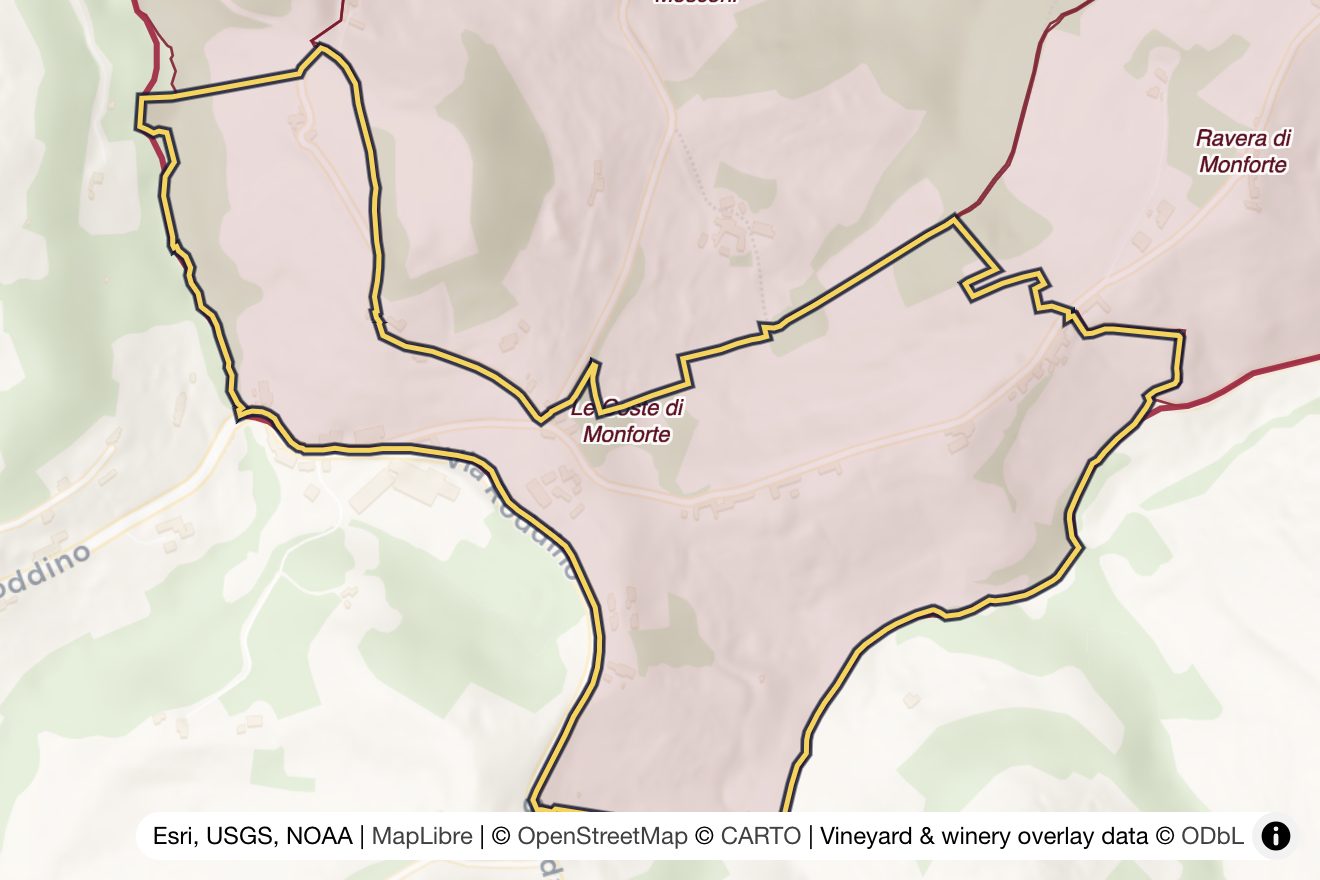
The specific topographical features of Le Coste di Monforte (its precise elevation, aspect, and mesoclimate) contribute to its individual expression within the broader Monforte terroir. The name "Le Coste" itself suggests hillside vineyards, a typical feature in this commune where vineyard sites occupy varied expositions across complex terrain. These topographical variations create subtle but meaningful differences in heat accumulation, air drainage, and sunlight exposure that distinguish one MGA from another even within the same geological formation.
Wine Characteristics
Wines from Monforte d'Alba's Helvetian soils typically display greater structure, more pronounced tannins, and enhanced aging potential compared to the generally softer, more aromatic expressions from the Tortonian marls of the western townships. Le Coste di Monforte, sharing this geological foundation, can be expected to produce Barolo in this more structured, powerful style that has become synonymous with the eastern communes.
The sandstone influence typically manifests in wines with firm tannic architecture, considerable depth, and a certain austerity in youth that demands extended aging to achieve full harmony. These are not wines of immediate charm but rather expressions that reward patience, developing complexity and tertiary nuances over decades when properly cellared. The tannins, while substantial, are generally fine-grained rather than coarse, integrating slowly with the wine's fruit core and acidic backbone.
Aromatic profiles from Monforte d'Alba vineyards often emphasize darker fruit tones (black cherry, plum) alongside classic Nebbiolo notes of tar, rose petal, tobacco, and earth. With age, these wines frequently develop profound tertiary complexity including leather, truffle, dried flowers, and sweet spice. The structural intensity and tannic density that characterize Monforte wines provide the framework necessary for this extended evolution.
All Barolo, including wines from Le Coste di Monforte, must meet the denomination's strict production standards: maximum yields of 56 hectoliters per hectare and mandatory aging of 38 months total, with at least 18 months in oak. These regulations, among Italy's most stringent, ensure a baseline quality level across the denomination while allowing terroir differences to express themselves within this disciplined framework.
Production and Market Position
Unlike Monforte d'Alba's most celebrated MGAs. Bussia and Ginestra, which appear regularly on shortlists of Barolo's finest crus. Le Coste di Monforte has not achieved comparable recognition in the international market. This may reflect several factors: limited production volume, fewer prominent producers bottling the site as a single-vineyard wine, or simply the historical accident of which sites attracted early critical attention and commercial success.
The absence of widespread commercial bottlings specifically labeled as Le Coste di Monforte MGA makes it difficult to establish clear quality benchmarks or to identify the signature expressions that define the site's character. This situation is not uncommon among Barolo's numerous MGAs; the official registry includes many sites that remain largely unknown outside local markets, their grapes blended into communal or entry-level bottlings rather than showcased as single-vineyard wines.
For wine enthusiasts, lesser-known MGAs like Le Coste di Monforte can represent opportunities to explore Monforte d'Alba's terroir at more accessible price points than the famous names command. When producers do bottle Le Coste di Monforte as a designated MGA, such wines offer insight into the commune's characteristic power and structure without the premium attached to Bussia or Ginestra.
Conclusion
Le Coste di Monforte occupies a modest position within Barolo's hierarchy of recognized sites, lacking the historical prestige and critical acclaim of Monforte d'Alba's most celebrated vineyards. Yet it shares the fundamental geological and climatic advantages that make Monforte d'Alba one of Barolo's five core communes, capable of producing powerful, age-worthy wines of considerable distinction.
The site's Helvetian soils and hillside exposition provide the terroir foundation for structured, tannic Barolo in the eastern commune style. While specific information about producers, historical significance, and individual bottlings remains limited, Le Coste di Monforte represents a legitimate expression of its commune's terroir, governed by the same strict regulations that define all Barolo DOCG production. For those willing to look beyond the famous names, such lesser-known MGAs offer the possibility of discovering compelling wines that express authentic terroir character at comparatively modest prices.