Introduction
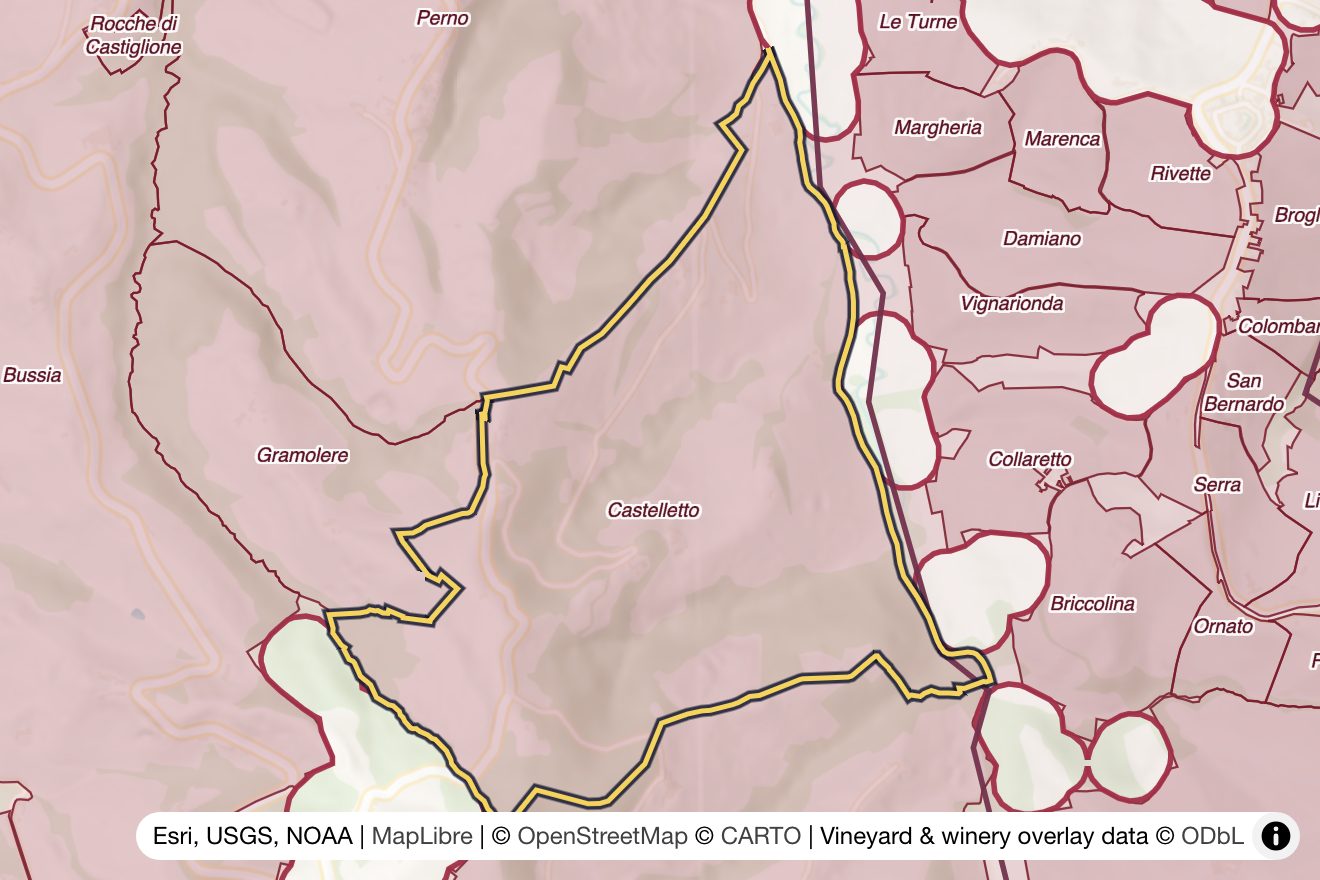
The introduction of the MGA system addressed the paradoxical situation that emerged from the 1980s onward, when the multiplicity of single-vineyard bottlings, in the absence of official classification, focused attention on individual producers rather than specific sites. While the MGAs are not classified hierarchically, they are identified as "crus," establishing a framework for understanding Barolo's geographical complexity. Castelletto's position within this system places it among the recognized vineyard sites of Monforte d'Alba, a commune that has long been associated with powerful, structured expressions of Nebbiolo.
Terroir
Monforte d'Alba's vineyards occupy the eastern portion of the Barolo production zone, positioned on the side of the valley divided by the Alba-Barolo road that runs through the valley floor. This geographical division is not merely administrative but represents a fundamental distinction in soil composition that profoundly influences wine character throughout the appellation.
The vineyards of Monforte d'Alba, including Castelletto, are characterized by soils from the Helvetian epoch, distinguished by a higher proportion of compressed sandstone compared to the calcareous marls found in La Morra and Barolo to the west. These Helvetian soils are notably less compact and less fertile than their Tortonian counterparts across the valley. The sandstone-rich composition creates a soil structure that is better draining and more challenging for the vine, factors that consistently correlate with wines of greater concentration and structural complexity.
The physical characteristics of these soils predominate over chemical attributes in their influence on wine quality) a principle established through decades of viticultural research. The moderate fertility and well-regulated water supply provided by Monforte's sandstone-based soils create conditions of measured vine stress that concentrate flavor compounds and phenolic material in the grapes. The soil's composition and structure dictate how roots navigate the complex layering of substrata, determining the vine's access to water and nutrients throughout the growing season.
The marginal climate of the Langhe amplifies the influence of these terroir factors. In such climates, where viticultural conditions challenge the complete ripening of Nebbiolo, the interplay between soil, topography, and microclimate becomes critical to achieving optimal grape maturity while maintaining the variety's characteristic acidity and aromatic complexity.
Wine Characteristics
Wines from Monforte d'Alba, shaped by the commune's distinctive Helvetian soils, typically yield more intense, structured Barolos that mature more slowly than those from the Tortonian soils of La Morra and Barolo. This general principle applies to Castelletto, positioning wines from this MGA within the broader stylistic profile of Monforte's production.
These structural characteristics manifest in wines with substantial tannic frameworks, requiring extended aging to harmonize their components. The sandstone influence contributes to a certain minerality and a firmer tannic grip compared to the softer, more immediately approachable profiles often found in wines from calcareous marl soils. The concentration achieved through moderate vine stress results in darker-fruited expressions, with black cherry, plum, and blackberry notes forming the aromatic core.
Despite the intensity and structure associated with Monforte, all fine Barolo shares certain fundamental traits that transcend communal boundaries. The color is never deeply opaque (Nebbiolo, like Pinot Noir, produces wines that tend toward ruby, evolving relatively rapidly to garnet or brick tones. The aromatic profile combines immediate fruit impressions of cherries and plums with the variety's signature secondary and tertiary characteristics: dried cherries, rose petals, tar, and liquorice. With extended bottle age, these perfumes gain complexity and nuance, developing the ethereal qualities that distinguish great Barolo.
The tannic structure in wines from Monforte's sandstone soils tends toward firmness rather than aggression, providing the architectural framework for decades of evolution. The pronounced acidity characteristic of Nebbiolo, preserved even in riper vintages by the variety's natural tendency and the region's marginal climate, balances this tannic structure and ensures wines of remarkable longevity.
Regional Context
Understanding Castelletto requires situating it within Monforte d'Alba's viticultural landscape. The commune is positioned between Castiglione Falletto to the north and Serralunga d'Alba to the east, two townships that share Monforte's Helvetian soil structure and stylistic orientation toward power and longevity. Castiglione Falletto, situated on a spur dividing the two main valleys, produces wines that combine structural backbone with a more forward elegance. Serralunga d'Alba, with its similarly sandstone-rich soils, yields wines of even greater tannic intensity and aging potential.
Within this context, Monforte d'Alba represents perhaps the most balanced expression of the eastern valley style) structured and concentrated, certainly, but without the extreme power of Serralunga or the transitional character of Castiglione Falletto. The commune's most celebrated sites (Bussia and Ginestra, along with the historically significant Santo Stefano di Perno (now part of the Perno MGA)) have established Monforte's reputation for producing Barolos of exceptional depth and complexity.
Production Standards
The Barolo DOCG maintains some of Italy's most rigorous production standards, requirements that apply equally to wines labeled with MGA designations like Castelletto. The maximum permitted yield stands at 56 hectoliters per hectare, a disciplined limit designed to ensure concentration and quality. This relatively modest yield ceiling, combined with the naturally lower fertility of Monforte's Helvetian soils, results in small berries with high skin-to-juice ratios, contributing to phenolic concentration and structural complexity.
The aging requirements for Barolo rank among the longest mandated for any wine: a minimum of 38 months from November 1st following the harvest, with at least 18 months spent in oak. These extended aging periods allow the integration of tannins and the development of tertiary aromatic complexity before commercial release, though most serious Barolos benefit from additional bottle age beyond the legal minimum.
Conclusion
Castelletto represents one of Monforte d'Alba's officially recognized vineyard sites within the MGA framework, sharing the commune's characteristic terroir of Helvetian sandstone soils and the stylistic profile these conditions impart. While it has not achieved the historical prominence of Bussia or Ginestra, its designation as an MGA acknowledges its distinct geographical identity within one of Barolo's most important production zones. Wines from this site would be expected to display the intensity, structure, and aging potential characteristic of Monforte d'Alba, offering the powerful, slowly evolving style that defines the eastern valley's approach to Nebbiolo.