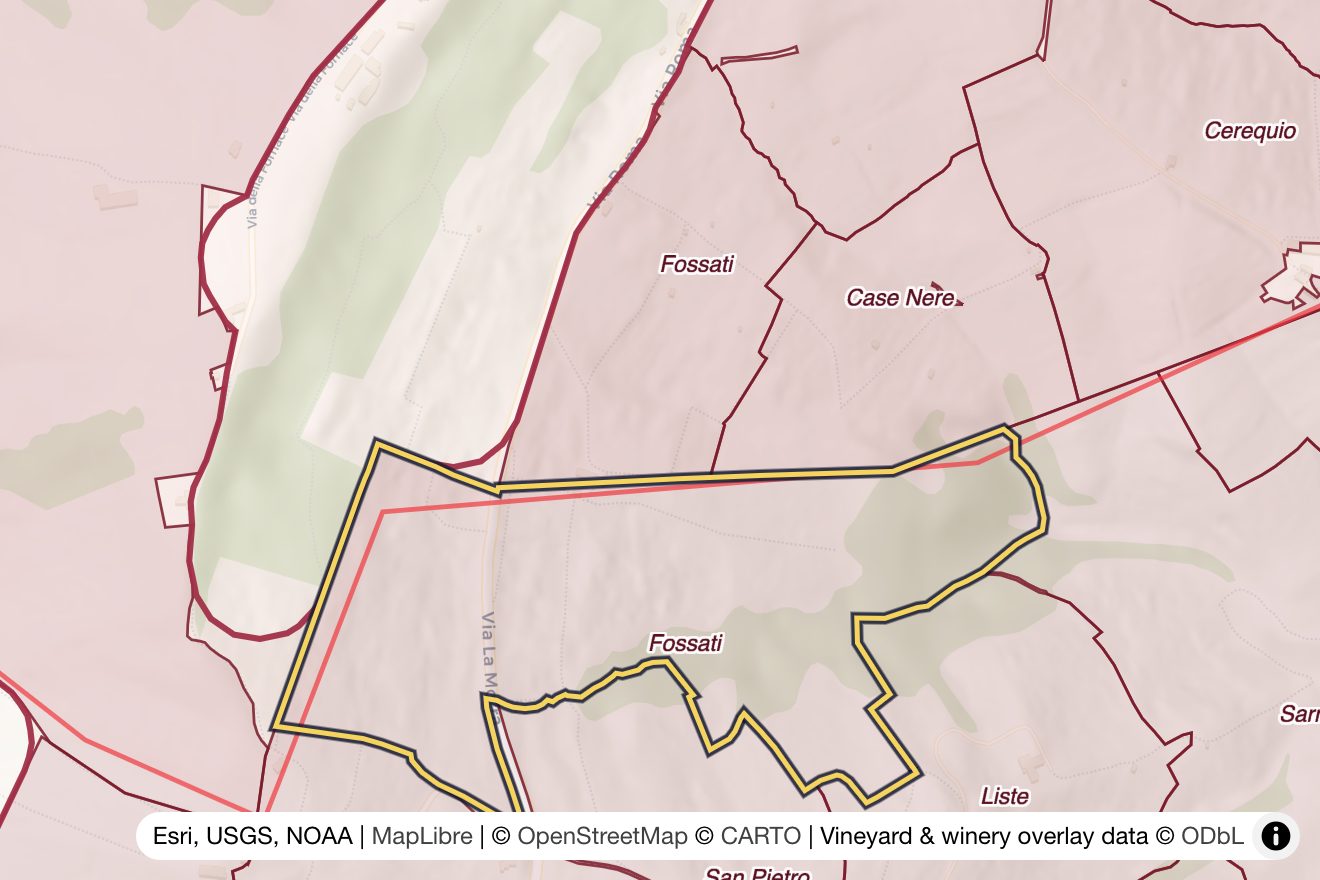
That double life accounts for most of the confusion around the name. Published figures for "Fossati" frequently describe one producer's parcel rather than the whole MGA. The clearest example is the widely repeated claim that Fossati measures 3.2 hectares, which is in fact the size of Borgogno's single holding on the Barolo side, not the size of the cru.
Position
The delimitation places Fossati at roughly 370 to 435 metres, with a prevailing east-southeast exposure. That elevation band puts it among the higher sites in the commune and above neighbouring Case Nere, which is delimited at roughly 300 to 370 metres.
Producer-reported altitudes vary, and two of them fall outside the delimited range. Enzo Boglietti declares 370 to 420 metres, which sits inside it. Roberto Voerzio's parcel is described at 350 metres, below the delimited floor, and the importer sheet for Lapo Berti gives 513 metres, far above the delimited ceiling. Where producer figures and the delimitation disagree, the delimitation is the better guide to the site as a whole; the producer numbers are best read as descriptions of individual parcels or as approximations.
Exposure is more consistent. The delimitation records prevalently east-southeast. Boglietti records east to southeast, and Lapo Berti's rows are described as east-facing. Borgogno gives southeast for its Barolo-side parcel. Several wine databases list Fossati as south or south-southeast facing, which the delimitation does not support. An easterly aspect means a site that takes light early and loses it sooner in the afternoon than the south-facing crus of the same hill. The name is the Italian plural for ditches.
Soils
Alessandro Masnaghetti's Enogea profile of Bricco delle Viole, a few hundred metres away in the commune of Barolo, notes that the two sites have very similar soils; Bricco delle Viole is mapped as evolved soils of laminated Sant'Agata Fossili marls. That places Fossati within the Tortonian marl family that underlies this side of the Barolo zone.
Producer declarations from inside Fossati agree on the marl and disagree sharply on the topsoil. Boglietti reports subalkaline ground, silty and clayey, with organic matter scarce. Lapo Berti's analysis gives 25 percent sand and 39 percent clay, with high iron. Voerzio describes stony, light soil with clay layers, and reports vines rooting to ten metres in places. Borgogno, on the Barolo side, records calcareous and clayey marl with a slight sandy fraction. Gianni Gagliardo, however, describes its Barolo-side plot as loamy, with a good amount of organic matter, medium limestone and good fertility, which is the opposite of Boglietti's reading.
A 33-hectare site spanning two communes and a substantial drop in elevation is not obliged to be uniform, and on the evidence of the growers it is not. The marl is the constant; vigour is not.
The Wines
The one characteristic growers do agree on is timing. Gagliardo's plot runs behind the rest of its holdings: budbreak comes late, picking comes last, and the estate logged 15 October for the 2021 vintage. It credits the woodland around the plot for the microclimate.
Descriptions of the wine itself diverge. Gagliardo's recent note leans floral and sweet-toned, violet over red fruit with mint and liquorice behind, and gives a round palate, ripe tannins and structure it places between medium and substantial. Voerzio's Fossati is described as deeply coloured and firmly tannic with vivid aromatics, and his Fossati Case Nere Riserva 10 Anni, which blends the two crus, as tending toward riper, blacker fruit. Flatiron's survey of the commune is less enthusiastic about the elevation, arguing that the upper reaches of the hill, La Serra and Fossati among them, sit at the edge of ripeness for La Morra's finest Barolo, with the caveat that warmer vintages are shifting that judgement.
There is no single Fossati style in the published record. Late ripening is the site's most consistently reported trait, and the range of descriptors reflects a cru worked in small parcels across two communes and a wide elevation band.
Producers
On the La Morra side, Enzo Boglietti bottles a Fossati from vines that are 30 percent 60-year-old and 70 percent 15-year-old plantings, Guyot-trained. Roberto Voerzio uses Fossati both as a single cru and as a component of his Barolo del Comune di La Morra, which in recent vintages draws on top La Morra crus including La Serra, Fossati and Case Nere (earlier vintages also included Boiolo), and blends it with Case Nere for the Riserva 10 Anni. Cesare Bussolo, who trained and still works with Roberto Voerzio, made Fossati his first Barolo bottling, from the 2014 vintage. Dosio Vigneti, based in La Morra, claims the first Barolo ever labelled Fossati, in 1986, roughly a quarter century before the MGA system gave the name legal standing.
On the Barolo side, Borgogno works a 3.20-hectare parcel, fermenting in concrete with a submerged cap for 40 days and ageing four years in 4,500-litre Slavonian oak casks. Gianni Gagliardo farms one of its smallest plots here, in the commune of Barolo, and counts Fossati among ten Barolo plots across five communes; production is tiny, at 871 bottles in the 2020 vintage. At Lapo Berti the must starts on its own yeasts, split between steel and open demi-muids with no temperature control, and the cap is pushed down between one and four times a day; twenty-four months in used barrels of 225 and 500 litres follow, with no fining and no filtration before bottling.