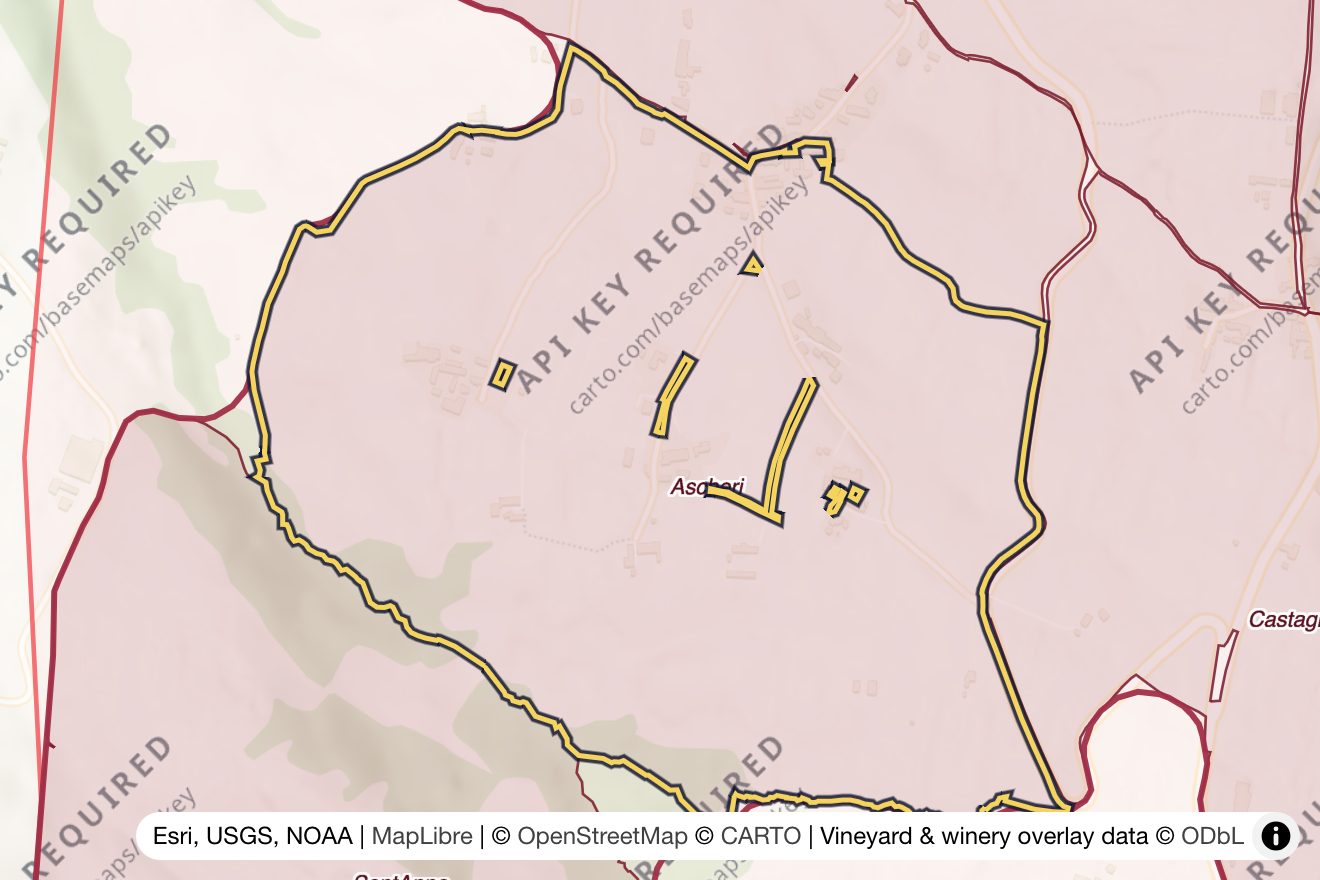
Position
The delimitation takes its name from the borgata Ascheri, one of the small hamlets strung across this side of the hill. La Morra's marked trail number 3, the Castagni to Rivalta route, leaves the village and drops through the borgate of Simane, Genesi-Rossi and Alfieri to Ascheri, then runs on gentle gradients to Rivalta before climbing back through Castagni to the Cappella di Loreto. The commune's own description puts the route on the Tanaro valley side of the hill, through chestnut wood, orchard and worked ground as much as vineyard, with Cherasco filling the middle of the view. That is the character of the flank Ascheri sits on.
Published statements about the site's neighbours are thin, and they do not describe a ring of famous names. Michele Reverdito's UK importer, working from the grower's notes, puts the estate's Ascheri parcel at 250 metres facing west, lying west of its Castagni parcel, with its Bricco Cogni parcel just to the north. Castagni is given separately as 320 metres facing southeast, due north of La Morra village. That is a relation of east and west across the top of the hill rather than one of upslope and downslope, and it is the only neighbour relation for Ascheri that an accessible published source states. Higher on the same descent, the borgata Simane falls inside the San Giacomo delimitation; the same importer notes Reverdito could sell that fruit as Barolo San Giacomo but declines, judging the soil too heavily clay, and bottles it as Langhe Nebbiolo instead.
Growers report altitudes across a wide band, and no authoritative range for the delimitation itself appears in any accessible source, so these figures should be read as parcel-level and grower-supplied. Reverdito's parcel is given at roughly 250 metres, west facing by the importer and southwest facing by the estate. Matteo Ascheri farms the Rivalta land at 350 metres with southwest and southeast aspects. Ellena Giuseppe's hectare is given at 1,121 feet, a shade over 340 metres, with a second block in the site at 1,100 feet facing southwest. Ninety-odd metres of vertical range between the parcels that reach bottle means the name on the label says less here than the identity of the grower behind it.
Ground
The Barolo and La Morra side of the appellation rests on Sant'Agata Fossili marl, the Tortonian formation of calcareous clay and blue-grey marl. Ascheri sits where that gives way. The western and northwestern edge of La Morra, and Verduno alongside it, run down to the Tanaro on younger Messinian material, the Cassano Spinola conglomerates, which crop out along the river near Verduno and are credited with rounder wines and softer tannin than the Tortonian ground behind them.
The growers' own descriptions do not converge. Reverdito's parcel at 250 metres is described simply as marl. Ellena's account runs the other way. He finds heavy calcareous clay at a height where he would not expect it, without the sand that lends most of La Morra its perfume, and reads the wine it gives, powerful but not heavy-footed, as closer in shape to the commune of Barolo than to the La Morra norm. Two accounts of the same delimitation, ninety metres apart, pointing in opposite stylistic directions.
The Wine and Its Makers
Michele Reverdito was founded in 2000 by Michele and his sister Sabina, on vineyards their father Silvano began buying in 1967, starting with Bricco Cogni. The estate now works 26 hectares across La Morra, Serralunga d'Alba, Verduno and Monforte d'Alba, with Ascheri held alongside Castagni, Berri, La Serra, Bricco Cogni, Badarina, Riva Rocca and Bricco San Pietro. Farming here is run with an outside agronomist, keeps residues out of the soil and the water table, and green-manures the rows with a deliberately broad seed mix rather than a single cover crop. No barriques: ageing runs in tonneaux and large botti. Masnaghetti's characterisation of the wines from Reverdito's section of the site, as the estate quotes it, is warm-hearted.
Ellena Giuseppe has farmed at La Morra since 1966, with about fifteen hectares of which five are vine and eight hazelnut. One hectare in Ascheri planted in 1969 makes the Barolo Ascheri; a Riserva is also drawn from the site, from vines the importer puts at around sixty-five years old. A younger Ascheri block planted in 1980 supplies part of the estate's Barolo del Comune di La Morra, a blend of five La Morra vineyards.
Cantine Ascheri shares its name with the site, the La Morra locality where the family began making wine in the early nineteenth century. The family's roots are in La Morra; Giacomo Ascheri set up on Via Piumati in Bra in 1880 and made Barolo there. Bra had been on the railway since 1855, and in 1874 the new line to Ceva put it on a rail route to Savona, and the estate points to that connection as the reason the town became a despatch point for the wine. Roughly ten Barolo houses and traders were at work in Bra in those decades; this one alone still operates. Its Barolo now comes off sixteen hectares of Nebbiolo spread across three communes, La Morra, Verduno and Serralunga d'Alba, with the Barolo Ascheri drawn from the Rivalta land between La Morra and Verduno, at 350 metres, where Barbera, Dolcetto and Pelaverga grow alongside the Nebbiolo. The Pelaverga is the measure of how far this corner reaches: the Verduno Pelaverga DOC covers the whole of Verduno and only parts of La Morra and Roddi.