Position
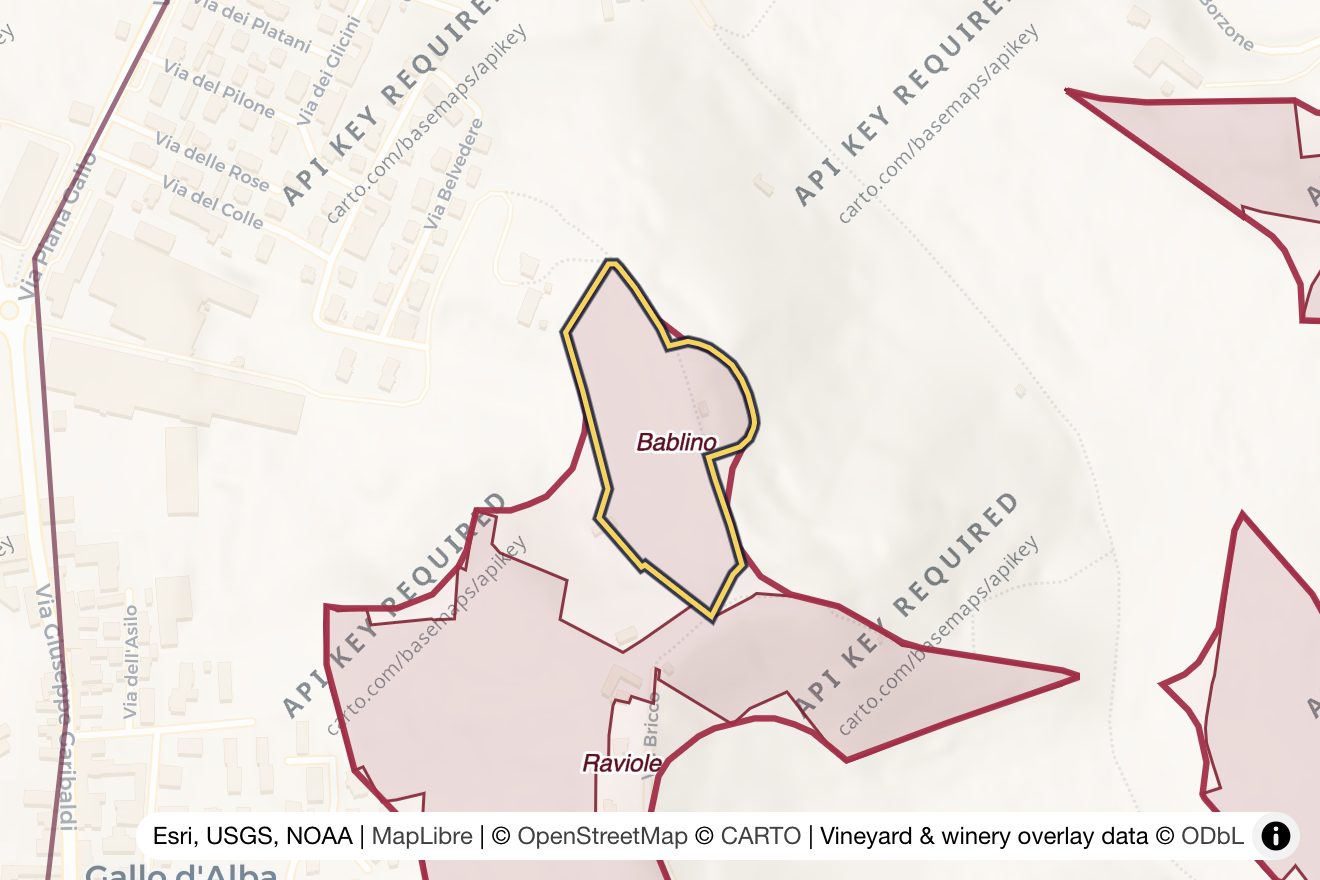
Two landforms account for Grinzane Cavour. One is a low hill with the castle at its summit, and Castello, Gustava and Garretti lie beneath it on the southern side. Beyond that hill run three further ridges, roughly parallel to one another, and the vineyard land concentrates on their western flanks, which take the better light. Borzone and Canova hold the first of the three, La Corte the second, Raviole and Bablino the third.
Alessandro Masnaghetti's Enogea cartography treats that third ridge as the castle's own spine carried further out. That is the useful fact about Bablino's position. It is not an isolated pocket on the far side of the commune; it is the tail of the castle's hill, and Raviole is its companion along the same crest.
Exposure here resists a single summary, and the accounts differ by scale. Enogea characterises the three ridges by their western slopes, and separately notes that basins on the castle's southern flank shift exposures across the Castello, Gustava and Garretti sector. Producers working the third ridge report a more southerly tilt: Bricco Carlina gives its Grinzane parcels as south to southwest, and Damilano gives Raviole as southwest at around 300 metres. Where these diverge, the delimitation-level description is Enogea's; the producers are reporting the particular rows they farm.
Geology
Most of Grinzane Cavour rests on a single formation. Sant'Agata Fossili marl, the bluish-grey Tortonian calcareous clay of the denomination's northern reaches, underlies the commune almost throughout. Growers here describe their working soil as clayey-calcareous, which is that formation stated in practical terms.
One departure from the marl is mapped on this side of the commune. Enogea shows a band of alluvial deposit running out from the castle in the direction of Raviole, geologically younger than the Sant'Agata beds around it and carrying a more developed soil. Damilano's own account of Raviole leans on that band, crediting the deposit rather than the marl for the wine's lift and fruit. Whether it continues past Raviole into Bablino has not been established.
The Wine
No Barolo reaches the market as Bablino alone, so the site has no record of its own to read.
The nearest evidence is Raviole, its companion on the ridge. Raviole went unbottled under its own name until Damilano released the 2015 as the first varietal expression of the mention, and Luigi e Massimo Veglio have bottled it since, from the 2016 vintage. Damilano's account of that wine runs to violets, wild strawberry and fresh cherry, with fine tannin and acidic freshness, and puts the fruit and the liveliness down to alluvial ground rather than marl. That describes Raviole, not Bablino. The two share a ridge, not a bottling record.
Producers
Bricco Carlina is the estate to know for Bablino. Founded in 2014 by siblings Camilla and Francesco Scavino at the foot of the Grinzane Cavour castle, it works around eight hectares of Barolo and holds parcels in three of the commune's mentions: Bablino, Castello and Raviole. Vine age across those holdings runs from fifty to eighty years. The estate describes its vineyards as farmed without chemical treatments and itself as pursuing organic certification, while its importer's technical sheet calls the fruit organically certified.
Bablino does not appear on a label of its own. Each mention is vinified separately, and the estate's 2015 technical sheet describes the three being assembled into a single Barolo; Castello is now also bottled on its own, alongside a Barolo del Comune di Grinzane Cavour. The cellar work given on that sheet is unhurried. Fruit is destemmed and given a pre-fermentation maceration with délestage. Fermentation and skin contact then run about a fortnight under controlled temperature, the cap broken by pumpover four or five times a day. The skins afterwards stay submerged for anywhere from a further month to a further two, the length set by the character of the fruit. Ageing is twenty-four months in Slavonian botti of 20 hectolitres, then a year in bottle.
That the ridge carries the castle's name is not incidental. Camillo Benso, Count of Cavour, was mayor of Grinzane for seventeen years, from 1832 to 1849, and made the castle estate a site of the first modern winemaking experiments in the Langhe. The castle has housed the Enoteca Regionale Piemontese Cavour since 1967, and it stands as one of the components of the Vineyard Landscape of Piedmont: Langhe-Roero and Monferrato, inscribed on the UNESCO World Heritage list on 22 June 2014. Bablino sits at the tail of that hill, unbottled alone, waiting for someone to make the case Damilano made for Raviole.