Name and register
In the official list Solanotto stands as a single name with no alternatives attached to it. That is worth noting, because not every mention around it is so straightforward. Altenasso is registered as "Altenasso (o Garblet Suè o Garbelletto Superiore)", which means Garblet Suè and Garbelletto Superiore are alternative names for that one site rather than separate vineyards. Vignolo is a third mention, registered separately and under its own name alone.
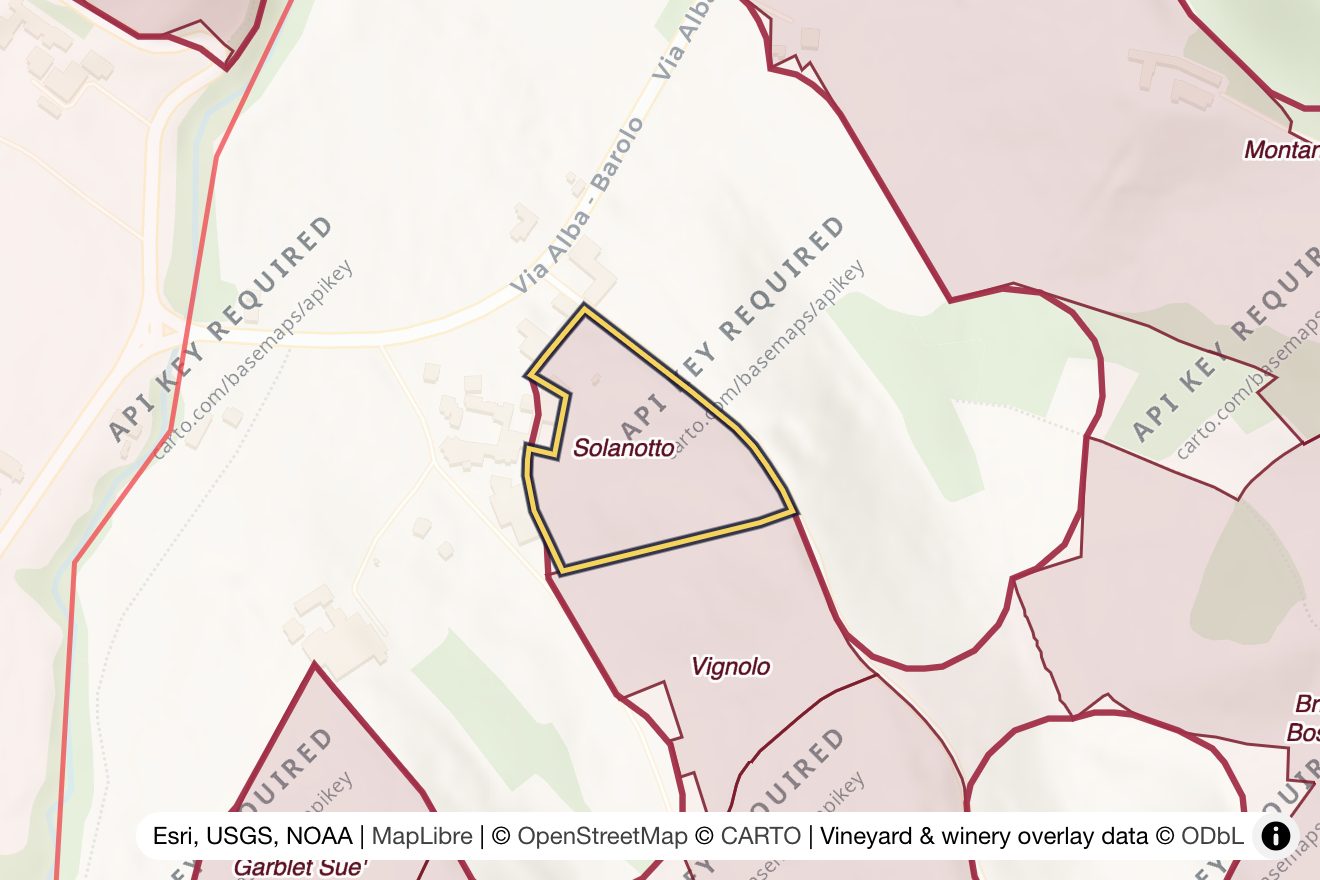
The boundaries are a different matter. The detailed cartography of the Barolo mentions, for which the reference work is Alessandro Masnaghetti's, is not openly published, and Solanotto's perimeter and the list of mentions it actually touches cannot be established from freely available sources. Published claims about which crus Solanotto borders, as opposed to which crus lie near it or face it across a slope, should be treated as unconfirmed until checked against that cartography. Adjacency read off a polygon map is not the same thing as a border as the literature describes it.
For the same reason, no figure is given here for the site's extent, mean elevation, gradient or exposure. None of those could be sourced.
Producers
Solanotto is a name that is hard to find on a label, and the one estate documented as using it, Azelia, is reported to blend its fruit into a Barolo rather than name it.
Azelia, in Castiglione Falletto, builds its Barolo Classico from seven crus, 30 percent of the fruit from Castiglione Falletto and 70 percent from Serralunga d'Alba, from vines averaging fifty years on a white calcareous soil tending to clay, between 250 and 370 metres. Published descriptions of the wine name Solanotto and Altenasso as its Castiglione Falletto sources, alongside sites in Serralunga d'Alba. That declared altitude band is an estate-wide range covering seven parcels in two communes, so it carries no information about the elevation of any single one of them and cannot be used to place Solanotto on the slope.
Cavalier Bartolomeo was founded in 1924 in the hamlet of Garbelletto, below Castiglione Falletto, and makes around 15,000 bottles a year in total. Its Barolos are Altenasso, San Lorenzo and Fiasco Riserva, alongside Barbera d'Alba, Dolcetto d'Alba and Grappa di Barolo, among others. Solanotto is not among the vineyard names the estate uses, and none of its wines carries that name.
What can be said, then, is narrow. Solanotto is a delimited mention of Castiglione Falletto that seldom reaches a label under its own name. It is documented as blending fruit in at least one Barolo: Azelia's multi-site Barolo is reported to include Solanotto in its blend.