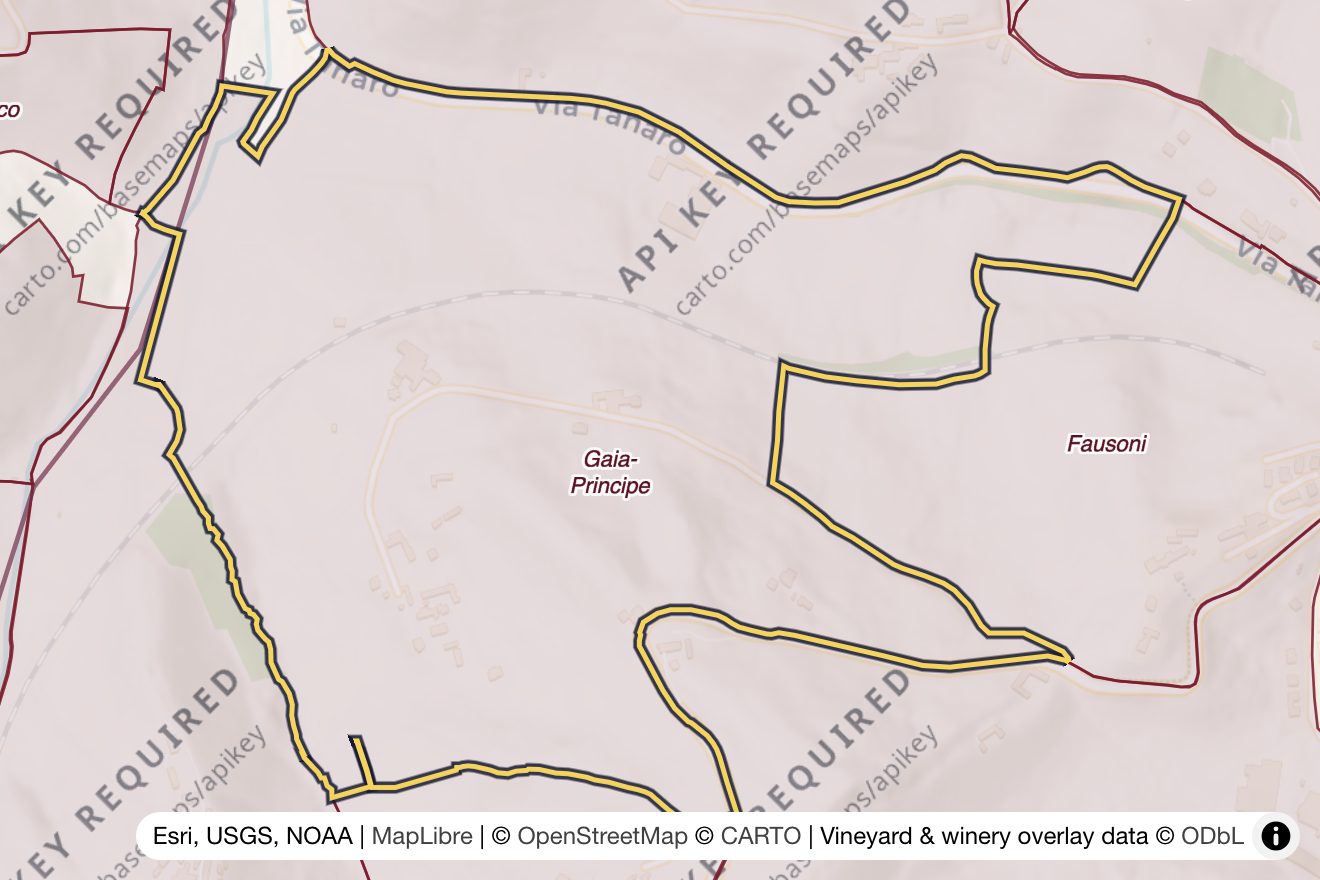
Even inside the registered vineyard, Nebbiolo is not the whole story. Alessandro Masnaghetti's Enogea survey puts the plantings at roughly 51.5 percent Nebbiolo, with Barbera at 15 percent, Langhe bianco at 14 percent, Moscato at 8.5 percent, and the remainder split between Langhe Nebbiolo, Langhe rosso and Dolcetto. Barbaresco accounts for barely half of what grows here, which is worth holding in mind before reading the 75 hectare figure as a measure of Nebbiolo supply.
The Shape of the Site
Enogea places the MGA on one hillside, bracketed below by the railway along the valley floor and above by the road that climbs from Neive to Tre Stelle. That hillside does not run straight. Between the Fausoni boundary and the Currà boundary it bends through a long arc, so rows angled toward Gallina sit in cooler light while rows angled toward Cottà take the warmer. Elevation across the MGA runs from 170 to 290 metres. Slizza is the one registered menzione vigna inside the delimitation.
The names around it carry more market recognition than Gaia-Principe does. Cottà and Gallina were both singled out among the zone's best in Luigi Veronelli's 1969 ranking, and Renato Ratti's 1984 Barbaresco map added Currà and Albesani to the recognised names. Currà, on Enogea's reading, lies between Gaia-Principe and Cottà, and its wines are built closer to Cottà's than to the lighter, straighter-lined bottlings that come off Gaia-Principe.
That last point is the useful one for a buyer. Masnaghetti's verdict on the arc is that it counts for less in the glass than the map would suggest: what leaves this site is known for perfume and fruit rather than for frame. This is not a cru that argues its case on weight.
Ground and Aspect
Enogea assigns Gaia-Principe a single geological classification: MSAs, the sandy facies of the Marne di Sant'Agata Fossili. That is the sandier end of the Tortonian marls, not the laminated marl of the Barbaresco commune classics.
Aspect is where the site demands care. Enogea gives the best-exposed positions west to southwest and the remaining sites north to northeast, which is a wide spread for one delimitation. Producer descriptions diverge accordingly: Prinsi gives its parcel a north-west orientation, while Azienda Agricola Ronchi describes its Gaia-Principe holding as facing south to southeast. Anyone reducing this cru to a single exposure is describing one grower's rows, not the MGA. Expect real bottle-to-bottle divergence between producers here, and taste accordingly.
Who Bottles It
Prinsi (the Lequio family, based in Neive) is Enogea's recommended tasting for the MGA. The estate runs roughly 25 hectares with about 13 under vine, and its Barbaresco holdings include Gaia Principe, Gallina, Fausoni and Basarin, so the estate's Nebbiolo clusters tightly along this stretch of Neive, with Fausoni a direct abutter of Gaia-Principe. The Gaia Principe is Guyot-trained at 3,500 vines per hectare, fermented in temperature-controlled stainless with skin maceration, put through malolactic in wood, then aged in large French oak casks before bottle time.
Azienda Agricola Ronchi (Rocca Giancarlo) is run by the fourth generation of a family whose house stands inside the Ronchi vineyard itself, in the small valley just over the line from Neive; the commune of record is Barbaresco, not Neive. Estate bottling dates to the 1950s and the holdings run to around 16 acres, worked by hand. The Gaia-Principe rows sit a short way east of the cellar and were planted between three and four decades ago. The wine is straight Nebbiolo aged 18 months in large Slavonian botti, the Slavonian counterpart to Prinsi's large French oak casks.
Roberto Sarotto harvests here from late September into early October, ferments under temperature control with extended maceration, and gives the wine a minimum of one year in oak. For the ground behind the bottling the estate reports a medium-textured soil, sand and silt fractions carried alongside limestone and marl.
San Silvestro takes the Slavonian cask route, ageing in large botti and then bottle, and positions the wine on a cellar window of about a decade.
Il Poeta, a collaboration between the grower Natale Seghesio and winemaker Paolo Sartirano, is made at the Sartirano family cellar and bottles a Gaia Principe aged nine months in Slavonian casks followed by three years or more in bottle before release.
Cascina Rabaglio also bottles a Barbaresco Riserva Gaia Principe.
Naming and Verification
The name appears variously as Gaia-Principe, Gaia Principe, and occasionally as the paired holdings Gaia and Principe, which is worth knowing when searching allocation lists, customs paperwork or auction catalogues; the same cru can index three ways. Labels most often read simply "Barbaresco Gaia Principe."
For confirming which producer holds what, Masnaghetti's Enogea cartography is the working tool. The Neive map plots the commune's official crus with proprietor names marked cru by cru, and the Barbaresco MGA encyclopedia covers the delimitations in detail. Producer literature on this site tends to describe one parcel as though it described the whole, particularly on exposure and altitude, so checking a bottling against the cartography rather than against a retailer description is the safer habit.