Overview
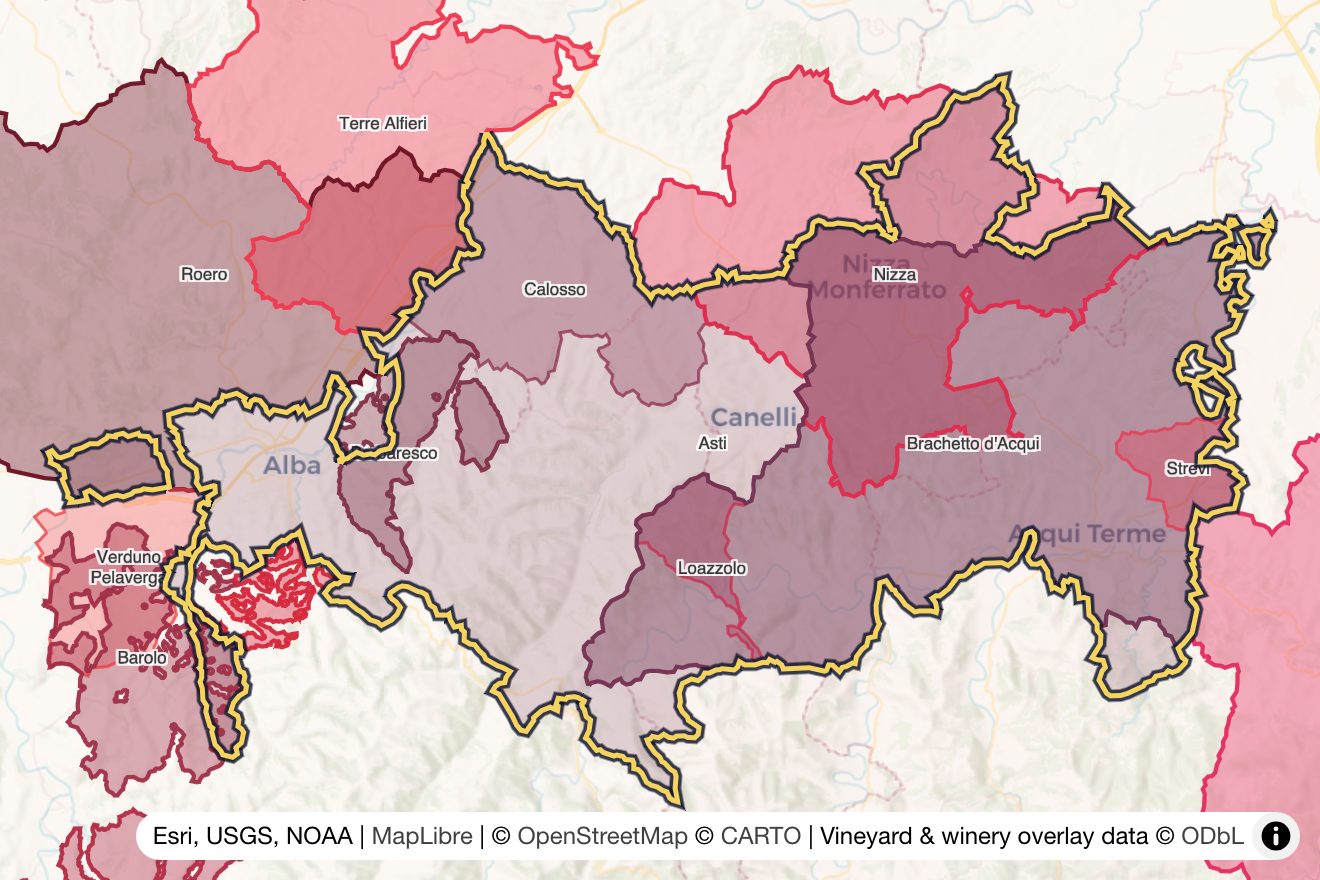
Asti is both a province at the heart of Piedmont's Monferrato hills and the name of Italy's most famous aromatic sparkling denomination: Asti DOCG, which with its gentler sibling Moscato d'Asti covers the Moscato Bianco grown around Canelli and its neighboring valleys. The wider Asti country is equally the kingdom of Barbera, whose Barbera d'Asti DOCG and Nizza DOCG mark the province's red summit, along with local specialties from Grignolino to Ruché.
History
Moscato's sparkling tradition was industrialized at Canelli in the nineteenth century, where Carlo Gancia adapted Champagne methods to the aromatic grape from 1865, founding the Italian sparkling industry; the tank method later made Asti Spumante a global export. Asti and Moscato d'Asti were united under DOCG in 1993, and Canelli, the historic cradle with its UNESCO-listed cathedral cellars, received its own DOCG for Moscato in 2023. On the red side, Barbera d'Asti rose from the province's everyday wine to DOCG in 2008, its Nizza subzone becoming an independent DOCG in 2014.
Terroir & Climate
The Asti country is classic Monferrato: chalky, sandy marls over a sea-bed geology, rolling at 150 to 500 metres between the Tanaro and the Apennine foothills. The climate is continental with dry, bright summers. Moscato holds the steep, high calcareous slopes around Canelli, Santo Stefano Belbo and the Belbo and Bormida valleys, where aroma and acidity peak; Barbera takes the warmer, fuller exposures throughout the province.
Grape Varieties & Wine Styles
Asti DOCG is fully sparkling, sweet and low in alcohol; Moscato d'Asti, gently frizzante at around five percent, is the grower's version, grapey, floral and delicate, drunk young and increasingly the category's quality face. Barbera d'Asti runs from vivid, juicy everyday red to the structured, oak-raised wines of Nizza. The province's supporting cast includes Grignolino d'Asti, pale and peppery, Freisa d'Asti, sweet Malvasia di Castelnuovo Don Bosco, and Ruché di Castagnole Monferrato, the perfumed rare red of its own small DOCG.
Notable Producers
For Moscato: Ca' d'Gal, Paolo Saracco, Elio Perrone and the historic Canelli houses Gancia and Contratto. For Barbera: Braida of Giacomo Bologna, whose Bricco dell'Uccellone redefined the grape, Vietti's La Crena, Coppo and the Nizza estates around Vinchio and Castelnuovo Calcea. Cocchi and the vermouth trade keep Moscato's fortified traditions alive at Asti itself.
What to Know
Asti the sparkling wine and Moscato d'Asti differ in pressure, sweetness and audience: the latter is the sommelier's choice and the former the celebration staple. The province's Barbera is treated in its own entries where the site's hierarchy provides them, and Nizza is its ambition tier. Moscato d'Asti from a top grower, drunk within a year or two, remains one of Italy's singular wine experiences at any price.