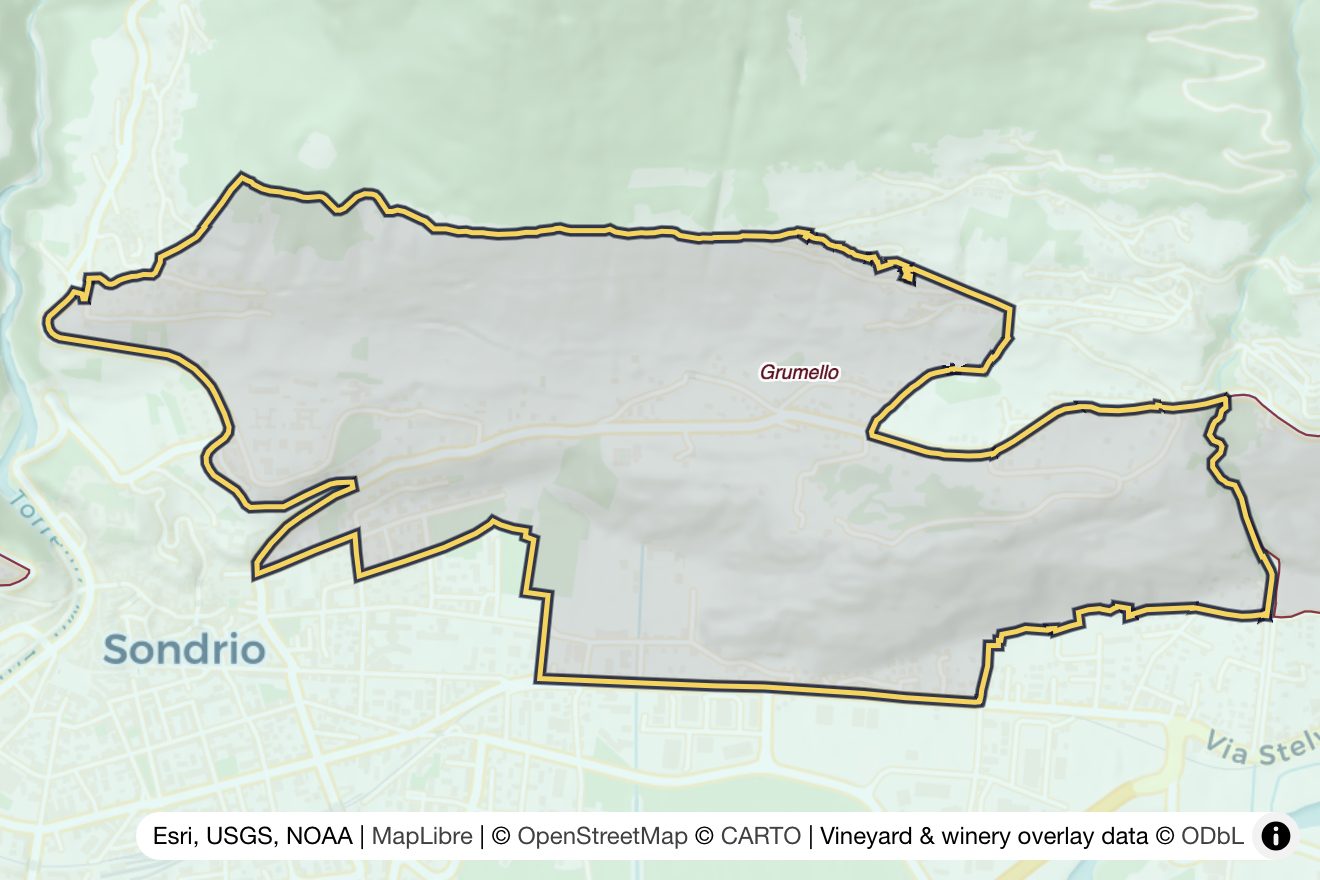
Overview
Grumello is a subzone of the Valtellina Superiore DOCG, occupying the terraced slope northeast of Sondrio around the medieval Grumello castle, in Lombardy's alpine Valtellina. Around 78 hectares of Nebbiolo, locally Chiavennasca, grow on its dry-stone terraces, yielding what is conventionally the roundest and most approachable of the valley's cru wines.
History
The subzone takes its name from the thirteenth-century castle of the De Piro family whose ruins crown the slope. Like the rest of the valley's heroic vineyard, Grumello's terraces were assembled over centuries to supply the transalpine trade, and the site entered the appellation system with Valtellina Superiore's DOC in 1968, confirmed in the 1998 DOCG. The Sondrio-adjacent position made it historically the city's home vineyard.
Terroir & Climate
The slope faces full south on granite- and schist-derived sands, slightly deeper and less austere than Sassella's immediately to the west. Elevations run roughly 350 to 500 metres. The site shares the valley's alpine-Mediterranean paradox: high mountains, low rainfall, intense light and the daily breva wind off Lake Como, ripening Nebbiolo at latitudes and altitudes that should forbid it.
Grape Varieties & Wine Styles
Rules follow Valtellina Superiore: minimum 90 percent Nebbiolo, two years of aging with one in wood, three for Riserva. Grumello's wines show the house profile of the valley, red cherry, alpine herb, rose and mineral cut, with a softer tannic edge and earlier accessibility than Sassella; they drink well from release through ten to fifteen years.
Notable Producers
Ar.Pe.Pe.'s Rocca De Piro and Buon Consiglio bottlings come from Grumello, and Nino Negri, Rainoldi, Fay and Mamete Prevostini all work the subzone, alongside small terrace growers.
What to Know
Grumello is the customary entry point among Valtellina's crus: recognizably the valley's Nebbiolo, on a friendlier clock than Sassella. The castle silhouette above the terraces marks the site from the valley road, and the name on a label is a geographic guarantee under the DOCG.