Overview
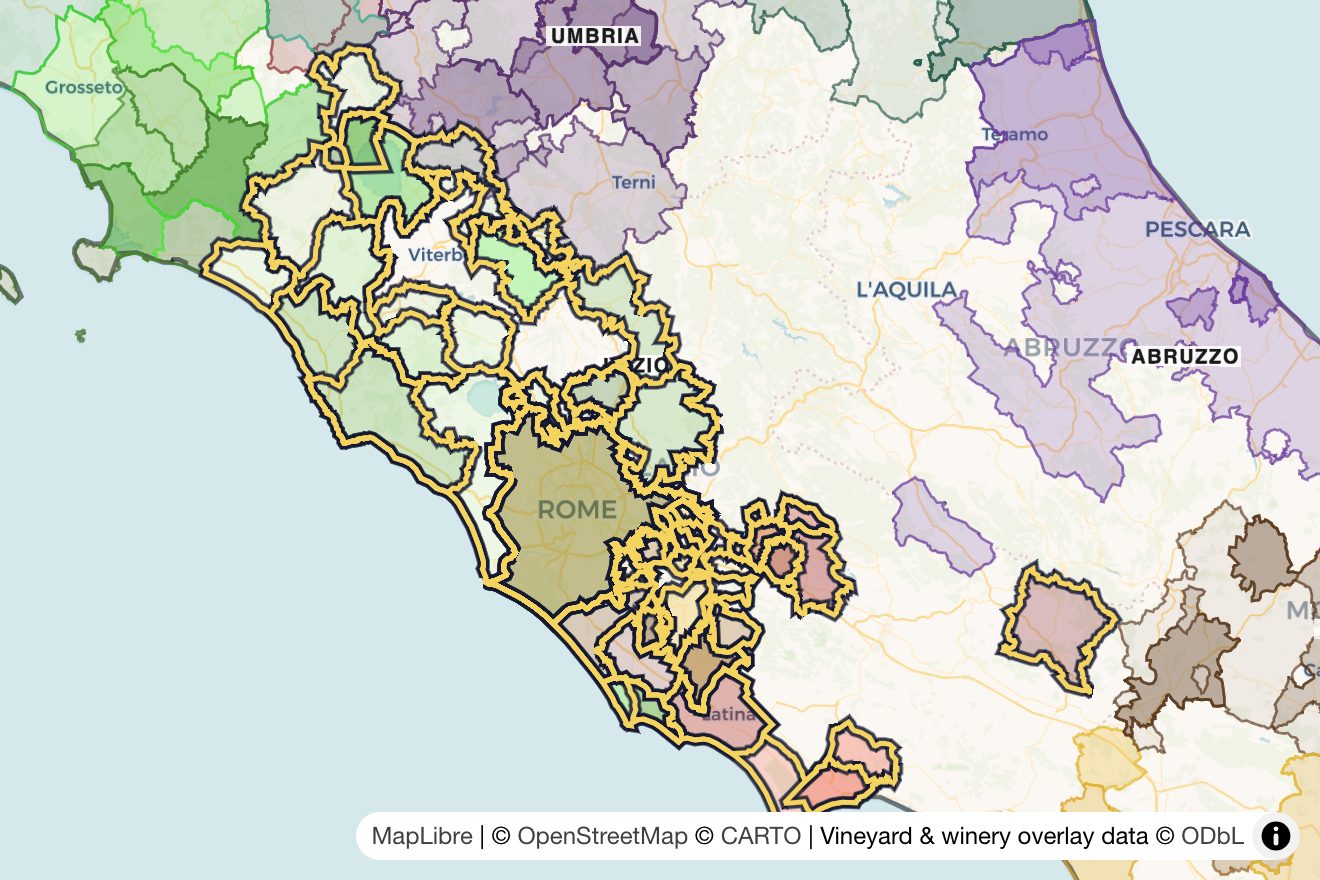
Lazio is the region of Rome, a volcanic wine country whose production has served the capital's tables for over two millennia. Its historic identity is white: Frascati and the Castelli Romani hills south of the city, planted on the craters of the Alban volcano, alongside Est! Est!! Est!!! di Montefiascone by Lake Bolsena in the north. The modern era has added a serious red movement built on the native Cesanese and on international varieties from the coastal plain, revising a reputation long tied to carafe wine.
History
Roman viticulture ringed the capital from antiquity, and the papal court sustained the Castelli's whites through the centuries, with the Est! Est!! Est!!! legend of Bishop Fugger's wine-scouting servant attached to Montefiascone since the Middle Ages. Frascati was among Italy's first DOCs in 1966, its volume boom serving postwar Rome at the cost of its standing. Quality revival came late: Frascati Superiore gained DOCG status in 2011 with Cannellino, its sweet tradition, alongside, and Cesanese del Piglio's 2008 DOCG marked the native red's return. Estates on the coastal Agro Pontino, led by Casale del Giglio's variety trials from the 1980s, opened the region's modern chapter.
Terroir & Climate
Volcanism defines the classic zones: the Alban hills' craters and tuff south of Rome, and the Vulsini complex around Bolsena in the north, give potassium-rich volcanic soils, good drainage and the saline edge of the region's whites. The Apennine foothills to the east, home of Cesanese, are higher, on mixed soils of iron-rich clay, limestone and volcanic material, with continental nights; the Maremma laziale coast is warm, breezy alluvium. The climate overall is Mediterranean, tempered by lakes, sea and elevation in the interior.
Grape Varieties & Wine Styles
The white base is Malvasia, with Malvasia Puntinata the quality strain of the Castelli, and Trebbiano; Frascati Superiore at its best is dry, floral and almond-saline, and Cannellino its late-harvest sweet counterpart. Est! Est!! Est!!! works similar varieties at Montefiascone. Cesanese, in the Piglio, Olevano Romano and Affile zones, gives the native red: perfumed, spicy, mid-weight wine with red fruit and pepper. The coast and inland estates add Bellone and Grechetto among whites and Merlot, Syrah, Cabernet and Petit Verdot among reds, the latter behind several of the region's most awarded bottles.
Notable Producers
Casale del Giglio dominates the coastal modern school. Castel de Paolis, Villa Simone and Fontana Candida's single-vineyard selections lead Frascati; Falesco, of the Cotarella family, bridges Lazio and Umbria with Montiano its flagship Merlot; and Damiano Ciolli at Olevano Romano heads the Cesanese revival with Corte dei Papi and Casale della Ioria in the Piglio.
What to Know
Lazio's map divides into volcanic whites around Rome, Apennine Cesanese to the east, and a varietally free coastal plain; the DOCG names, Frascati Superiore, Cannellino and Cesanese del Piglio, mark its classified summits. The region remains under-priced relative to neighbors, and its best current work, old-vine Malvasia and serious Cesanese, trades well below equivalent quality elsewhere in central Italy.