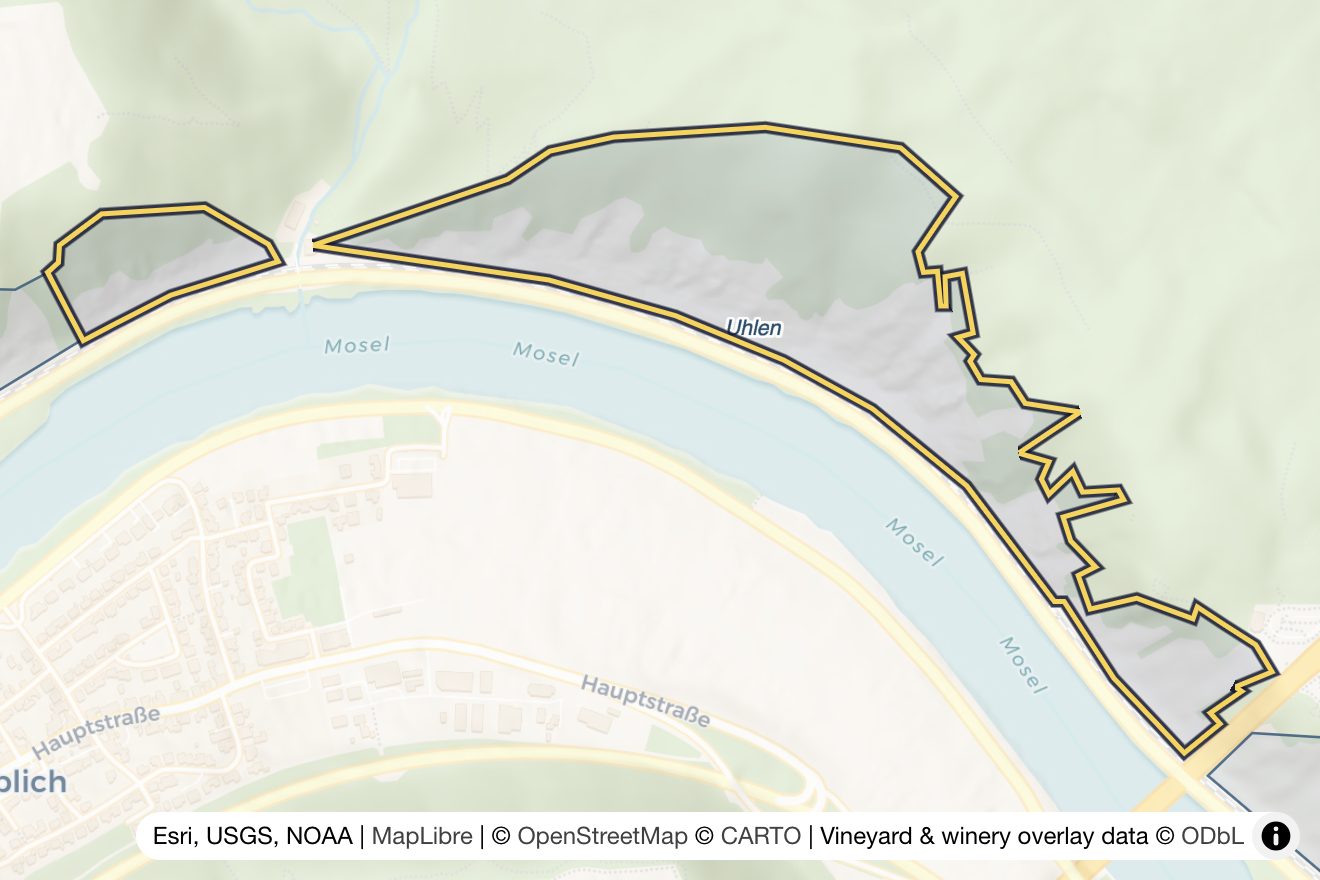
Overview
Uhlen Laubach is the central of the three geological sectors of the Uhlen, the terraced amphitheater of vines that runs along the left bank of the lower Mosel between Winningen and Kobern-Gondorf, a short distance upstream of Koblenz in the Terrassenmosel. The Uhlen as a whole covers 16.79 hectares on the Winningen municipality's figures; the Laubach sector accounts for 6.94 of them, between the Blaufüsser Lay at the Winningen end and the Roth Lay toward Kobern-Gondorf. The name became a fixture on labels through Weingut Heymann-Löwenstein, which began vinifying and bottling the Uhlen's three rock formations separately from the 2001 vintage (2000 for the sweet wines), and in October 2018 the European Union registered "Uhlen Laubach" as a protected designation of origin (gU), one of the first single-vineyard PDOs in Germany, alongside Uhlen Blaufüsser Lay, Uhlen Roth Lay, Bürgstädter Berg, and Monzinger Niederberg. Reinhard Löwenstein led the application, an effort reported to have taken about eight years. The site is also classified VDP.GROSSE LAGE in its own right.
Terroir & Position
The Uhlen faces south-southwest to southwest at gradients above 100 percent (45 degrees), with as many as 29 terrace levels stacked above one another behind dry-stone walls. Heymann-Löwenstein gives its Laubach parcels as 75-240 meters in elevation at slopes of 100-150 percent. What separates Laubach from its neighbors is lime: the rock is Devonian sandy grey slate with an unusually high calcareous content, which the producer puts at up to about 10 percent with a soil pH near 7.5, deposited as an ancient sea basin shallowed and filled with sediment. Many stones carry marine fossils, including mussels and corals. This calcareous slate is rare on the Mosel, and the wines are conventionally described as the softest and deepest of the three Uhlen sectors, against the iron-marked austerity of Roth Lay and the cooler, clay-inflected Blaufüsser Lay.
Producers
Heymann-Löwenstein in Winningen farms 2.5 hectares of Laubach across three parcels, with vines averaging over 50 years old and a significant ungrafted portion; the estate bottles a Grosses Gewächs each year and residually sweet Auslesen in suitable vintages, fermented on wild yeasts in wooden barrels. Weingut Knebel, also in Winningen, has the biggest share of its 1.2 hectares of Uhlen vines in the Laubach sector and draws its Uhlen Riesling Grosses Gewächs from old vines there, though the label reads simply Uhlen. Other Winningen estates, among them Richard Richter, Freiherr von Heddesdorff, Fries, and Rüdiger Kröber, farm parcels of the wider Uhlen.
What to Know
Labels may read "Uhlen Laubach" or "Winninger Uhlen Laubach"; before the sectors were separated, wines from these parcels went to market simply as Winninger Uhlen. Under the PDO rules reported at the time of registration, the name covers dry wines (under 18 g/l residual sugar) and noble-sweet styles, with no Kabinett or Spätlese permitted under the site designation. Laubach is the only lime-bearing sector of the Uhlen; the neighboring Blaufüsser Lay is in fact a clay-rich disruption within the younger Laubach strata, which explains why the two adjoin yet taste distinct.