Overview
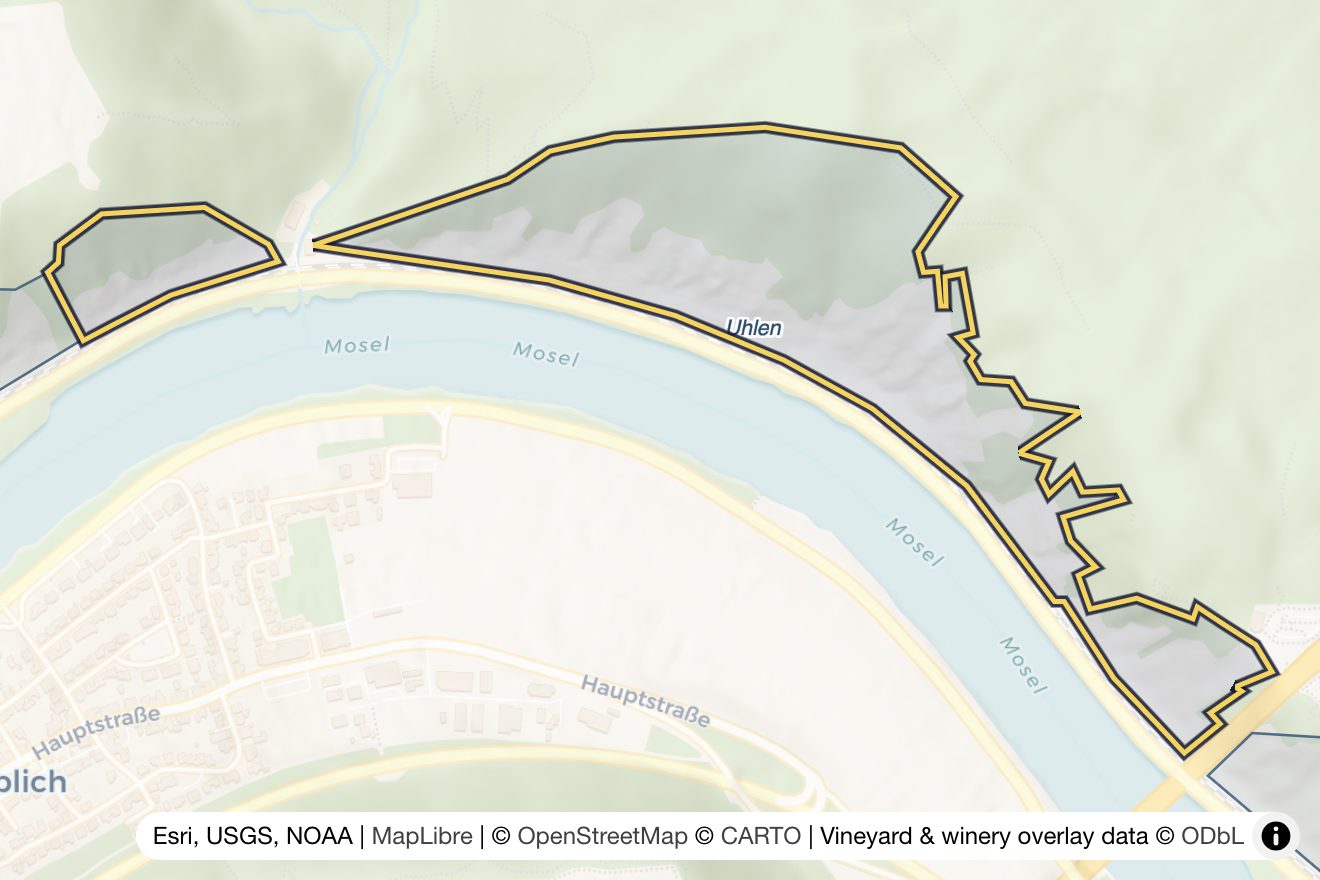
Uhlen Blaufüsser Lay (also written Blaufüßer Lay) is the smallest of the three geological sectors of the Uhlen, the terraced slope on the left bank of the lower Mosel between Winningen and Kobern-Gondorf in the Terrassenmosel. Of the Uhlen's 16.79 hectares (on the Winningen municipality's figures), Blaufüsser Lay covers just 1.58, at the Winningen end of the site below the cliff head known as the Blumslay; Laubach lies at its back in the center of the slope, with Roth Lay beyond toward Kobern-Gondorf. Weingut Heymann-Löwenstein made the name known by bottling the Uhlen's three rock formations separately from the 2001 vintage, and in October 2018 the European Union registered "Uhlen Blaufüsser Lay" as a protected designation of origin (gU), among the first single-vineyard PDOs in Germany together with Uhlen Laubach and Uhlen Roth Lay. The site is also classified VDP.GROSSE LAGE in its own right.
Terroir & Position
The sector faces south-southwest on terraces at extreme gradients; Heymann-Löwenstein gives its parcel as 80-180 meters in elevation at slopes of 100-170 percent. Geologically, Blaufüsser Lay is a disruption within the younger Laubach strata: blue-grey Devonian slate that carries more clay than the surrounding rock and is correspondingly softer. The marine sediments here are described as finer and more clay- and plankton-rich than the sandier slate of neighboring parcels. "Lay" is the regional word for slate rock, and the blue-grey stone is the most common explanation for the name. Where Laubach is calcareous and Roth Lay iron-marked, Blaufüsser Lay wines are conventionally described in terms of clear, subtle, cool and stony minerality.
Producers
Heymann-Löwenstein in Winningen farms a single parcel of 0.7 hectares, with vines averaging over 60 years old and a significant ungrafted portion; the wine is bottled as a Grosses Gewächs, fermented on wild yeasts in wooden barrels and aged on the lees into the summer after harvest. Weingut Knebel, also in Winningen, farms a parcel of the Blaufüsser Lay among its 1.2 hectares of Uhlen vines, though its own Grosses Gewächs is labeled simply Uhlen. The tiny surface means production is small in any hands.
What to Know
Labels may read "Uhlen Blaufüsser Lay" or "Winninger Uhlen Blaufüsser Lay"; before the sectors were separated these grapes went into wines labeled simply Winninger Uhlen. Under the PDO rules reported at registration, the designation covers dry wines (under 18 g/l residual sugar) and noble-sweet styles only. At 1.58 hectares this is the rarest of the three Uhlen bottlings, and the one whose geology is defined against Laubach rather than independently: a clay-rich blue-slate seam inside the lime-bearing formation that surrounds it.