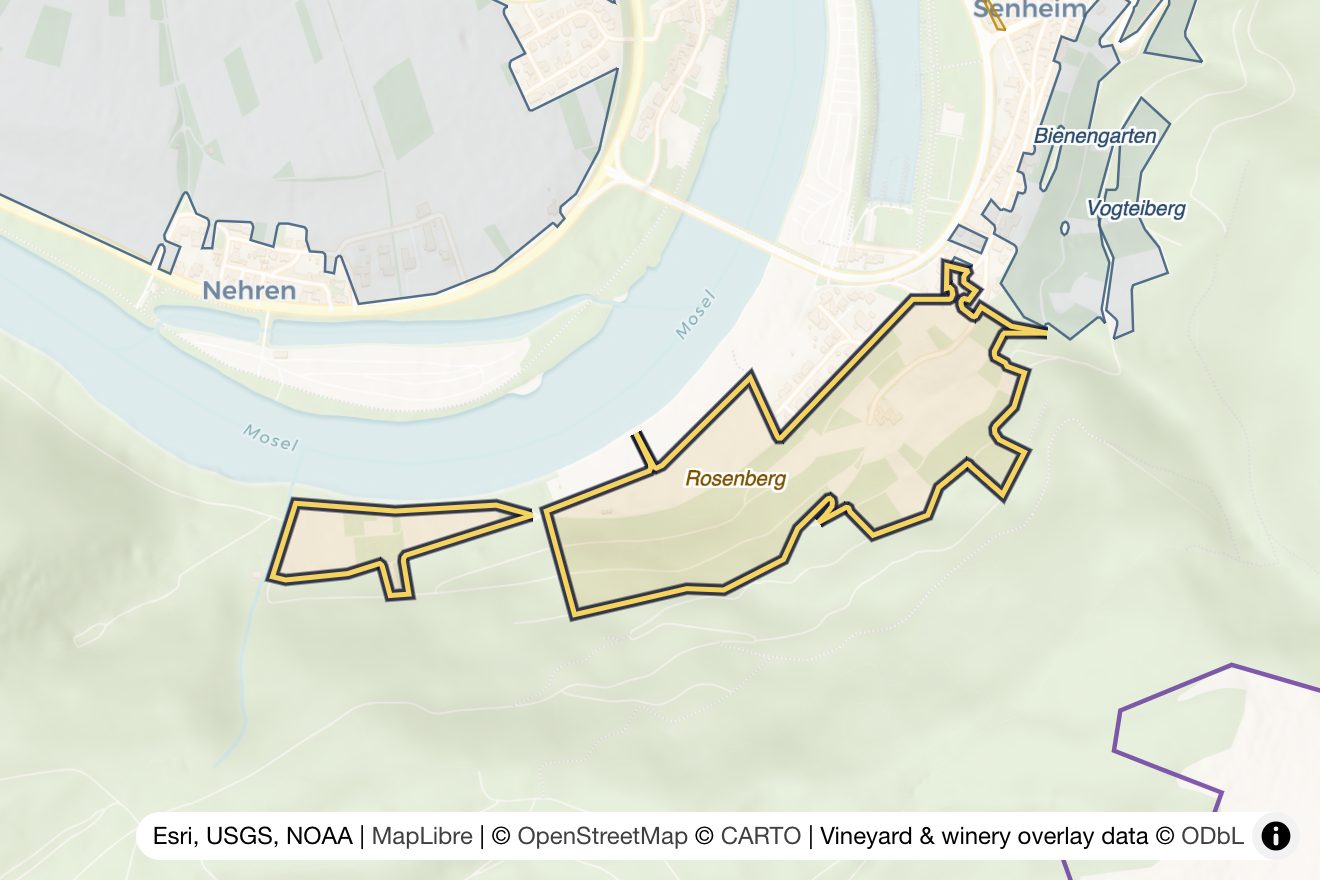
An unusually scattered village
Senheim-Senhals straddles a bend of the Mosel between Cochem and Zell, with vineyards on both banks, and its Einzellagen are split across three different Grosslagen, which is rare. The Rosenberg sits in Rosenhang, along with Bienengarten, Wahrsager, Vogteiberg and Lay. The Römerberg, at 31.2 hectares by far the village's largest site and shared with Nehren, falls in Grafschaft. A parcel of the Rüberberger Domherrenberg belongs to Goldbäumchen. Anyone reading a Senheim label needs to know that Senheimer Rosenhang, the Grosslage bottling most commonly encountered in the trade, is a collective wine from nine communes and is not this vineyard.
The fragmentation has a historical logic. Senheim belonged to the Protestant Grafschaft Sponheim rather than to Electoral Trier, which governed most of its neighbours, and it burned almost completely in the fire of 13 August 1839, which destroyed 106 houses and 22 press houses.
Weathered clay slate near the chapel
Weingut Loescher Erben provides the only detailed account of the site. Its Rosenberg parcels lie near the eighteenth-century Marian chapel known locally as the Oberstes Häuschen, a structure first mentioned in 1607 and rebuilt around 1700 on older foundations, on the upslope edge of the village. The soil is an almost completely weathered clay slate, close in character to that of the estate's Bienengarten, and the estate reads the wines as showing elegance and vitality.
That places the Rosenberg in the middle of Senheim's range as its growers understand it. The Bienengarten, the estate's steepest holding and formerly known as Senheimer Schwarzenberg auf Zinnenstegel, was the village's most valued site for centuries and gives a more crystalline, more precise wine. The Lay, on weathered blue clay slate across terraced and steeply hanging sections, gives something starker and straighter. The Rosenberg is the softer-shouldered of the three.
No VDP member estate is based in Senheim, and the site carries no VDP standing.