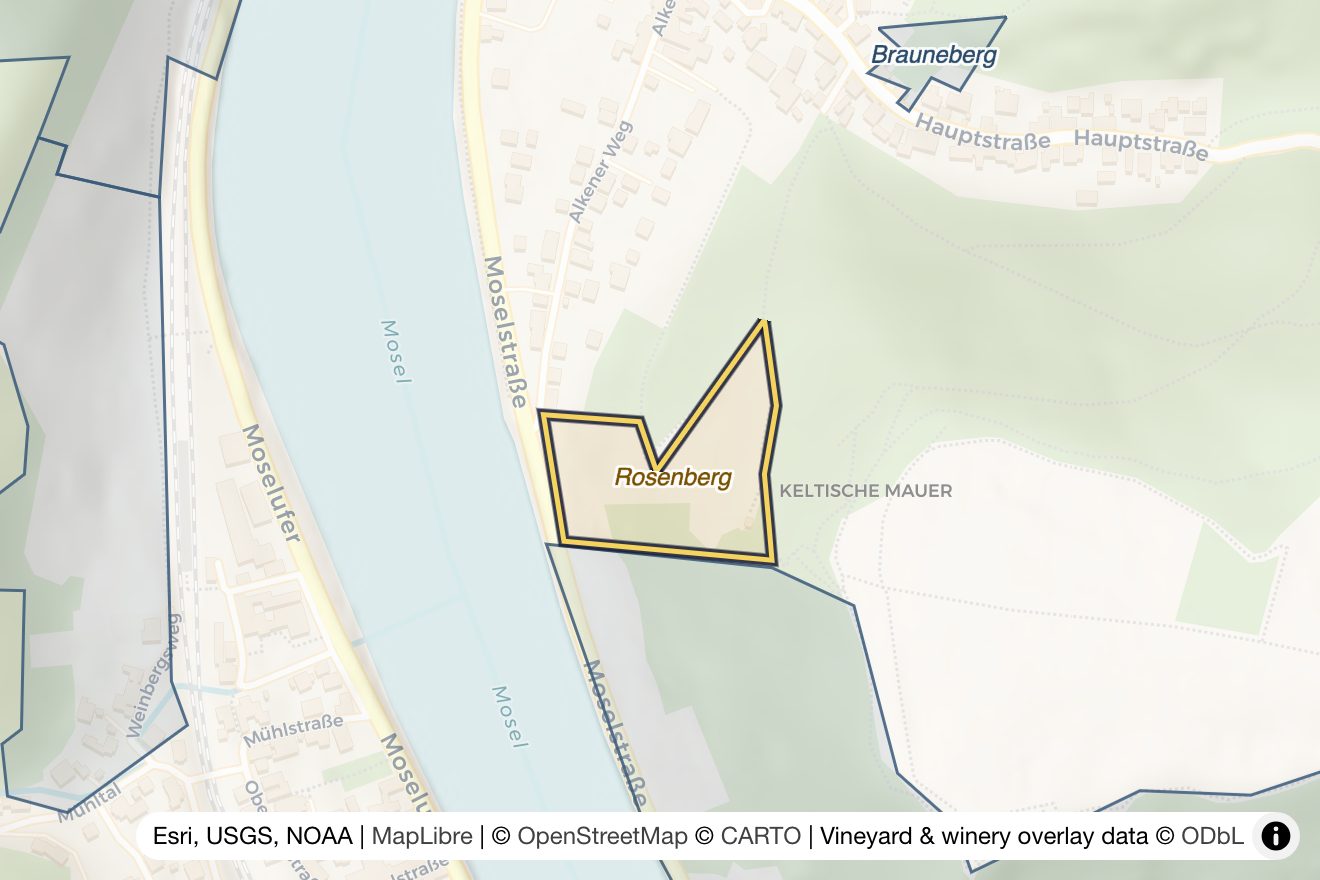
Oberfell lies where the Oberfeller Bach enters the Mosel, on ground climbing toward the Hunsrück.
From Mönchsberg to Rosenberg
The site is old, and it changed names inside living memory of the paperwork. The Weinfreunde Königinnenwingert association, which has done the archival work here, traces the vineyard to the Benedictine abbey of Maria Laach, founded in 1093 by Pfalzgraf Heinrich II, which held both the Mönchsberg and the Bleidenberger Hof in Oberfell for centuries. An eighteenth-century abbey document cited by the association records 16,900 vines in Oberfell yielding more than three Fuder in good years, and rates that wine above what the abbey drew from Alken next door. Secularisation under Napoleon after 1800 turned monastic property into state and then private hands, and a later Flurbereinigung consolidated the parcels and issued the Mönchsberg with its present name of Rosenberg.
The village once mattered. Viticulture is documented in Oberfell in 634, in a charter listing sixteen wine estates, eleven larger and five smaller. In the 1930s Oberfell carried 44 hectares of vines and ranked with Winningen and Kobern among the larger wine communes of the lower Untermosel. In the 1950s around 30 hectares remained, worked by more than a hundred families as a sideline and sold profitably in Fuder to larger cellars. The Prussian vineyard classification of 1868 had placed Oberfell's slopes between the third and eighth classes. What followed was the standard post-war sequence in an unfavoured village: no Flurbereinigung, poor access to the terraces, young people leaving the trade, and the 1960s swing toward early-ripening Bacchus, Müller-Thurgau and Kerner on flat land, which stripped Mosel Riesling of both price and prestige. Four part-time growers remain.
The slope itself
The association's own survey describes a gradient around 60 percent, the site sweeping from the northwestern edge of the village round toward the west, forming the smaller end of the long Alkener Lay massif that runs between Oberfell and Alken. The soil is moderately weathered sandy clay slate, increasingly accompanied by quartzites toward the top of the slope, in beds the survey identifies as Rittersturzschichten. Thin across most of the terraces, it is nonetheless described as slightly heavier and more drought-resistant than the neighbouring Oberfeller Brauneberg, and as suited above all to classic, drinkable Kabinett. At the time of that survey, most of the site was lying fallow.
The Königinnenwingert replanting
The association was founded on 26 March 2010 to bring the abandoned ground back. Its project covers one hectare and 2,500 Riesling vines, laid out as modern small cross-terraces rather than fall-line rows, a deliberate compromise that keeps terracing as a landscape feature while allowing machinery onto a 60 percent slope. The Dienstleistungszentrum Ländlicher Raum and the Ortsgemeinde support it; Weingut Alfred und Gabriele Christ takes on the farming and the vinification; sponsors adopt individual vines against an annual allocation of bottles and a name plate in the vineyard.
The name explains itself once the patron is identified. Sonja Christ, born in Oberfell in 1984, was the village's own wine queen in 2004 and 2005, represented the Mosel region in 2008, and was crowned the 61st Deutsche Weinkönigin in 2009. Königinnenwingert is literally the queen's vineyard.
Beyond the association's wine, Oberfeller Rosenberg surfaces only occasionally in commerce: Weingut Thönnes has bottled a Riesling Auslese from the site, and the Winzerwirtschaft in neighbouring Alken lists dry and off-dry Rieslings under the name.
No VDP member estate is recorded in Oberfell, and the association's classified Terrassenmosel sites lie downstream around Winningen. The Rosenberg carries no VDP standing.