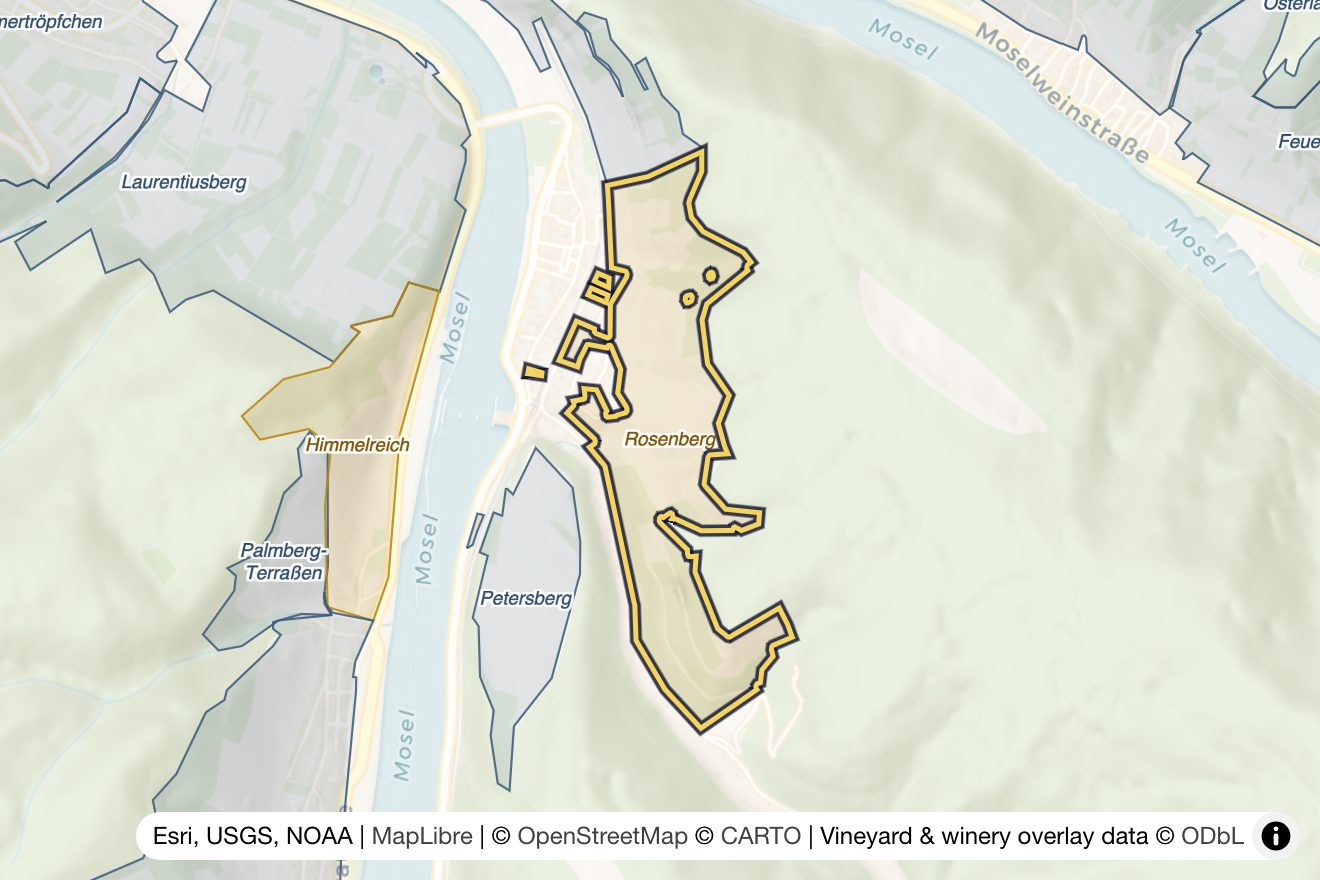
Position, Grosslage and Extent
The Rosenberg belongs to the Grosslage Grafschaft, inside the official Bereich Burg Cochem that the trade prefers to call the Terrassenmosel. Grafschaft is a collective appellation pooling vineyards from Nehren, Ediger-Eller, Bremm, Neef, St. Aldegund, Alf, Bullay and Zell-Merl, so a Grafschaft label locates a wine only within a stretch of river. The einzellage name is the one carrying information.
Exposure runs southwest and west. The west-facing flanks rise directly behind the village; a further set of parcels turns south into the Bachtal, where the stream has cut its own small valley. Parts are genuinely steep and parts are not, which is the honest description of a composite name rather than a single slope.
Our einzellagen layer delimits 37.91 hectares, with the centre point falling on Auf der Heid, the height above the village. Published planted figures run far below that, because they count vines rather than delimited ground: the Landwirtschaftskammer Rheinland-Pfalz register for the 2024 harvest records 6.6 hectares of vines under the Rosenberg name at Neef, against 9.0 hectares for Neef's share of the Frauenberg and 7.1 for the Petersberg. That gap is the usual Mosel arithmetic of a boundary drawn generously in 1971 around ground much of which has since gone back to scrub and wood.
Neef shows what the 1971 consolidation did to the local map in a second way. The historic Petersberg below the Petersberg chapel was absorbed into the Frauenberg, and the Petersberg name was reassigned to flatter plateau ground in the direction of Bullay.
Rock and Name
The Rosenberg is not the pure Devonian slate of the river front, and Weingut Amlinger & Sohn, whose cellar is in the village, is unusually precise about the difference. Their account puts greywacke on the slopes, weathered to scree loam and reworked into deep Rigosol and Regosol profiles; grey-brown Devonian sandstone shot through with reddish inclusions; gravelly loam in the parcels closest to the houses; and only pockets of true slate scree. The result is soil that is deeper and considerably richer in humus than the terraced slate a few hundred metres away.
The same estate rejects the obvious reading of the name. Roses have nothing to do with it, and neither do horses; they trace Rosenberg to old dialect forms meaning a jutting rise.
Who Farms It and What It Gives
Amlinger & Sohn treat the Rosenberg as Pinot Noir ground rather than Riesling ground, and say so without hedging. Their reading is that the loamy steep parcels in the Bachtal ripen Spätburgunder to a fleshy, full weight comparable to the lower Ahr, while the upper vineyards behind the village, where grey slate takes over, give something leaner, more mineral and more fruit-driven, closer to the upper Ahr. They bottle a Rosenberg Pinot Noir Steillage feinherb and a Rosenberg Réserve Pinot Noir trocken, and are candid that Riesling here rarely shows a strong signature, the Bachtal parcels excepted for their minerality.
Weingut August Croeff, also in Neef, farms the Rosenberg alongside the Petersberg and the Frauenberg, and like everyone else in the village reserves top billing for the Frauenberg.
The historical record points the same way. Reading the Prussian vineyard tax map of around 1900, on which darker shading meant higher assessment and therefore higher quality, Amlinger place the top classes on the lower south slopes of the Frauenberg and the Calmont. The Rosenberg is not where the Prussian assessors put their money.
No VDP standing attaches here. The VDP's own vineyard register lists no classified parcel at Neef; within the Terrassenmosel its entries are confined to Winningen and Hatzenport.