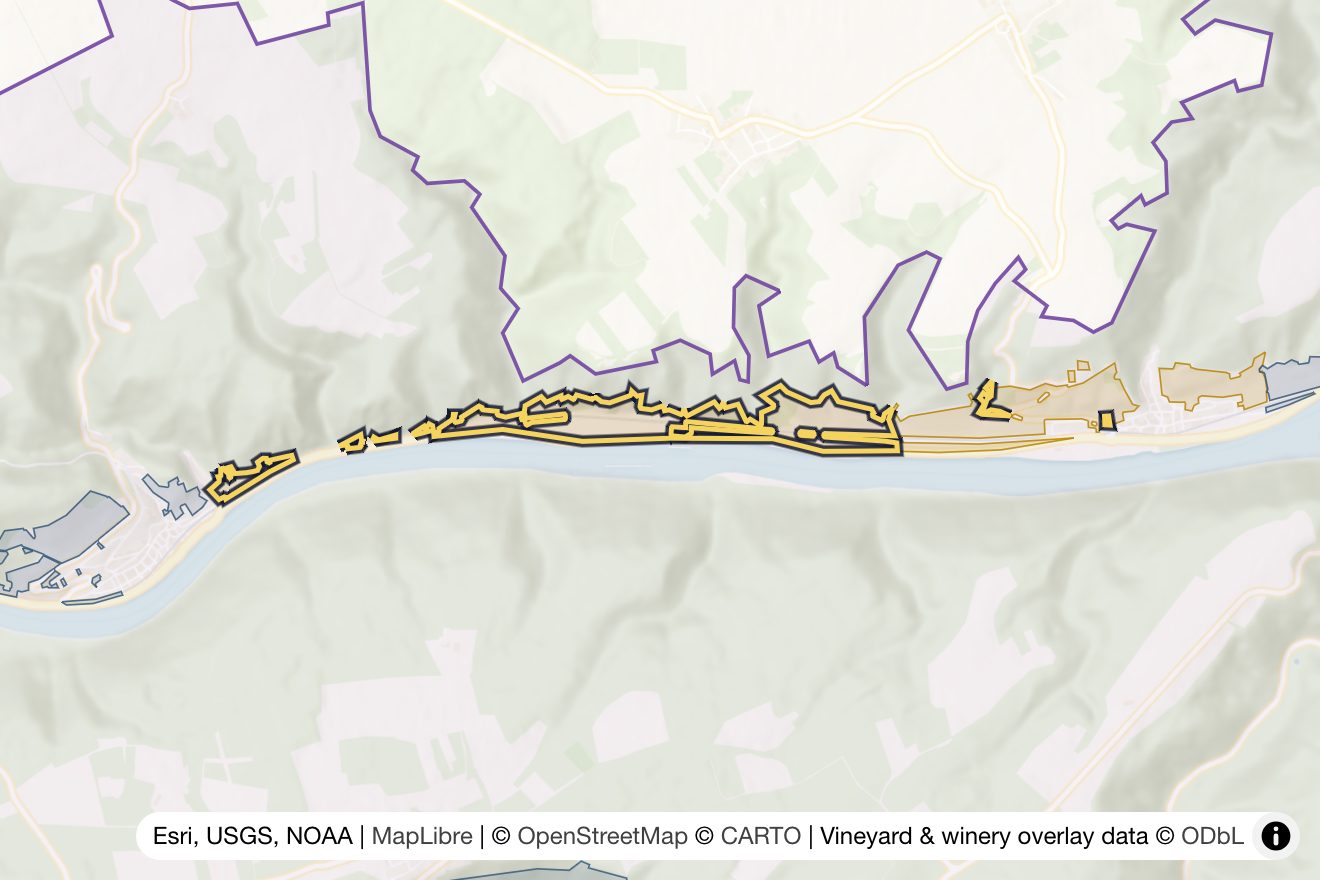
Growers along this stretch reject the floral reading of the name. Weingut Schneiders in Bruttig-Fankel gives the derivation as Old German Roß or Rost with the diminutive form Rosen, meaning a jutting rise in the ground. The topography, not the flowers.
The Grosslage tells you nothing
The site sits inside Grosslage Goldbäumchen, in the Bereich Burg Cochem, a collective appellation gathering vineyard land from fourteen communes including Ernst, Klotten, Pommern, Müden, Moselkern and parts of Cochem, Briedern, Ellenz-Poltersdorf, Senheim and Treis-Karden. A bottle labelled Klottener Goldbäumchen or Pommerner Goldbäumchen may legally contain fruit from any of them. Only the village-qualified Einzellage name on a label points at this hillside.
The Pommern half: terraces, and vines from about 1860
Two estates describe the same landform in the same words, independently. Schneiders-Moritz in Pommern places its old parcel on terraced steep slope directly behind the railway line between Pommern and Klotten, on what it calls the longest unbroken south-facing slope of the Mosel. Leo Fuchs, also in Pommern, describes its roughly ten hectares as lying between Pommern and Klotten on that same long south face. The soil there is stony and skeleton-rich slate weathering material, shallow across the upper terraces and of moderate depth further down.
What makes the Pommern end of the Einzellage genuinely important is a single parcel. Schneiders-Moritz farms ungrafted Riesling planted around 1860 whose original vine population survives intact, and cites a 2007 Geisenheim study placing it among the oldest vine plantings in Europe. Very few Mosel sites at any price level carry a comparable object.
The village context reinforces the age. Pommern takes its name from the Roman Pomaria, the orchard or fruit garden, and Abtei Himmerod was granted its first vineyard here in 1234 and went on to hold the largest single property in the village until the French dissolution of 1802.
The Klotten half: flat ground and red grapes
At the other end of the same site number, Weingut Theo Loosen, based in Klotten, describes Rosenberg as where its flat vineyards live, deep-soiled, workable with a small tractor, planted principally to Dornfelder and Rivaner and turned into Rotling and a soft Dornfelder. The estate reserves its serious slate for elsewhere in the village: the Brauneberg, pure weathered slate on a southwest face, listed among the Mosel's best in the tax survey of 1897 under its older name Wirges; and Burg Coraidelstein, slate cut with loam that wraps around the whole village and holds vines over sixty years old, partly rebuilt as cross-terraces after the 1983 Flurbereinigung.
That is the honest shape of this Einzellage. One number covers a monument of German viticulture at the Pommern end and everyday red-grape flatland at the Klotten end, which is precisely why the register bothers to break the hectares out by parish.
Bottlings, and what the classification is not
Leo Fuchs bottles a dry Pommerner Rosenberg as a Großes Gewächs, along with a Gewürztraminer Auslese from the site, and describes the dry wine in terms of ripe orchard fruit, honey and density carried on a fine fruit-acid interplay. Since the 2021 rewrite of German wine law, Großes Gewächs is a designation administered through the regional protection association rather than a VDP trademark, which is how an estate outside the VDP labels one legitimately; Fuchs has belonged to the Bernkasteler Ring, now Ring Mosel 1899, since 2004. Schneiders-Moritz bottles Riesling from the old-vine terraces, and Weingut Weckbecker of Moselkern also works parcels in Klotten and Pommern.
The VDP's Mosel-Saar-Ruwer roster lists no member estate in either Klotten or Pommern, and the association's classified Terrassenmosel sites lie well away from here, around Winningen and Pünderich. No VDP standing should be attached to this vineyard.