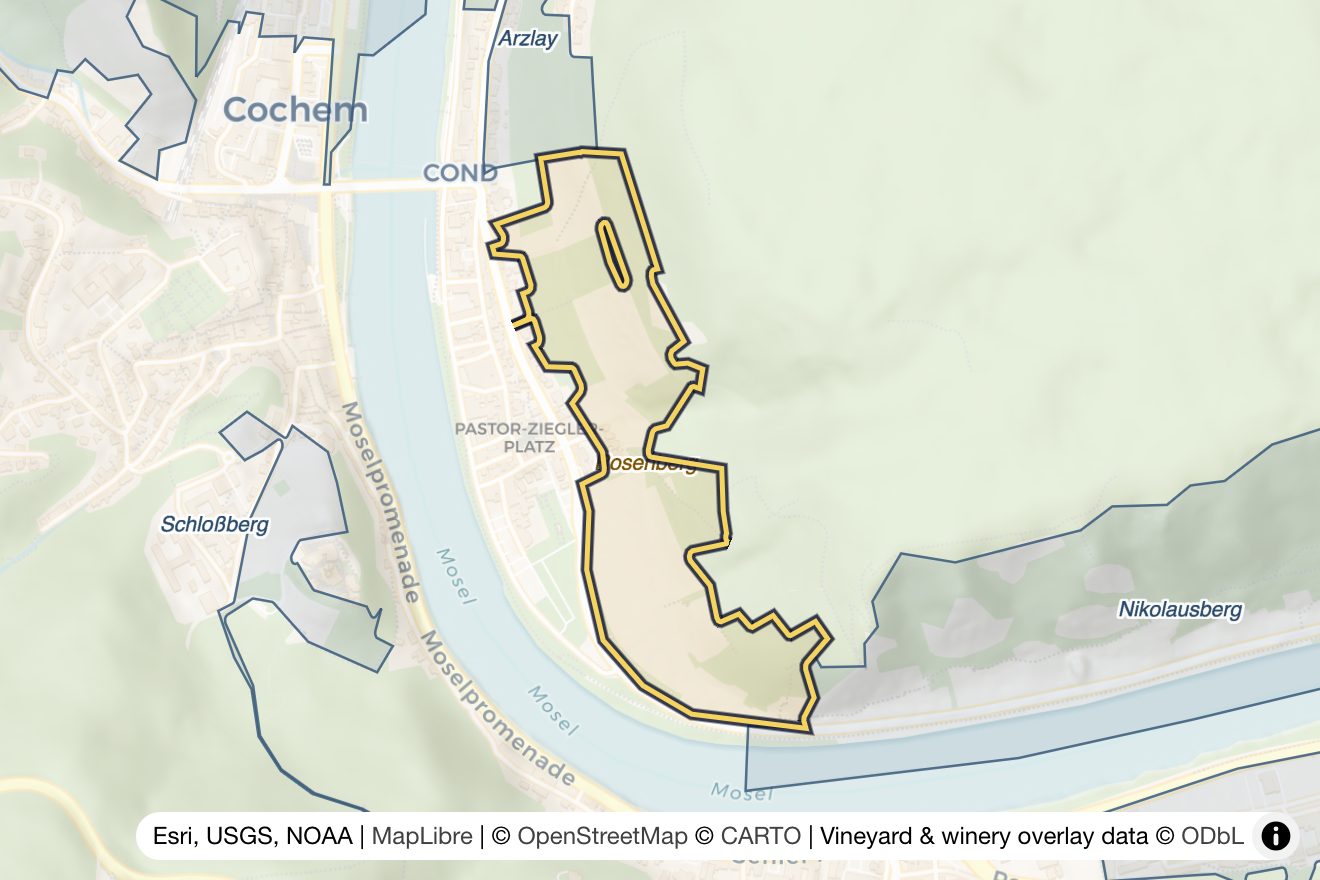
Where It Sits and What It Belongs To
Weingut Thielmann & Schinnen, which farms here, describes the site as southwest-facing and directly opposite the town, with the best view of it from the Reichsburg. Local promotion calls it the sunny side of Cochem and puts it roughly twenty minutes on foot above the town centre. It is terraced ground, and for more than a decade a group of Cochem growers and hosts staged the Weinlagenfest inside the vineyard itself, running wine and food stands along the terrace paths; the festival has since moved down to the riverbank.
The Grosslage is Rosenhang, and the line between Grosslagen runs straight through Cochem. The Cond sites, meaning the Rosenberg, the Nikolausberg and the Arzlay, fall to Rosenhang; the Herrenberg, Pinnerkreuzberg and Schlossberg fall to Goldbäumchen. Both are collectives spanning many villages, so neither name describes a slope, which is exactly why the einzellage matters. The official Bereich is Burg Cochem.
Rosenberg is among the most repeated names in German viticulture, and the local density makes the point: within this same Bereich there are further Rosenbergs at Fankel, at Senheim, at Moselkern and on the shared Klotten and Pommern ground, none of which has anything to do with this one.
Our einzellagen layer delimits 15.84 hectares. The Landwirtschaftskammer register for the 2024 harvest records 6.4 hectares of vines under the Rosenberg name at Cochem in the Gemarkung Cond, the smaller figure because it counts what is planted rather than what is bounded.
Rock, Planting and the Wines
The soil is weathered slate, and Thielmann & Schinnen make the conventional but locally accurate point about it absorbing daytime heat and returning it to the vines after dark. Descriptions of the Cochem sites circulating in the local trade add a detail worth carrying: a high proportion of quartzite and quartzitic sandstone mixed through the slate, which warms quickly.
The planting is not monocultural Riesling. Thielmann & Schinnen give their Rosenberg holding roughly seventy percent Riesling and thirty percent Spätburgunder and work all of it by hand. Within their range, whose motto is Steiler & Schiefer, the Rosenberg supplies the fruitier Rieslings, while the top-premium bottlings come from the steeper Valwiger Herrenberg on the far side of Cochem, a site the estate rates at up to sixty percent gradient. They nonetheless count the Rosenberg among the best ground they hold, and have made a Spätlese from it that was once listed under the shorthand Riesling C. Their own note on the dry bottling leans on yellow fruit, citrus and peach with a fine mineral thread.
Several Cochem estates bottle it. Weingut Haxel, on the Endertstraße in the town and committed to Riesling alone, lists Cochemer Rosenberg at Kabinett and Spätlese level in dry and off-dry versions. Josef Thielmann, Jürgen Steuer and H. H. Hieronimi appear on retail listings under the same site name.
No VDP classification applies. The VDP register lists no classified parcel at Cochem, and the nearest classified ground on the Terrassenmosel is downstream at Hatzenport and Winningen.