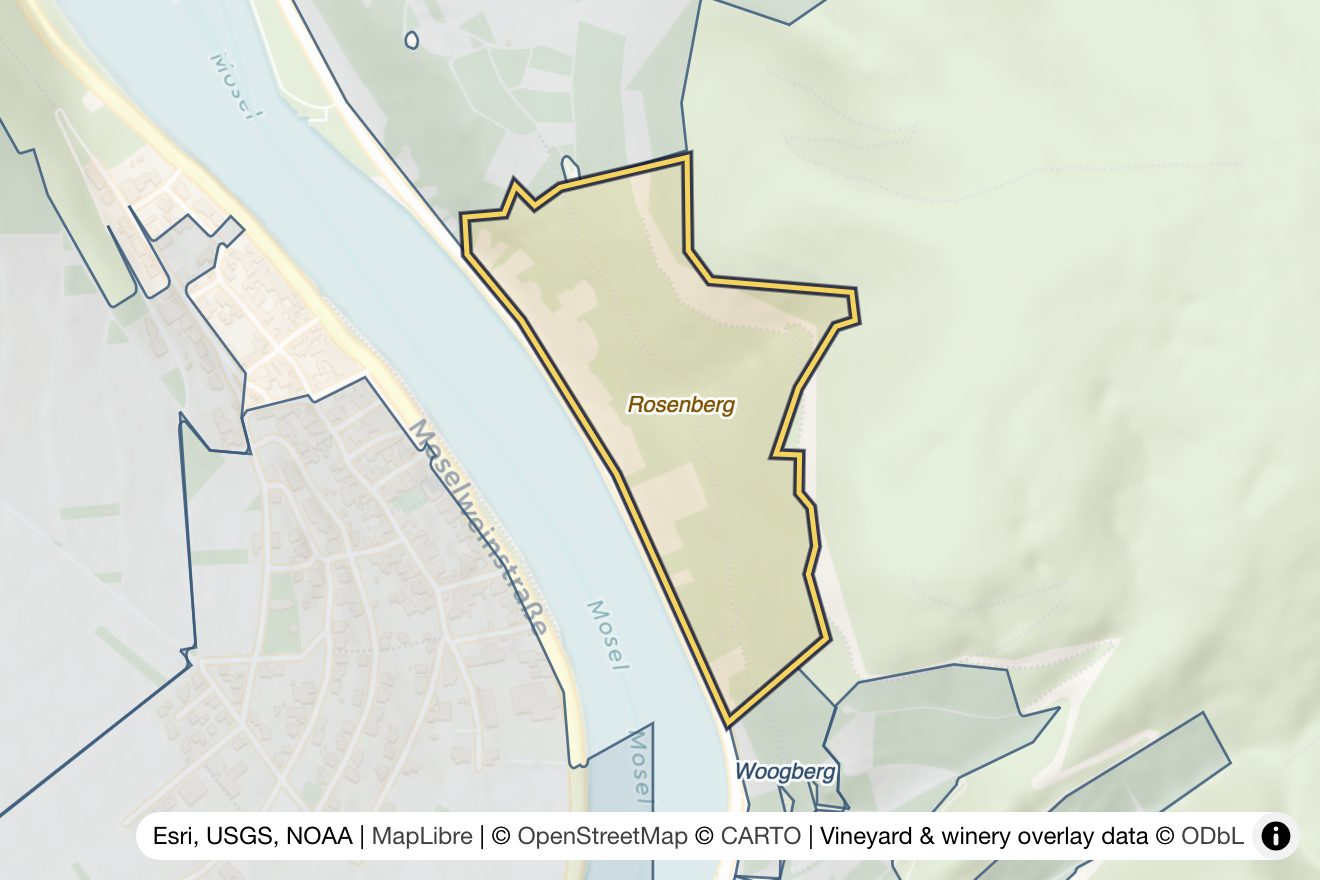
Weingut Schneiders, which farms here, is blunt about the name: it has nothing to do with roses, nor with horses. The derivation given is Old German Roß or Rost plus the diminutive Rosen, meaning a protruding rise.
A confusing address
The site sits in Grosslage Rosenhang, which shares that same root and creates a trap on labels. Rosenhang is a collective appellation drawing on Beilstein, Briedern, Bruttig-Fankel, Cochem-Cond, Ellenz-Poltersdorf, Mesenich, Senheim, Treis and Valwig, so a Senheimer Rosenhang or Bruttiger Rosenhang can come from anywhere across that spread and need contain nothing from the Rosenberg. Worse, the Rosenhang alone contains three separate Einzellagen called Rosenberg: this one at Fankel, one of 6.4 hectares at Cochem-Cond, and one of 4.9 hectares at Senheim. A fourth, at Neef, sits in the adjacent Grosslage Grafschaft. The village qualifier is not decoration here; it is the only thing distinguishing four different hillsides.
Greywacke, quartz and water
The geology is what separates this site from its neighbours, and it is not the Devonian slate that dominates Mosel writing. Schneiders describes the Rosenberg's bedrock as greywacke shot through with quartz veins, a combination that takes up water readily and holds it, on a face oriented south-southwest. That matters more each decade: the shallow slate that defines most of the Terrassenmosel shuts vines down in dry summers, while a water-retentive sandstone-derived rock keeps them working.
The contrast within a two-kilometre radius is instructive. Immediately adjoining is the Fankeler Layenberg, on grey and partly golden slate. Across the river from Bruttig the Götterlay rises at around 65 degrees on shallow to moderately deep weathered slate facing east to southeast, worked with a rack railway, and gives a fruitier, more nervous Riesling. The Bruttiger Pfarrgarten, between the village and the Valwiger Herrenberg, holds old and partly ungrafted vines on grey slate. Four sites, four rock-and-aspect combinations, one commune.
The wines and who makes them
Riesling from the Rosenberg is worked in two directions: powerful, spicy dry wines on one hand, and nobly sweet bottlings on the other. The greywacke's water supply is the plausible reason the site sustains both, since botrytis selections and ripe dry wine both demand fruit that has not shut down under stress.
Weingut Schneiders is the fullest documented grower here. Weingut Paul Schunk bottles Fankeler Rosenberg Spätlese and Auslese from old vines in steep planting, and Weingut Riedel also lists the site. Brunnenhof works in the same village.
The VDP's Mosel-Saar-Ruwer membership includes no estate in Bruttig-Fankel, and the classified Terrassenmosel sites the association names lie upstream at Pünderich and downstream at Winningen. No VDP classification applies to the Fankeler Rosenberg.