Ground and Exposure
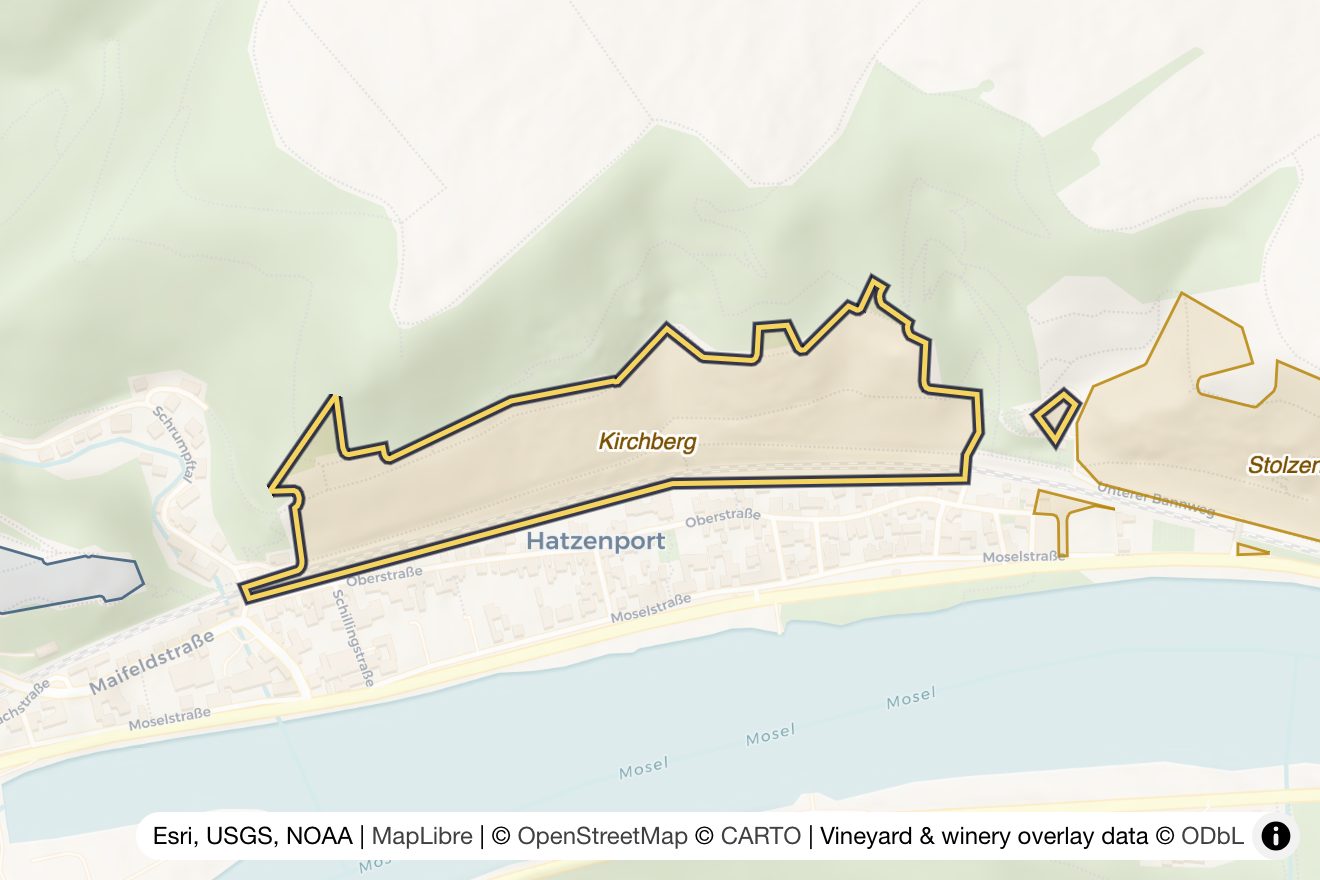
Hatzenport sits on the Mosel's left bank in the Terrassenmosel, the last stretch of the river where cultivation depends on dry stone walls rather than continuous slope. The Kirchberg rises immediately behind the village, due south facing, and accounts for roughly half of Hatzenport's vineyard area; the commune as a whole carries about fourteen hectares under vine across three sites, the Kirchberg, the Stolzenberg and Burg Bischofstein.
The einzellagen layer shipped with these maps delimits 9.04 hectares, measured geodesically. Growers in the village describe a planted Kirchberg closer to eight hectares at an average gradient near 55 percent. The two numbers should not be forced together: delimited ground includes walls, staircases, exposed rock and fallow terraces, while planted figures count vines. Terrain measured across the delimited block falls from about 220 metres on the upper ridge to roughly 85 metres at the water, with the productive band concentrated between about 85 and 160 metres. Heymann-Löwenstein gives 100 to 150 metres for its own parcel and puts the gradient on the terraced sections at 100 to 150 percent, which is the local rather than the average figure and is credible for the wall-held steps rather than the hillside as a whole.
The climate data Hatzenport publishes is unusually favourable for the Mosel: around 1,350 hours of sunshine and about 580 millimetres of rain a year, against a German average near 800. Village sources make the fair claim that this is the warmest and driest corner of the river. Until 1959 the terraces were worked entirely from the village below, before upper access tracks were cut.
Rock
The Kirchberg is not one soil. Heymann-Löwenstein describes its parcel as Devonian Lower Emsian quartzite, a hard slate laced with quartzite whose red colour comes from iron oxidised to hematite. The Trischelsberg parcel higher in the site is described as stony slate and greywacke weathering soil. Weingut Weckbecker, farming further along the Terrassenmosel, characterises its Kirchberg ground differently again, as dense and loamy with a lime content unusual for the Mosel. Taken together the picture is of hard quartzitic red slate through much of the block, greywacke where the weathering profile deepens, and clay bands cutting across the fall line.
That matters practically. Quartzite-hardened slate fractures rather than crumbles, drains fast, and stores less water than the softer grey and blue slates of the Mittelmosel; the clay seams are what keep the vines alive in dry summers. It is the reason the site ripens early and still finishes tight.
Classification, Growers and Wine
The Kirchberg belongs to the Grosslage Weinhex within the Bereich Burg Cochem. Weinhex entered the vineyard register only in 1971, as a renaming of the cadastral site Heideberg, and takes its name from the witch trials that killed nineteen people in the district between 1631 and 1656. Every wine from the constituent sites in Güls, Winningen, Kobern-Gondorf, Lehmen, Niederfell, Dieblich and Hatzenport may be sold simply as Weinhex, with no village named at all, which is precisely why the village-qualified single site is the only label term worth reading.
Parcels within the Kirchberg are classified VDP.GROSSE LAGE, and the classification is narrower than the hill. Heymann-Löwenstein of Winningen, the VDP member confirmed here, farms a single parcel of half a hectare with vines averaging around fifty years, and bottles it as VDP.GROSSES GEWÄCHS; earlier vintages appeared under the Erste Lage designation, and Mosel Fine Wines rated the 2015 in that guise at 92+, citing pear and Provençal herbs against a palate defined by grip and salt. Half a hectare is what the VDP mark actually attaches to. The remainder of the Kirchberg is worked by growers outside the association: Winzerhof Gietzen and Weingut Albrecht Gietzen in Hatzenport, Brunnenhof Ibald, the organic Traubenhüter estate, and Weckbecker, who also has Spätburgunder and Cabernet Dorsa planted here alongside Riesling. Weinbau im Trischelsberg holds a half-hectare monopoly parcel inside the Kirchberg whose historic name was restored to the register after recultivation, worked entirely by hand at yields below 25 hectolitres per hectare; the Trischelsberg was singled out among the river's best ground on the 1897 Mosel-Weinbau-Karte für den Regierungsbezirk Coblenz.
The Grosses Gewächs is fermented on ambient yeast in wood, without enzymes or fining agents, and held on its lees into the following summer before bottling dry. Within Heymann-Löwenstein's range it stands apart from the Winningen sites: where the Uhlen bottlings split one hill into three named geological bands, Kirchberg arrives as a single statement, more herbal and stony than overtly fruited, with the saline finish that hard red slate tends to give. The village growers work in a lighter register, dry and feinherb Riesling with sharp acidity and pronounced mineral bite; a 2012 Kirchberg from Winzerhof Gietzen took the regional S-Riesling competition against twenty-eight rivals on exactly those terms.