Where It Sits
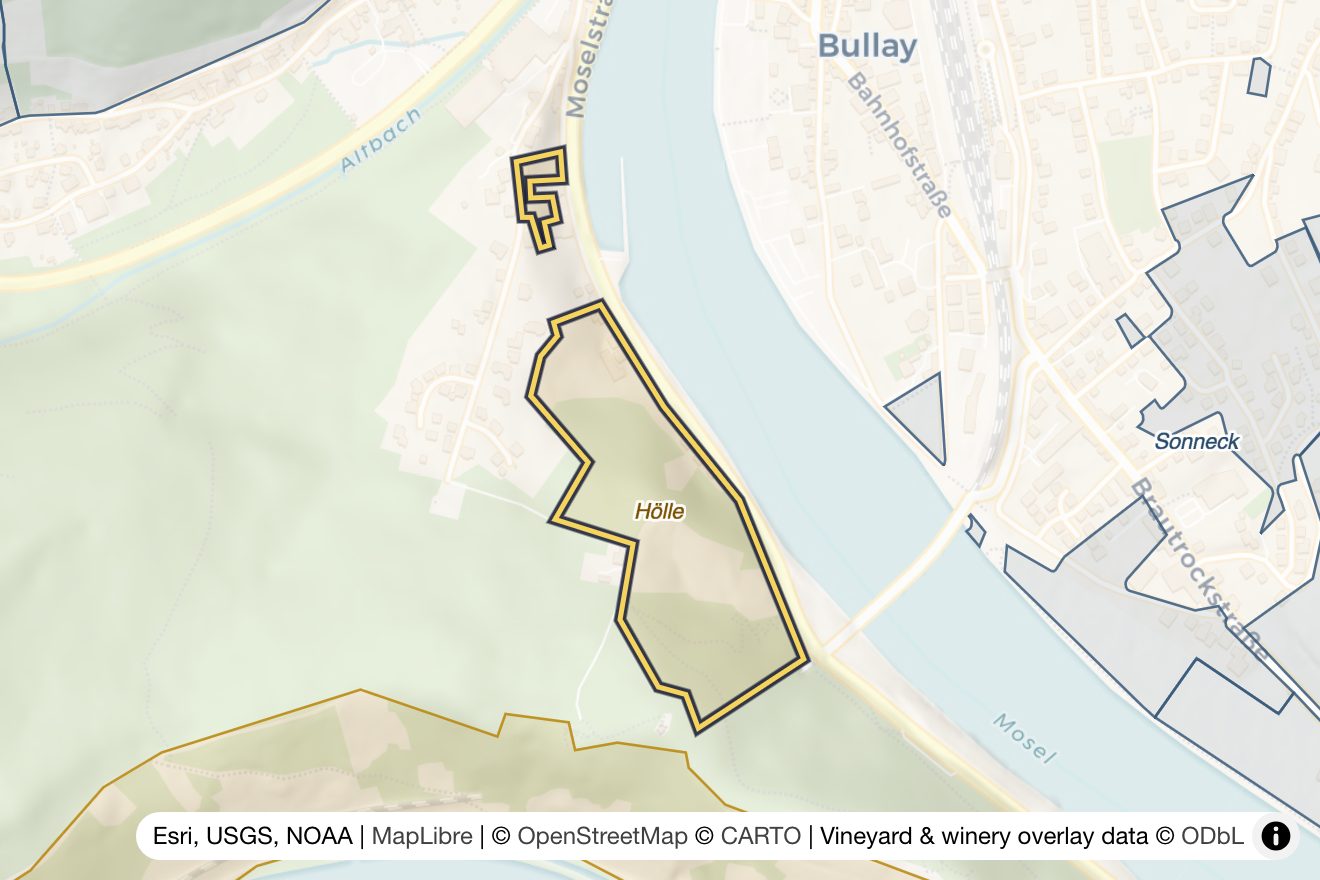
Alf lies on the left bank at the mouth of the Alfbach, facing Bullay across the double-deck bridge, in the stretch of the lower Mosel below the Zell loop. The Hölle occupies the flank at the eastern edge of the village, above the Moselstrasse, on the shoulder the river swings past as it turns north toward Bullay and Sankt Aldegund. Importers who have walked it describe a steep slate hill sitting more or less inside the village, and that is accurate: houses run to the foot of the vines.
The einzellagen layer shipped with these maps delimits 9.37 hectares, measured geodesically. Planted area is smaller, since delimited ground counts walls, tracks, rock and abandoned terrace. Terrain measured across that block rises from about 95 metres at the water to roughly 190 metres, at a mean gradient near 40 percent, and the fall runs consistently east and northeast rather than south. That exposure is unusual among the lower Mosel's serious sites and it explains the wines: strong early sun, afternoon shade, and acid retention that a south face would burn off. Ulli Stein's own notes on the site describe it as deep-rooted and well supplied with water, capable in some years of delivering both the highest must weights and the highest acidities in his cellar. The American importer Chambers Street calls it a classic Kabinett hillside, which is the same observation from the other end.
Soil descriptions diverge and are worth treating as unsettled. Accounts of the old parcel refer to red slate with clay; other trade writing on the site calls the slate blue. Slate with clay banding is common to all of them, and the iron note that runs through the finished wines argues for oxidised material somewhere in the profile.
Standing and Who Farms It
The Hölle belongs to the Grosslage Grafschaft within the Bereich Burg Cochem, alongside Alf's other individual sites: Arrasburg-Schlossberg, Burggraf, Herrenberg, Kapellenberg, Katzenkopf and Kronenberg. The VDP's own vineyard register lists no classified site in Alf and no member estate farming there, so no VDP standing attaches to this site; any classification flag in mapping data should not be read that way.
The site's reputation rests almost entirely on one estate. Wein-Erbhof Stein, run by Ulli Stein from Haus Waldfrieden above Alf and Bullay, farms about 6.5 hectares of steep slate, roughly 90 percent Riesling, with its other holdings in Sankt Aldegund at the Palmberg-Terrassen, Klosterkammer and Himmelreich. Within the Hölle sits the parcel Stein labels 1900: a plot of roughly 0.15 to 0.2 hectares carrying somewhere between 1,000 and 1,200 ungrafted Riesling vines planted in that year, described in the trade as the second-oldest producing Riesling ground in the Mosel. The figures differ from one importer sheet to the next and should be read as approximate. Stein is the single largest custodian of Germany's surviving ungrafted plantings, and the survival of this parcel is the reason the Alfer Hölle name travels at all.
The Wine
Stein bottles the site twice: a straight Alfer Hölle Riesling from younger grafted vines, and the 1900 cuvée from the pre-phylloxera plot, fermented in neutral wood and left to settle without correction. The Prädikat on the old-vine wine moves with the season rather than a house formula, appearing as Spätlese feinherb, Spätlese trocken and, from 2021, Kabinett trocken.
The profile is consistent across vintages and reviewers: crushed flowers and flint on the nose, then quince, apricot skin and Meyer lemon in layers, with a resinous green edge that reads as pine and mint against the fruit. Underneath sits a core of iron and salt. The wine's signature is the combination that ungrafted old vines on a cool aspect can produce and few others can, considerable ripeness and glycerol weight carried at low apparent density, with acidity that keeps the whole thing airborne.