The strip by the weir
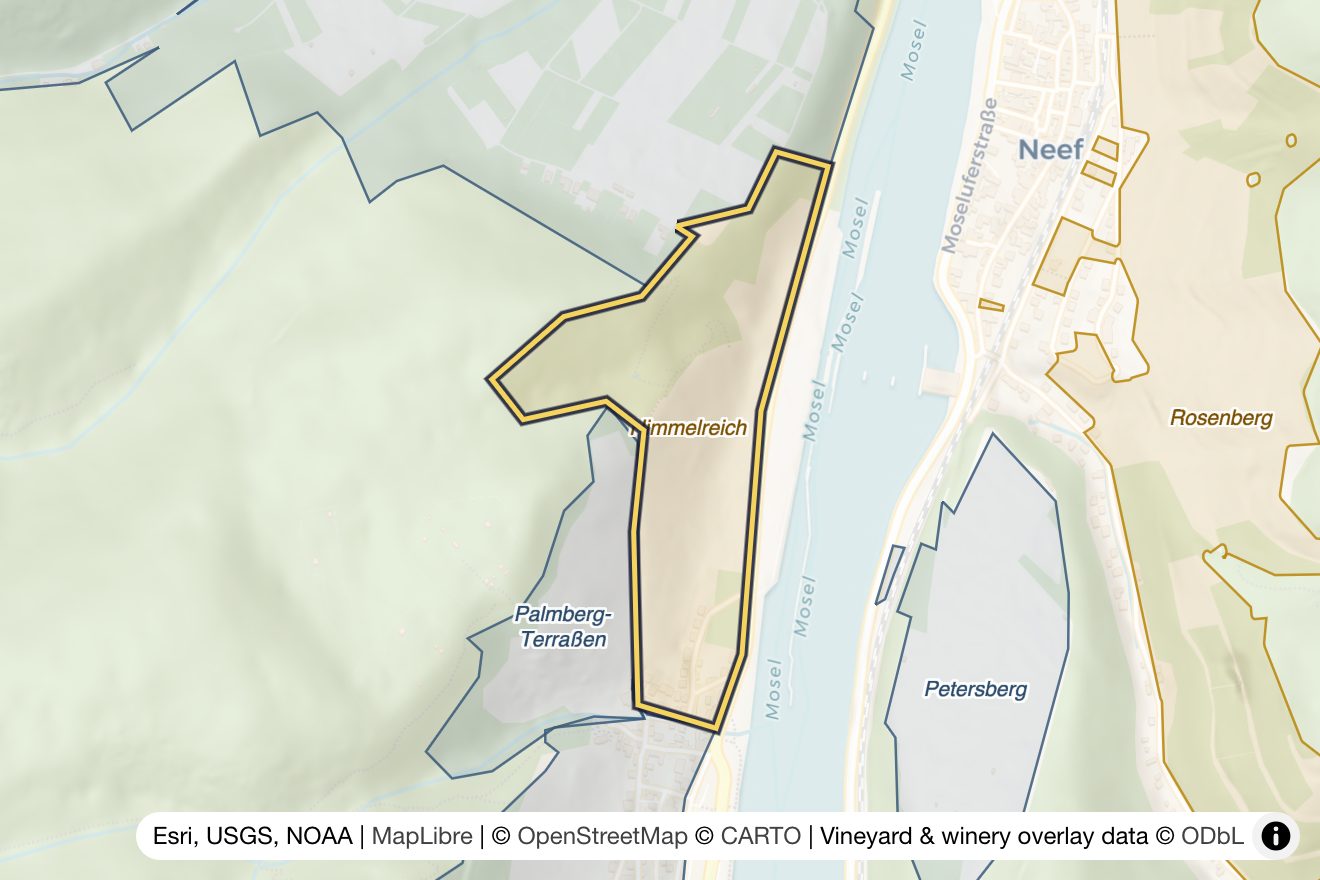
Sankt Aldegund sits on the left bank between Bullay and Neef, on a reach where the Mosel runs close to due north before bending west. The Himmelreich is a single continuous block running roughly 900 metres upward and northward from the Romanesque old church along the bank, ending where the river turns at the Staustufe Sankt Aldegund, the weir built in 1963 at Mosel kilometre 78.37 as part of the canalisation. That geometry gives the site an easterly exposure onto the water rather than the due south of the Mosel's showpiece slopes, and the morning-sun profile matters to how the wines turn out.
Our einzellagen layer delimits 17.65 hectares. The Rheinland-Pfalz register recorded 4.2 hectares of planted vineyard in 2022 and 2.8 hectares in 2024, the difference between the two sets of figures being that the register counts vines while the delimitation encloses the whole slope, walls and unworked ground included. Even by Mosel standards this is small: the village's three sites together, Himmelreich, Klosterkammer and Palmberg-Terrassen, amount to about seven hectares of vines in the current register. The Gemeinde describes the Himmelreich as almost purely a slate steep slope, worked at low yields for lean, mineral wine, and Winzerhaus Scheid notes that its parcels here cannot be machine-worked at all.
Blue slate, old wood
The rock is blue slate with a minority of grey. That distinction is not decorative here, because Ulli Stein, whose estate is in the village, works both the Himmelreich and the neighbouring Palmberg-Terrassen and reads the difference directly: he attributes the more charming, open-fruited character of his Himmelreich wines to the blue slate, and finds the Palmberg, which turns into a cooler side valley on blue and grey slate, better suited to the stronger dry bottlings while the Himmelreich makes the better sweeter wines. The vine material supports the same reading. His Himmelreich parcels are ungrafted, averaging over seventy-five years and running to eighty and beyond, some five to ten years older on average than the Palmberg plantings; roughly ninety percent of the estate's total holdings are on original roots. He added a quarter-hectare parcel in 2009, and the upper reaches of the site narrow into terraces of one or two rows.
Stein calls the Himmelreich his premier cru and the Palmberg his grand cru, and describes the site as a classic Kabinett hillside. His bottlings from it run just off dry, in the range of fourteen grams of residual sugar, and the Blauschiefer Riesling draws on old ungrafted vines in and around the vineyard. He is also the reason the site has any international profile at all: the author of the 2010 Mosel Manifesto arguing for the preservation of the steep slate, the litigant who forced the reversal of the Mosel's ban on red wine and won back the right to make Strohwein, and a buyer of Bremmer Calmont fruit at prices intended to keep that slope in production.
What is on the label
Wein-Erbhof Stein is the name that reaches export markets, with a Sankt Aldegunder Himmelreich Riesling Kabinett feinherb the most widely distributed bottling. Winzerhaus Scheid and Weingut Schumacher also hold and bottle parcels. Beyond that the site is farmed and sold locally.
Our data carries a Grosse Lage tag on this polygon. It should be disregarded. The VDP.GROSSE LAGE registered under the name Himmelreich is Graach's, above the Domprobst on the Mittelmosel, farmed by Willi Schaefer, Dr. Loosen, Kees-Kieren and others. No VDP member estate is recorded in Sankt Aldegund, and no parcel of this Himmelreich can be confirmed as classified. The Grosslage that does apply, Grafschaft, gathers Bremm, Bullay, Ediger-Eller, Neef, Nehren, Senheim and Zell-Merl alongside Sankt Aldegund, and locates a wine only within that run of the river.