The bowl
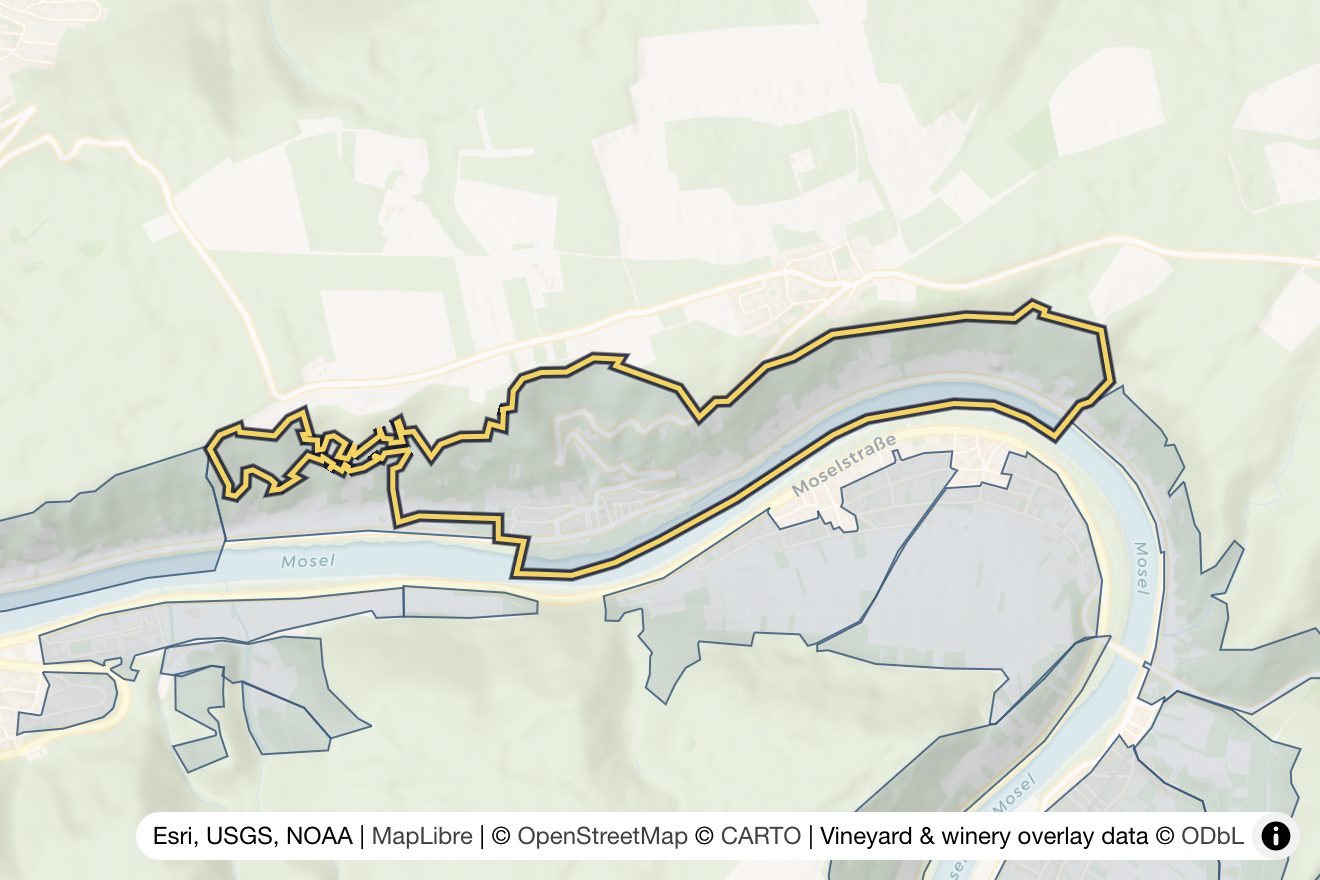
Valwig sits a short way upstream of Cochem, beside Ernst, on a reach where the Mosel runs close to east and west. The Herrenberg occupies the slope directly behind the riverside street and extends roughly three kilometres along it. Growers describe the shape as a half-round amphitheatre, and the description is topographic rather than promotional: the flanks turn back toward the water at either end, so vines on the wings look across the bowl rather than straight down the valley.
The exposure is south, which on the Terrassenmosel settles most arguments. Gradients reach and exceed sixty percent through the core, and the working surface is broken into small terraces carried on dry slate walls rather than presenting one continuous face. A monorack rack railway does the lifting on the steepest parcels. A 3.1 kilometre footpath laid out by BREVA, the steep-slope association that links growers in Bruttig-Fankel, Ernst and Valwig, runs through the middle of the vineyard, which is the easiest way to read the terracing from inside it.
Our einzellagen layer delimits 106.46 hectares here. Very little of that is vine. The Rheinland-Pfalz vineyard register recorded 17.9 hectares of planted area under the name in 2022 and 13.4 hectares in the 2024 return. The figures do not contradict each other: the 1971 delimitation enclosed rock, scrub, wall, track and abandoned terrace along with fruit, while the register counts only what is planted. The whole Gemarkung of Valwig holds roughly 27 hectares of vineyard, about 24 of them white varieties and three red.
Slate with greywacke through it
The rock is Lower Devonian, and it is not the clean blue slate of the Mittelmosel benches. Weathered clay slate dominates, but greywacke bands run through the sequence and quartzite fragments litter the surface. That mix is the signature of this part of the Lower Mosel: coarser, harder and less uniform than Wehlen or Graach, and correspondingly faster-draining. Growers in the village credit the quartzite content for the mineral tension in the wines.
Heat is the second half of the case. Estate accounts from Valwig put summer surface temperatures on exposed stone above fifty degrees, with the stored warmth released back into the canopy overnight. The practical result is a site that ripens Riesling dependably without forcing it. Village descriptions run to fine-boned fruit, floral lift and moderate alcohol rather than weight, and the better bottlings bear that out: concentration arrives through length and mineral grip rather than through mass.
Who farms it, and what the label leaves out
Holdings are fragmented across a village of a few hundred people. Weingut Dr. Zenzen is the largest name on the Moselweinstrasse; Ferienweingut Rudi Steuer, Jürgen Steuer, Göbel-Schleyer, Ferienweingut Ulrich Göbel, Rudorfer, Beuter and Boos all work parcels and bottle from them. Some vines exceed sixty years. Göbel-Schleyer's "1900" Riesling is the label most often cited outside the village, Weingut Dax bottles Spätlesen from the site, and Jan Matthias Klein of Staffelter Hof in Kröv has vinified Valwiger Herrenberg fruit for the Weinall project, which is how the name reaches the natural-wine trade.
No VDP member estate farms in Valwig, and our data records no VDP standing for the site. The nearest classified parcels on this side of the region lie well downstream at Hatzenport and Winningen. What a Valwig label may carry instead is Grosslage Rosenhang, an umbrella drawn in 1971 that also gathers Beilstein, Briedern, Bruttig-Fankel, Cochem-Cond, Ellenz-Poltersdorf, Mesenich, Senheim and Treis-Karden. A Rosenhang wine can come from anywhere in that stretch; only the einzellage name identifies ground.
Valwig's other site, the Schwarzenberg, carries about 6.5 hectares of vines on deeper soil along the same slope to the west, and takes most of the village's red and non-Riesling white. The division of labour is clean: Riesling and the steepest slate go to the Herrenberg.