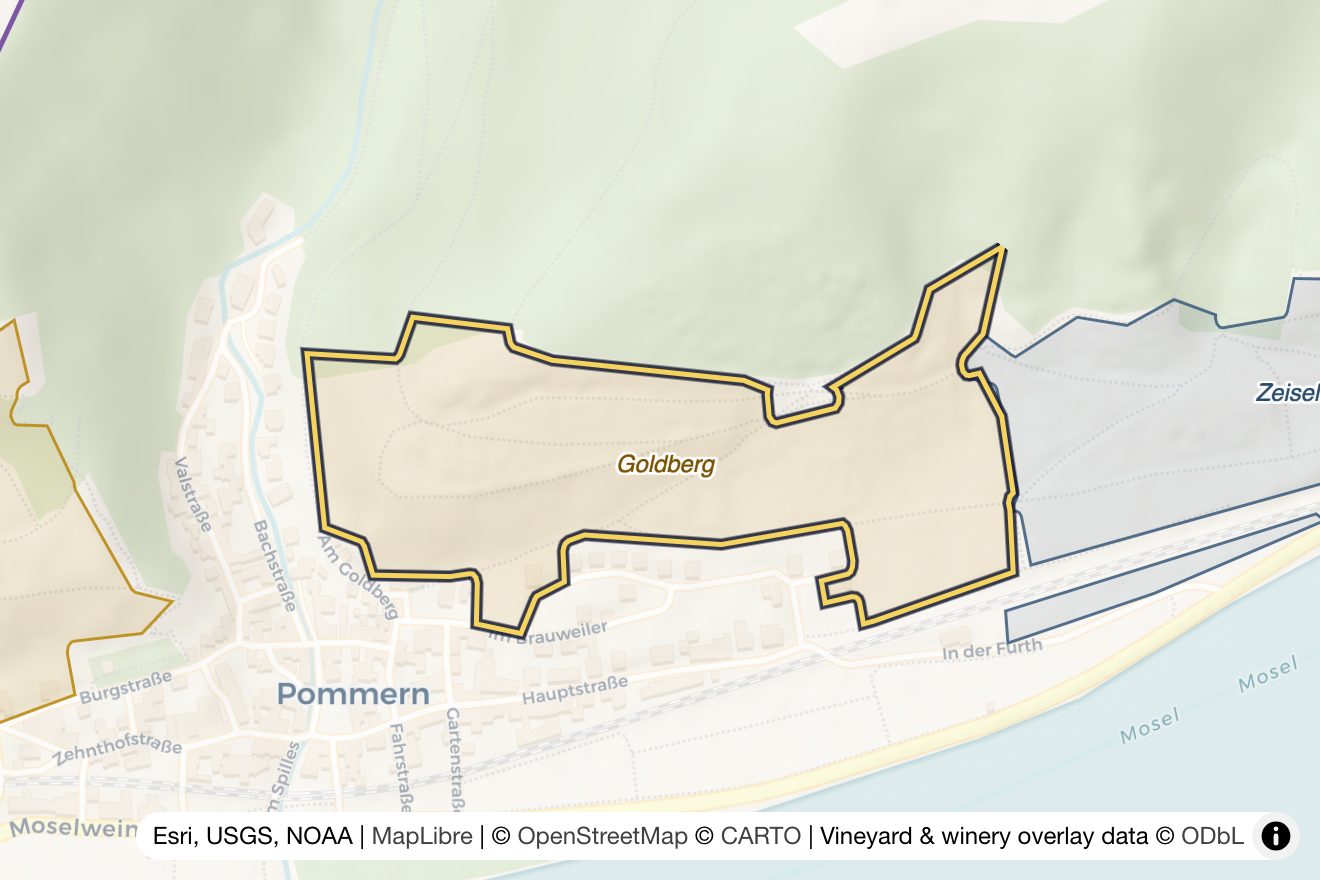
A compact block above the village
Our einzellagen layer delimits 9.35 hectares, split into five small pieces sitting immediately above and behind the houses, the whole thing contained in a rectangle of roughly 600 by 300 metres. The Rheinland-Pfalz register recorded 6.1 hectares planted in 2022 and 5.8 hectares in 2024. Published planted figures count vines rather than delimited ground, which is why they usually fall far short of a delimitation; the notable thing about the Goldberg is that they do not. Roughly two thirds of the delimited area is working vineyard, an unusually high proportion on a river where 1971 boundaries routinely enclosed several times more rock and woodland than fruit.
Pommern lies on the north bank, so its slopes run south. The village belongs to the long, near-continuous south-facing wall between Pommern and Klotten that local estates describe as the longest such stretch on the Mosel; the Goldberg is one small element of it, and its neighbours on the same slope carry more vines. Pommern's Rosenberg, shared with Klotten, holds about 19.6 hectares and stretches over four kilometres of hillside; the Sonnenuhr holds about 18.5, the Zeisel about 5.6. Soils are weathered slate. Growers here use the dialect word Schiefergör for the peppery savour they attribute to it, and it is the term that recurs across Pommern's own tasting notes rather than any generic mineral vocabulary.
Who works it
Weingut Leo Fuchs, with around eleven hectares one of the older and larger houses in the village, lists the Goldberg among its top sites and bottles a feinherb Riesling Spätlese from it. Weingut Michels names itself for the site outright, farming about 1.5 hectares in total across the Goldberg, Rosenberg, Sonnenuhr and Zeisel. Weingut Ebernach makes a dry old-vine Riesling from the Goldberg, and Blenz a fruity Hochgewächs. Weckbecker of Moselkern also works parcels in Pommern. The picture is of a working village site divided among small family estates rather than a name traded on the export market.
Our data carries a Grosse Lage tag here, and it does not belong to this vineyard. The VDP.GROSSE LAGE Goldberg listed on vdp.de is at Wawern on the Saar, a south-west facing site in a side valley above that village. No VDP member estate is recorded in Pommern, and no parcel in the Pommerner Goldberg can be confirmed as classified. What the label may instead show is Grosslage Goldbäumchen, an umbrella covering Klotten, Pommern, Müden, Moselkern, Treis-Karden, Ernst, Briedern, Ellenz-Poltersdorf, Bruttig-Fankel and Cochem-Sehl, which locates a wine only within a long stretch of the Lower Mosel. Pommern itself claims two thousand years of viticulture, and takes its name plausibly from the Latin pomaria, an orchard; a Roman memorial stone recording a Greek named Tychikos cured by wine is the local proof text.