The ground
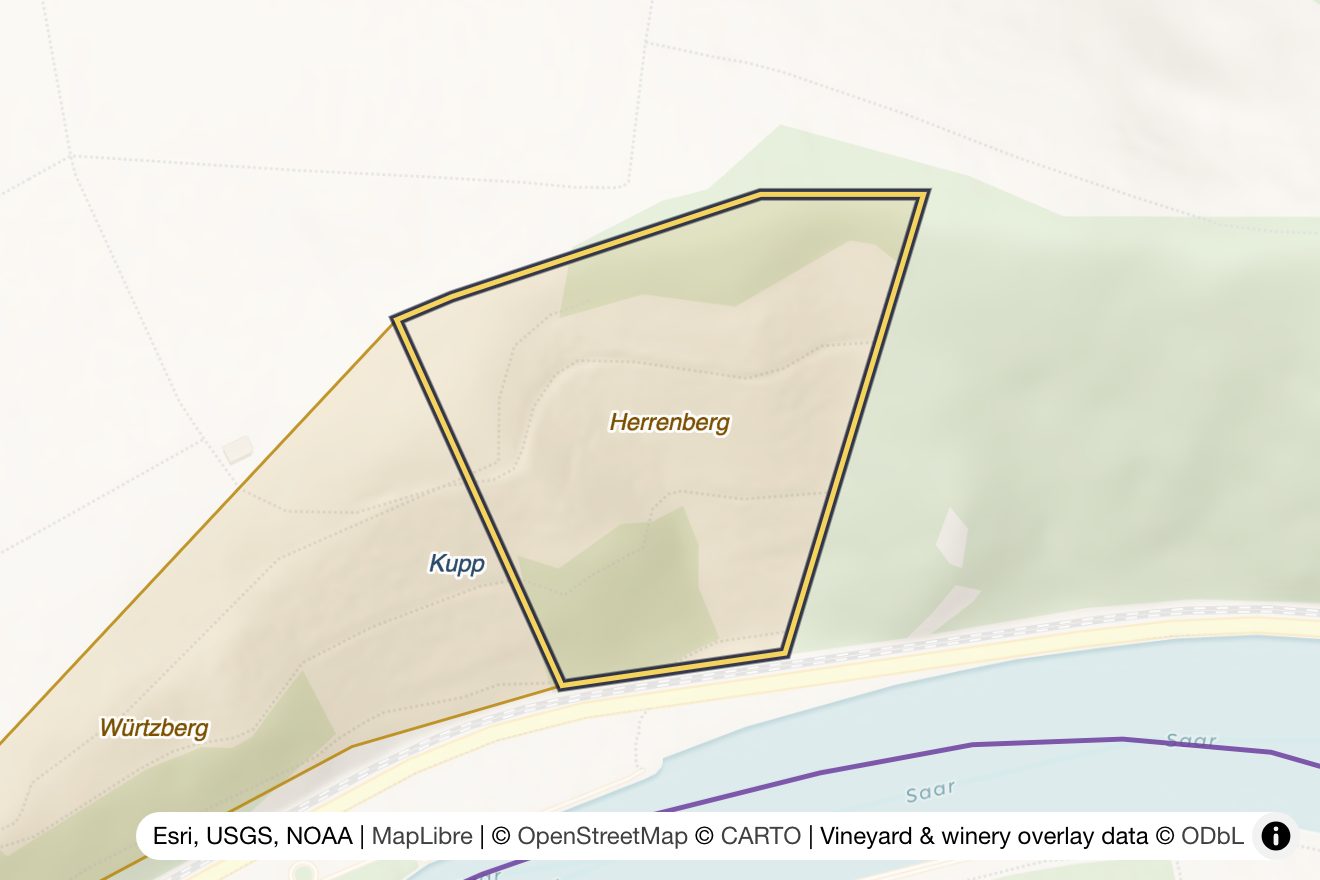
The einzellagen layer WineSaint ships delimits 11.35 hectares, measured geodesically, in a single compact block. The register enters the site as Lage 460255, Gemeinde and Gemarkung Serrig, with no planted area at all, marked k.A., its shorthand for ground held entirely by one business. Published planted figures normally differ from delimited ones because they count vines rather than land; here the register simply declines to publish, and that omission is itself the monopole record.
Terrain sampled inside the polygon runs from roughly 210 to 345 metres, a climb of some 135 vertical metres, with a median gradient of 53 per cent and pitches above 60. The face turns south, with the flanks swinging to south-southeast and south-southwest. The VDP's own profile agrees closely, giving south-southwest to southeast at 45 to 70 per cent on grey slate; the estate describes the soil as skeletal blue and grey slate, and bottles a Riesling under the name Blauschiefer. Serriger Würtzberg lies 600 metres west-southwest, Serriger Kupp 240 metres west.
The Grosslage is Scharzberg, which absorbs every Einzellage in the Saar Bereich and therefore distinguishes nothing.
The monopole and its history
Weingut Würtzberg owns the whole of it. The estate's account of its own founding is unusually well kept. In 1897 the widow of Eduard Puricelli bought the Würtzberg hill at auction from the Serrig Gehöferschaft; the first vine went in by her own hand on 13 March 1898, and parcels in both the Würtzberg and the Herrenberg were extended in the years that followed. Her son-in-law, the Prussian state minister Clemens Freiherr von Schorlemer zu Lieser, raised a neo-Renaissance press house above the river from 1903, inaugurated on 5 April 1905. The completed property ran to about 15 hectares, second in Serrig only to the state domain. The von Schorlemer family held it until the end of the 1960s.
Bert Simon then bought the two vineyards and afterwards the buildings, renaming the estate Weingut Herrenberg. He planted Weissburgunder and, in the mid-1980s, became the first grower on the Saar to plant Spätburgunder, which went into the warmest and steepest parcel of the Würtzberg rather than the Herrenberg. The journalist Dr Jochen Siemens owned and ran the property from 2006 to 2016 as Weingut Dr. Siemens; the Heimes family took it on in the summer of 2016 and reverted to the founding name, with Felix Heimes in charge since 2018 and about 17 hectares under vine.
The vineyard is still worked to a parcel map drawn in 1904. Weissburgunder was first planted in the Herrenberg in 1980 and occupies parcel 8 and much of parcel 4; Auxerrois has since been added. Planting density runs to about 6,000 vines per hectare and many parcels carry vines over 70 years old. Slate dry stone walls rise as high as ten metres inside the vineyard, and the wider Denkmalzone Würtzberg protects more than two kilometres of walling up to six metres tall together with a slate staircase that climbs over 200 vertical metres from the river to the treeline.
Classification and wine
The VDP's vineyard register carries HERRENBERG, Serrig as VDP.GROSSE LAGE with 6.51 hectares classified for Riesling, and carries the neighbouring Würtzberg at 4.00 hectares on the same footing. Neither entry names a member estate at work in the site, so the classified area reads as a survival from an earlier membership rather than a live claim. The owner belongs instead to the Ring Mosel, the Bernkastel auction society founded in 1899, and markets both monopoles under that association's Grosse Lage tier.
On skeletal blue slate at this gradient the Riesling comes out slim, high-toned and mineral rather than broad, which is the profile the estate itself claims for the site. Weissburgunder and Auxerrois from the same slope give softer, spicier wine that keeps the delicacy. The contrast with the Würtzberg next door is the useful one: red slate with quartzite and a deeper humus fraction there produces a fuller, spicier Riesling, and setting the two monopoles side by side is the clearest demonstration of red against blue slate available anywhere on the Saar.