A valley the Mosel abandoned, and a village the map renamed
The Tälchen is not a tributary valley in the ordinary sense. It is an abandoned meander of the primeval Mosel, cut off and left dry, and the four wine villages strung through it (Niedermennig, Obermennig, Krettnach, Oberemmel) sit on the floor of an old river bend with only a brook running where the Mosel once did. Niedermennig itself stands at 201 metres, at the mouth of the loop.
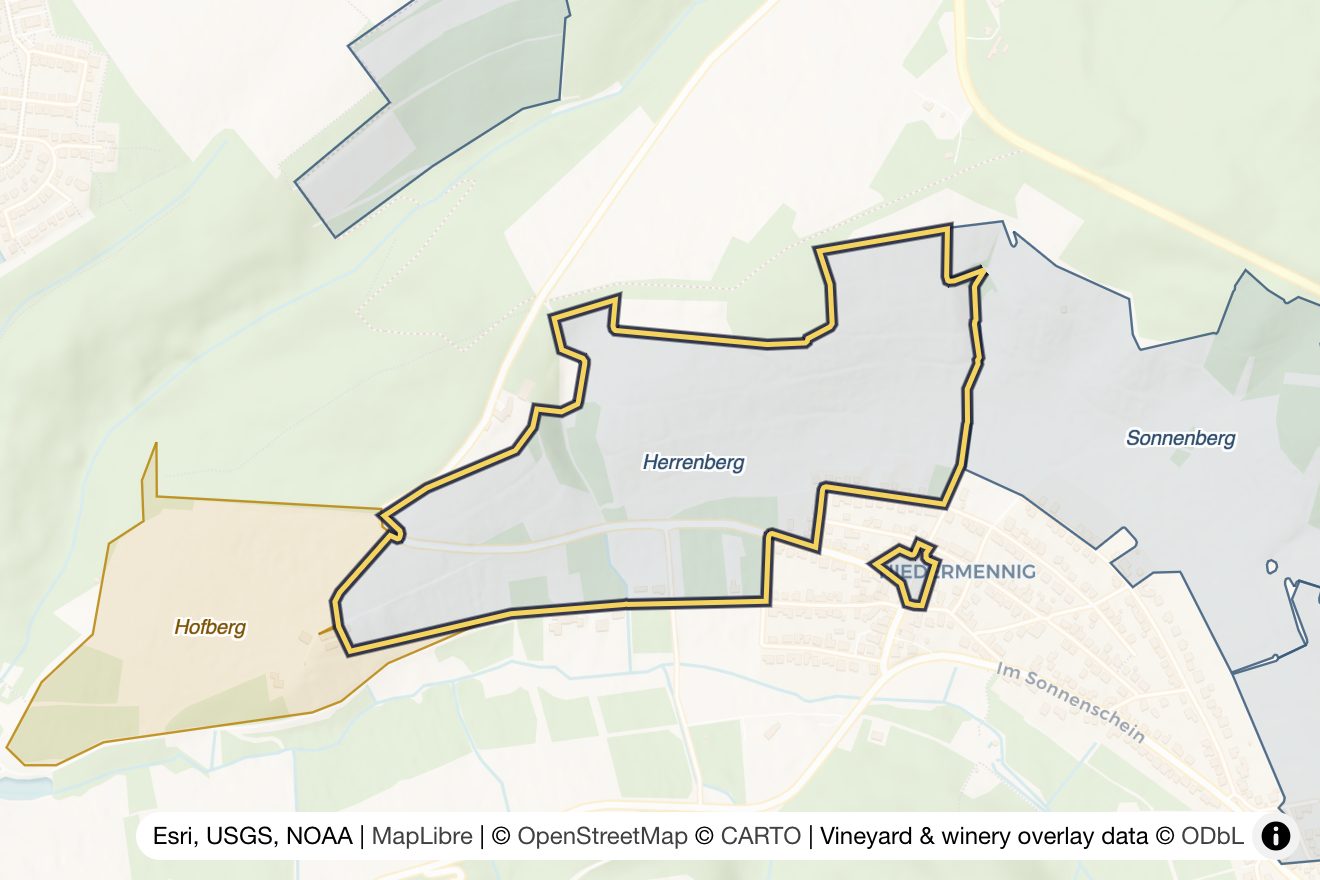
The administrative history explains a persistent confusion. Krettnach and Niedermennig were fused into a new commune, Mennig, on 7 June 1969; Mennig was absorbed into Konz on 7 November 1970, months before the wine law that fixed Germany's modern vineyard boundaries. The Rheinland-Pfalz Weinlagen register therefore carries the site under Konz, as Lagen-Nr 460230, while the Gemarkung stays Niedermennig and every label in commerce uses the historic village name. The register records 25.7 hectares planted. The delimited envelope measures 50.0 hectares. The gap is not an error: the 1971 delimitation drew lines around ground that could carry vines, not around vines that existed. Franz Josef Clotten's 1868 Prussian tax map of Mosel and Saar viticulture shows this ground under an older name, Zuckerberg.
Slope, rock and the cold
The Herrenberg is broad rather than dramatic, running from below the Falkenstein estate roughly half a mile back into the valley, facing south to south-west, between about 200 and 280 metres. Cover is thin over the bedrock.
Sources split on what that bedrock is called, and the split is instructive rather than contradictory. Falkenstein and its chroniclers describe iron-rich grey slate with quartz and quartzite-bearing sandstone. Stefan Müller records his parcel simply as Rotschiefer, red slate, and German site descriptions follow suit, adding that fine earth is unusually plentiful here. Iron-charged grey slate weathers rust-red at the surface, so both readings can describe the same hillside from different distances.
Altitude, no moderating body of water, and a valley floor that pools cold air make this one of the coolest pockets of German viticulture. Ripeness is earned, and the wines carry acid that would be punishing on lesser fruit.
Falkenstein's home ground
Erich Weber began making wine in 1981 and took on the derelict Falkensteiner Hof, acquired from the Friedrich-Wilhelm-Gymnasium foundation in Trier, in 1985; his son Johannes now works alongside him. The Herrenberg is the estate's centre of gravity, and the label is exact about it: whole bunches pressed quickly, juice moved by gravity, ambient fermentation in 1,000-litre Fuder, no chaptalisation and no deacidification, each cask bottled on its own.
That last point is why Falkenstein's Herrenbergs arrive as a small crowd rather than a single wine. The AP number identifies the cask, and each cask carries a nickname, usually the former owner of the plot it came from. The Kabinett trocken Egon (AP 19) and Kabinett feinherb Herbert (AP 15) are the fixtures, joined by Mutter Anna (AP 1), Palm (AP 3), Onkel Peter (AP 4) and Meyer Nepal (AP 11), the last from high in the site, level with the treeline. Riesling dominates, though a Weissburgunder Spätlese trocken and a Pinot Noir rosé also come off this ground. Falkenstein's other hill, the Falkensteiner Hofberg, is a separate registered site and not part of the Herrenberg.
Other hands, and rank
Stefan Müller, farming eleven hectares out of Konz-Krettnach, bottles a Herrenberg feinherb from a parcel he names Zeien, planted in 1973; Weinmanufaktur Petershof works the site as well. The VDP vineyard register lists no classified parcels in Niedermennig, the nearest classified ground in the Tälchen being the Hütte at Oberemmel. Rank here is not conferred by anyone. It is argued cask by cask, in wines that taste of apple skin, herbs, cold stone and salt, and that grow more persuasive after a decade in bottle.