The Register Entry
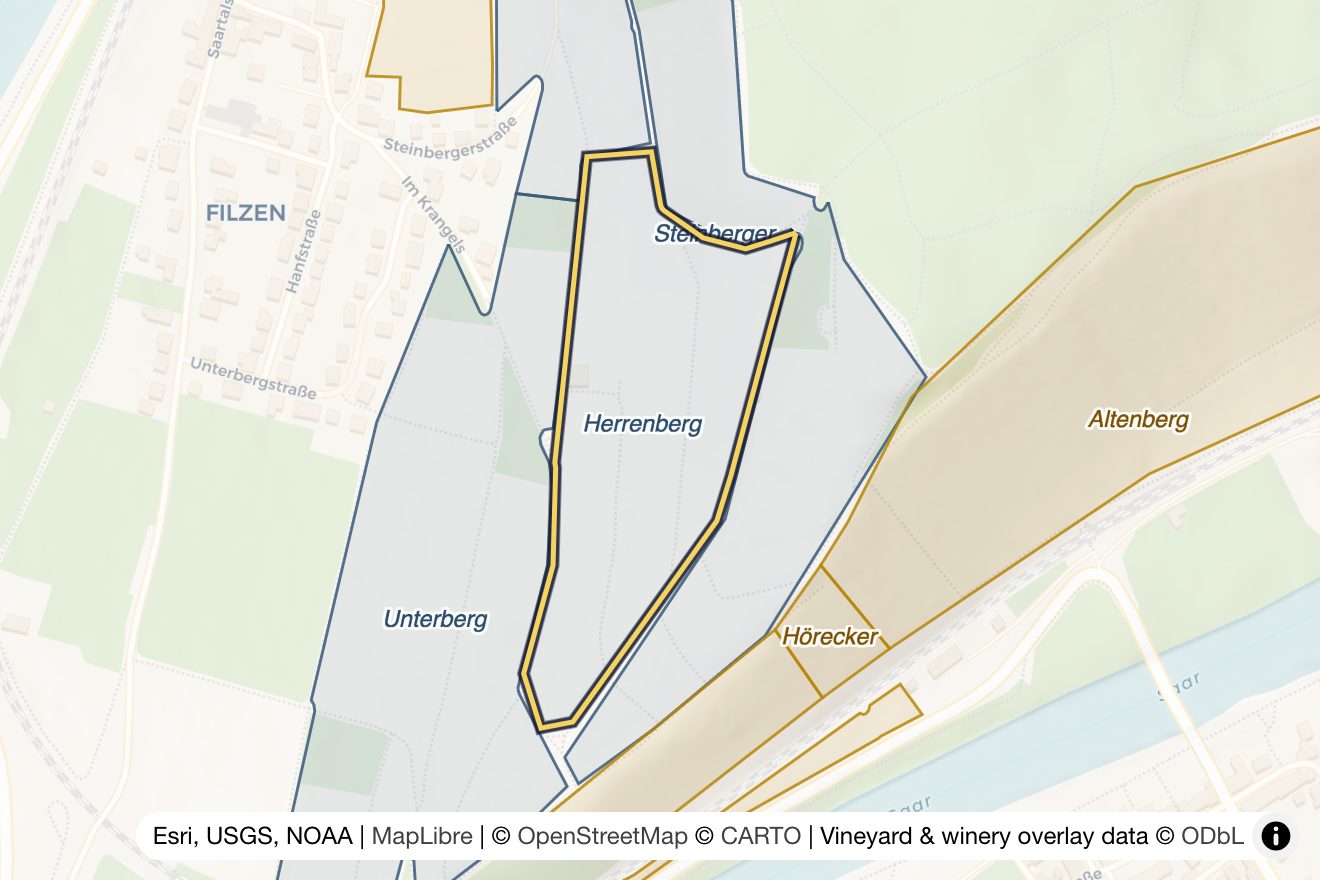
The Rheinland-Pfalz Weinlagen register carries the site as Lagen-Nr 460204, Gemarkung Filzen, Grosslage Scharzberg. Measured geodesically off the delimited boundary, the einzellage comes to 6.4 hectares, a compact figure next to the 17 hectares of Wiltinger Braunfels upriver. Against planted area the register prints "k.A.", a notation its own legend reserves for sites in the hands of one owner, since publishing the number would publish an estate's holding.
The farmed figures in circulation land in the same place. Lars Carlberg puts Reverchon at 6.4 hectares here; the estate says 6.5. Delimited and planted hectares usually diverge, because the 1971 delimitation drew its lines around ground capable of carrying vines rather than ground that carried them. In the Herrenberg the two readings nearly meet, which is another way of saying the slope is worked out to its edges.
Aspect is southwest, on gradients published at 30 to 50 percent, within an estate range of roughly 160 to 250 metres. Filzen's hillsides otherwise look west to west-southwest, folding together with Kanzem's into a V at the bend of the river. The rock is Devonian: lime-free slate that weathers readily, so the profile holds broken stone and fine earth in rough balance rather than the near-bare rubble of the steepest Mittelmosel faces.
Two Herrenbergs, One Konz
The modern commune of Konz absorbed several older wine villages, Filzen and Niedermennig among them. The register files their vineyards under Konz while the trade keeps the historic village name, which is why a label reads Filzener Herrenberg and the paperwork reads otherwise. One consequence is that a single commune now holds two Herrenbergs about four kilometres apart, and they are not the same thing. Niedermennig's sits inland in the Konzer Tälchen, facing south on iron-charged slate. Filzen's turns southwest on weathered slate directly above the Saar.
Sole Ownership
The estate is Weingut Reverchon, whose buildings stand at the foot of the hill. The vineyard begins behind the cellar and, by the estate's own reckoning, runs on almost as far as the Altenberg. The monopoly was not inherited intact but assembled, through exchanges and purchases that squared a fragmented hillside into one block.
The house itself was church property before secularisation, passing to the Staadt family in 1685, to the Reverchon family in 1921, and to Reverchon KG in 2007 under Hans Maret, with Ralph Herke directing vineyard and cellar since 2013. Nineteen hectares in total, 79 percent Riesling, and some of the Herrenberg's oldest rows ungrafted and past a century. Vines predate all of it: Tranchot's map of 1812 already shows vineyard across parts of the Herrenberg and the neighbouring Steinberg, and a 1725 visitation protocol from the Konz deanery counts tens of thousands of Jesuit vine stocks in the Konz holdings that contained Filzen. The name, the lords' hill, points the same direction.
Classification here needs care. The VDP's Mosel roster shows no member with parcels in the Herrenberg, so no VDP tier attaches to any of it; Filzen's VDP standing rests on the Pulchen, whose parcels are listed as VDP.GROSSE LAGE for Weingut Piedmont elsewhere in the same Gemarkung. Reverchon belongs instead to Der Ring Mosel, known as the Bernkasteler Ring until the name changed at the start of 2024, an association founded in 1899 with roughly 39 members that has operated its own Grosses Gewächs programme since 2005, limited to dry Riesling and Pinot Noir from internally classified steep sites. The dry Herrenberg is bottled under that scheme.
The Wines
Riesling covers the full register: Kabinett, Spätlese and Auslese in the Prädikat line, an Alte Reben bottling off the old rows, a dry Grosses Gewächs around 12.5 percent, and traditional-method Sekt that accounts for about a quarter of production.
The fruit reads yellow rather than green. Mirabelle and apricot lead, lime sits behind them, and the vineyard peach the Saar gives when a site ripens properly turns up in the riper bottlings. Sweeter Prädikate gather ginger and candied spice with a few years in bottle, while the dry wines close on stone instead of fruit. Acidity carries the structure, as it does across this river, but the southwestern turn of the slope keeps the wines clear of the hard green edge that squarely west-facing Filzen ground can show in cool vintages.